MERCY CORPS INTERNATIONAL
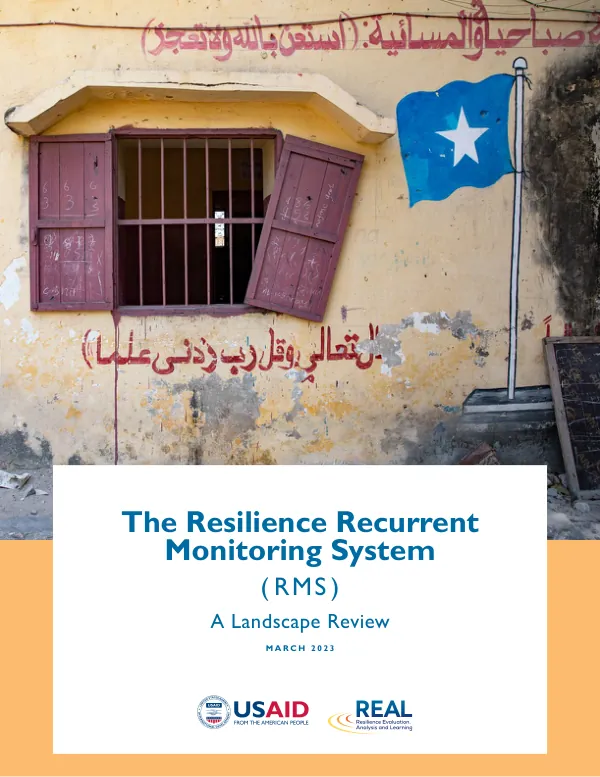
The Resilience Recurrent Monitoring System (RMS): A Landscape Review
The Resilience Recurrent Monitoring System (RMS) is a key resilience measurement tool for capturing the dynamics of how individuals, households, and communities respond to shocks and stresses and how this affects their wellbeing trajectories in the short and long term.
2023 · 38 pages
Sign in to readA free account is required to download.
Abstract
Measuring resilience requires tools that can capture these dynamics, and RMS has been fielded globally by multiple researchers and monitoring and evaluation (M&E) professionals, resulting in a wealth of knowledge and experience. The RMS Practical Guidance Note was developed in 2019 by Mercy Corps and TANGO International, based primarily on their own experiences designing and implementing RMS. However, several RMS have been fielded globally, resulting in a wealth of knowledge and experience that goes beyond the existing guidance. This knowledge and experience have yet to be systematically aggregated, discussed, and documented collectively by resilience researchers and implementers to identify the strengths and drawbacks of different approaches to RMSs for different purposes. The REAL Award is bringing together a group of global RMS designers and consumers to explore RMS implementation challenges and put forth collective recommendations for RMS application in humanitarian, development, and peacebuilding programs. The objectives of the overall RMS technical consultation include identifying and synthesizing promising practices for RMSs, understanding the current state of RMSs, and exploring the value, challenges, solutions, and future opportunities of RMSs. The RMS technical consultation seeks to identify and synthesize promising practices for RMSs, understand the current state of RMSs, and explore the value, challenges, solutions, and future opportunities of RMSs. The consultation aims to bring together a group of global RMS designers and consumers to explore RMS implementation challenges and put forth collective recommendations for RMS application in humanitarian, development, and peacebuilding programs. The RMS technical consultation has several objectives, including identifying and synthesizing promising practices for RMSs, understanding the current state of RMSs, and exploring the value, challenges, solutions, and future opportunities of RMSs. The consultation aims to provide a comprehensive understanding of RMSs and their applications in humanitarian, development, and peacebuilding programs. The RMS technical consultation has identified several key areas of focus, including the design, data collection, data management and analysis, dissemination and communication, and action and adaptation of RMSs. The consultation has also explored the role of implementing partners in RMS implementation and the cost-benefit analysis of RMSs. Additionally, the consultation has discussed alternatives to RMSs and the future of RMSs. The RMS technical consultation has brought together a group of global RMS designers and consumers to explore RMS implementation challenges and put forth collective recommendations for RMS application in humanitarian, development, and peacebuilding programs. The consultation has provided a comprehensive understanding of RMSs and their applications in humanitarian, development, and peacebuilding programs. The RMS technical consultation has several key findings, including the importance of RMSs in capturing the dynamics of how individuals, households, and communities respond to shocks and stresses and how this affects their wellbeing trajectories in the short and long term. The consultation has also identified several promising practices for RMSs, including the use of key informant interviews and focus group discussions to collect repeated measures from the same communities. The RMS technical consultation has also explored the value, challenges, solutions, and future opportunities of RMSs. The consultation has identified several key challenges to RMS implementation, including the need for a nuanced contextual understanding of the communities being monitored and the importance of RMS design and data collection methods. The consultation has also identified several solutions to these challenges, including the use of RMSs to identify program impacts and fill information gaps.