USAID DEC
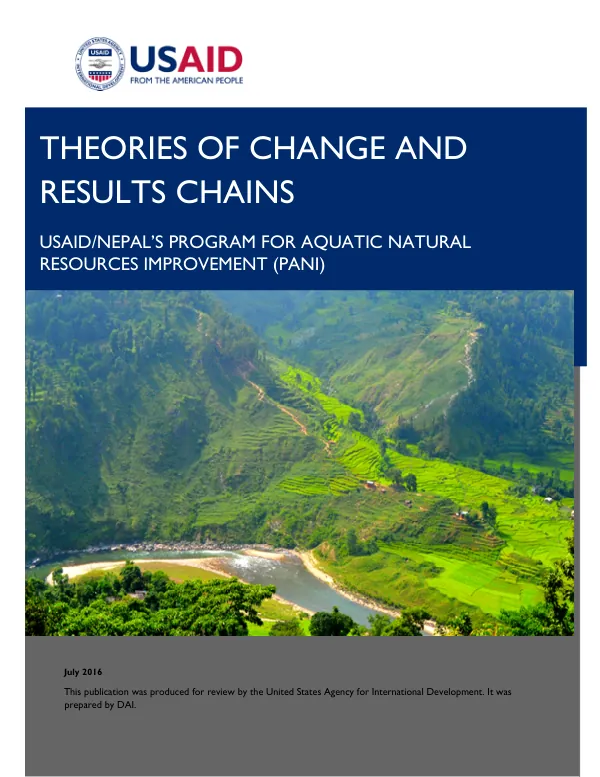
Theories of Change and Results Chains for USAID/Nepal's Program for Aquatic Natural Resources Improvement (PANI)
Sign inDAI
Theories of Change and Results Chains for USAID/Nepal's Program for Aquatic Natural Resources Improvement (PANI)
The Program for Aquatic Natural Resources Improvement (PANI) in Nepal is a USAID-funded initiative aimed at conserving freshwater biodiversity and increasing the sustainable management of water resources under changing climate conditions.
2016 · 22 pages
Sign in to readA free account is required to download.
Abstract
PANI is part of USAID/Nepal's on-going investment in strengthening natural resource management in Nepal, with a specific goal to enhance the country's ability to manage water resources for multiple uses and users. PANI is focused on the Karnali, Mahakali, and Rapti river basins, and is a sister project to the USAID-funded Nepal Hydropower Development Project (NHDP) and complementary projects funded by the US Department of Agriculture's Forest Service (USFS) and the International Water Management Institute (IWMI). The project is implemented by Development Alternatives, Inc. (DAI) and its partners, and began in April 2016 with an overall budget of $24.9 million over almost five years. PANI's objectives are to reduce threats to freshwater biodiversity in the three mid- and far western river basins and to increase the ability of targeted human and ecological communities to adapt to the adverse impacts of climate change through improved water management. To achieve its objectives, PANI will implement activities focused on four intermediate results: increasing knowledge, engagement, and benefits for local water users; improving basin-level resource management; strengthening coordination and enabling environments; and expanding the knowledge base. The project will work simultaneously at the community level to understand and deliver on community needs and at the basin and national levels to assist government in managing water resource allocation. PANI will also analyze and make tangible the benefits provided by aquatic biodiversity in some of the most remote parts of Nepal. The theory of change approach has been used to deepen understanding of the complex interrelationships among water, water uses, and the PANI communities that depend upon water. This approach begins with desired outcomes in mind and leads groups to work back through causal relationships and assumptions to a deeper understanding of what changes are needed, how they are related, and how they might be achieved to contribute to a desired long-term goal. The cause-effect relationships set forth within PANI's theories of change and results chains have their origin in USAID's 2014 Assessment of Water Resources Management & Freshwater Biodiversity in Nepal. This assessment served as the basis for PANI's statement of work (SOW) and helped inform USAID's initial situation analyses, which were further refined based on additional consultations with stakeholders and with the support of USAID's Measuring Impact program. The updated Theories of Change and Results Chains were developed over a two-week period at the end of June 2016, with the assistance of the Measuring Impact team and 37 participants, including stakeholders from beyond USAID and the PANI team. The draft results chains will inform and be informed by the process of dialog with program stakeholders, and will be refined as the PANI team grows and the dialog continues. The draft theories of change and results chains also serve as a significant input for the development of the PANI's life-of-project Monitoring and Evaluation (M&E) Plan, and fundamental starting point for its learning approach. These results chains will be further updated following initial meetings with stakeholders in July and, with the M&E Plan, resubmitted in conjunction with the first Annual Work Plan in August 2016.