USAID DEC
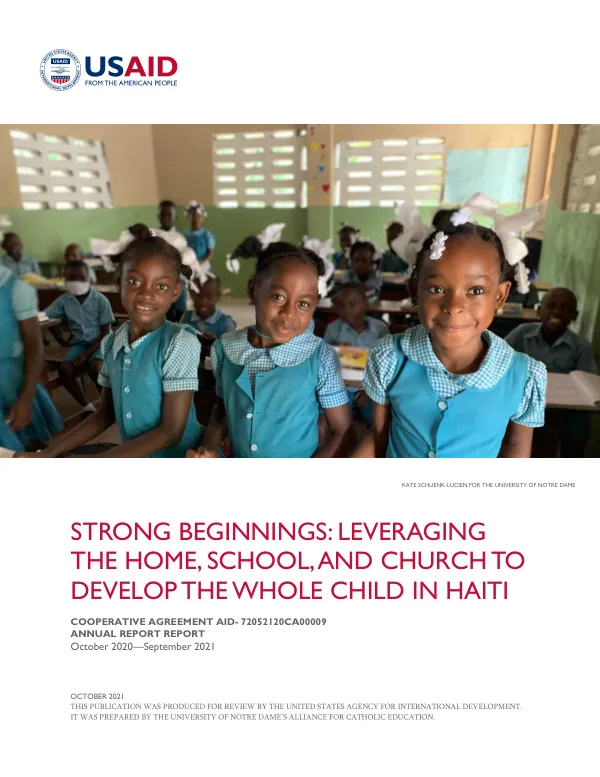
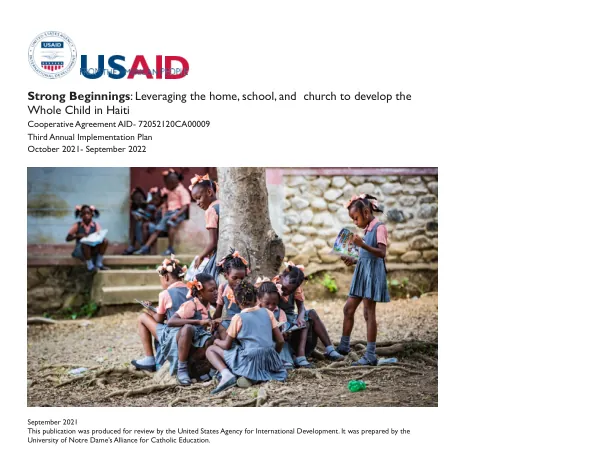
Third Annual Implementation Plan for Strong Beginnings: Leveraging the home, school, and church to develop the Whole Child in Haiti
Sign inCATHOLIC RELIEF SERVICES ORGANIZATION
Third Annual Implementation Plan for Strong Beginnings: Leveraging the home, school, and church to develop the Whole Child in Haiti
The Strong Beginnings initiative in Haiti aims to develop mature readers and life-long learners with improved physical and cognitive capacities.
2021 · 18 pages
Sign in to readA free account is required to download.
Abstract
The program focuses on three main outcomes: strengthening the reading skills of 1st and 2nd grade children, improving social and emotional learning (SEL) competencies of participating students, and supporting early childhood development of preschool children. To achieve the first outcome, the program will provide scripted literacy and SEL curriculum/materials and classroom libraries for 1st and 2nd grade in Creole and French. School supplies, including pencil cases, boxes of chalk, pencils, pencil sharpeners, and erasers, will be delivered to 80 schools in South and Grand'Anse. The program will also conduct robust teacher training and follow-up coaching on literacy, early childhood development, and SEL. This will involve observation and coaching visits from supervisors, cluster meetings of participating teachers and school leaders, and annual training for teachers, principals, and supervisors. The program will also establish community-delivered summer reading camps for lowest-performing students. These camps will provide a 3-day training for summer camp volunteers, followed by a 5-day summer camp program. The program will also provide student take-home books, student resources, and classroom libraries. To support the early childhood development of preschool children, the program will establish the L3 (Lakay, Legliz, Lekol) Learning Lab to support, develop, and test community-based solutions to locally identified problems that impact children's learning and development. The program will also provide training and support to preschool teachers and caregivers on early childhood development practices. The program will be implemented in partnership with the Diocesan Board of Education (BDE) and will involve domestic and international travel by program staff to support the implementation of activities. The program will also involve quarterly meetings of partners to examine monitoring data, discuss implementation challenges, and refine implementation strategy and support efforts aimed at continuous improvement. The program will be evaluated based on the following benchmarks and performance targets: 23 supervisors trained and equipped, 64 school directors out of 80 trained annually, 80 out of 100 first-grade teachers and 79 out of 98 second-grade teachers trained, 200 summer reading camp volunteers trained, 1000 1st and 2nd grade students in attendance at summer camps, and 400 parents attending meetings annually. The program will be implemented from October 2021 to September 2022 and will be supported by the University of Notre Dame's Alliance for Catholic Education, with funding from the United States Agency for International Development.
Related documents