USAID DEC
USAID’s LuzonHealth Project: Improving Demand for and Supply of Family Planning and Maternal, Neonatal, Child Health and Nutrition (FP/MNCHN) Services in the Province of Isabela
Sign inRTI INTERNATIONAL
USAID’s LuzonHealth Project: Improving Demand for and Supply of Family Planning and Maternal, Neonatal, Child Health and Nutrition (FP/MNCHN) Services in the Province of Isabela
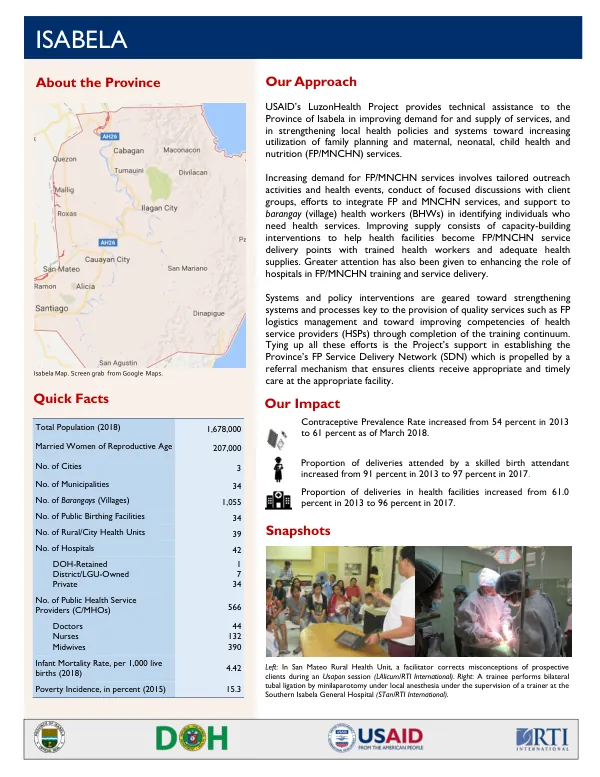
In the Province of Isabela, Philippines, USAID's LuzonHealth Project provides technical assistance to improve demand for and supply of family planning and maternal, neonatal, child health and nutrition (FP/MNCHN) services.
2018 · 2 pages
Sign in to readA free account is required to download.
Abstract
The project aims to strengthen local health policies and systems to increase utilization of FP/MNCHN services. Increasing demand involves tailored outreach activities, health events, and focused discussions with client groups, as well as support to barangay health workers in identifying individuals who need health services. Implementation in Isabela focused on three key interventions: increasing demand for FP/MNCHN services, strengthening supply, and improving systems and policy. The project trained health service providers in various skills, including bilateral tubal ligation by minilaparotomy under local anesthesia, family planning basic course, lactation management, and basic emergency obstetric and newborn care. The project also supported the establishment of FP services in public hospitals, ensuring FP commodities are available and delivered on time, and strengthening systems and processes key to the provision of quality services. The Province of Isabela has a total population of 1,678,000, with 207,000 married women of reproductive age. The province has 3 cities, 34 municipalities, and 1,055 barangays. The infant mortality rate in 2018 was 4.42 per 1,000 live births, and the poverty incidence in 2015 was 15.3%. The project has achieved significant results, including a 7% increase in contraceptive prevalence rate from 54% in 2013 to 61% as of March 2018. The proportion of deliveries attended by a skilled birth attendant increased from 91% in 2013 to 97% in 2017, and the proportion of deliveries in health facilities increased from 61.0% in 2013 to 96% in 2017. The project's Service Delivery Network (SDN) has consistently shown impressive results, with 1,087 FP referrals recorded as of June 2018. The SDN is propelled by a referral mechanism that enables a facility with limited capacity to refer patients requiring specialist care to district and provincial hospitals equipped to provide the needed care. The network is composed of three private birthing facilities, 12 rural health units, and two hospitals, ensuring that patients receive the appropriate and timely care at the appropriate facility.
Related documents
Documents in this collection
 2018
2018USAID DEC
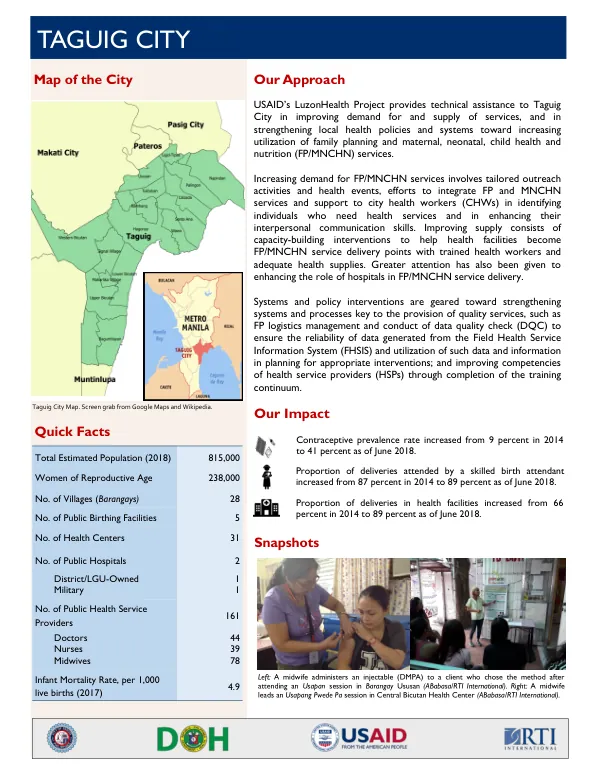
USAID LuzonHealth Project: Improving Demand for and Supply of Family Planning and Maternal, Neonatal, Child Health and Nutrition (FP/MNCHN) Services in Taguig City
Open record 2018
2018USAID DEC