USAID
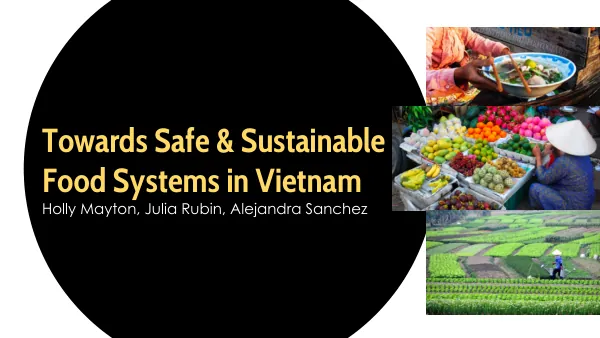
Towards Safe & Food Systems in Vietnam
The agricultural sector in Vietnam accounts for 43% of the national population, with 45% of the population under 25 years old.
2023 · 20 pages
Sign in to readA free account is required to download.
Abstract
There are 43 million household farms, with an average farm size of 1.7 hectares. Only 2% of vegetable purchases are made in supermarkets in Hanoi, highlighting the need for a shift towards more sustainable food systems. Food safety is a growing national concern. The policy process in Vietnam can be informed by data and insights from various sources, including online and in-person references. A novel conceptual framework has been developed to characterize data across eight domains: environmental health, food loss and inorganic waste, food safety and water quality, sociopolitical context, nutrition, food processing, food access and consumption, and food access and consumption. This framework includes 200 specific indicators. Stakeholders have been identified and engaged through introductory meetings and a stakeholder workshop. The workshop aimed to establish partnerships for future phases, gain insight into priorities and perspectives within each domain, and facilitate interdisciplinary collaboration between stakeholders from different specializations. The workshop goals included engaging stakeholders, establishing partnerships, and facilitating collaboration. The deliverables from this initiative include compiling data sources from online and in-person references, developing a novel conceptual framework, conducting introductory meetings and stakeholder meetings, and hosting a stakeholder workshop. The framework and indicators will provide a foundation for decision-making on how to intervene in the food system to enhance sustainability. The initiative's focus on multiple axes of the food system aims to address the complex challenges facing Vietnam's agricultural sector.
Related documents