USAID DEC
Tracking the water sector financial flows in Mozambique based on the TrackFin Methodology (2016-2018)
Sign inUSAID DEC
Tracking the water sector financial flows in Mozambique based on the TrackFin Methodology (2016-2018)
The water sector in Mozambique is a critical component of the country's development, with significant investments made in recent years to improve access to safe drinking water and sanitation services.
2021 · 59 pages
Sign in to readA free account is required to download.
Abstract
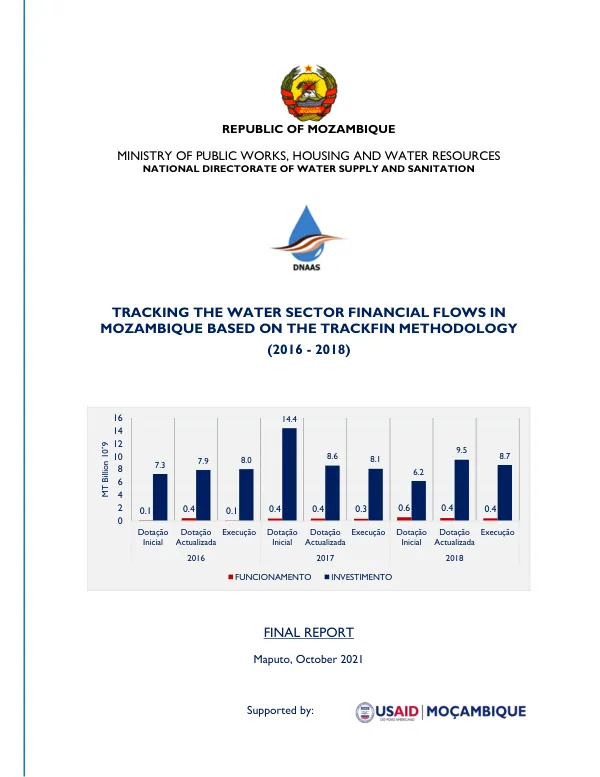
The National Directorate of Water Supply and Sanitation, under the Ministry of Public Works, Housing and Water Resources, is responsible for overseeing the sector's development and implementation of policies. The tracking of water sector financial flows in Mozambique is based on the Trackfin methodology, which was applied to data from 2016 to 2018. The methodology involves the collection and analysis of financial data from various sources, including government budgets, expenditure reports, and financial statements from water sector institutions. The data is then categorized and analyzed to provide insights into the sector's financial flows. The water sector in Mozambique is characterized by a complex institutional framework, with multiple institutions and stakeholders involved in its development and management. The sector's budget and expenditure trends have been analyzed to identify areas of improvement and opportunities for increased efficiency. The analysis reveals that the sector's budget has increased significantly over the past three years, with a total expenditure of approximately 14.4 billion meticais (MT) in 2018. The sector's financing modalities have also been analyzed, with a focus on domestic and foreign investments. The results show that domestic investment has been the primary source of funding for the sector, accounting for approximately 70% of total expenditure. Foreign investment has also played a significant role, with major investments made by international partners such as the World Bank and the European Union. The sector's expenditure has been categorized into operation costs and investment costs. Operation costs, which include salaries, maintenance, and other operational expenses, accounted for approximately 60% of total expenditure in 2018. Investment costs, which include capital expenditures and infrastructure development, accounted for approximately 40% of total expenditure. The sector's expenditure has also been analyzed by sector components, including water supply, sanitation, and water resources. The results show that water supply services have been the primary focus of sector expenditure, with a significant increase in investment in this area over the past three years. Sanitation services have also received increased attention, with a focus on improving access to sanitation facilities and services. The sector's services evolution has also been analyzed, with a focus on water supply coverage, sanitation coverage, and water resources. The results show that water supply coverage has improved significantly over the past three years, with a total of 85% of the population having access to safe drinking water in 2018. Sanitation coverage has also improved, with a total of 60% of the population having access to sanitation facilities and services in 2018. The sector's main partners have also been identified, with a focus on international partners and national entities. The results show that the World Bank and the European Union have been major partners in the sector, providing significant funding and technical assistance to support sector development. In conclusion, the water sector in Mozambique has made significant progress in recent years, with increased investments in water supply, sanitation, and water resources. The sector's financial flows have been analyzed using the Trackfin methodology, providing insights into the sector's budget and expenditure trends. The results show that the sector's budget has increased significantly, with a focus on domestic and foreign investments. The sector's expenditure has been categorized into operation costs and investment costs, with a focus on improving access to safe drinking water and sanitation services.