USAID DEC
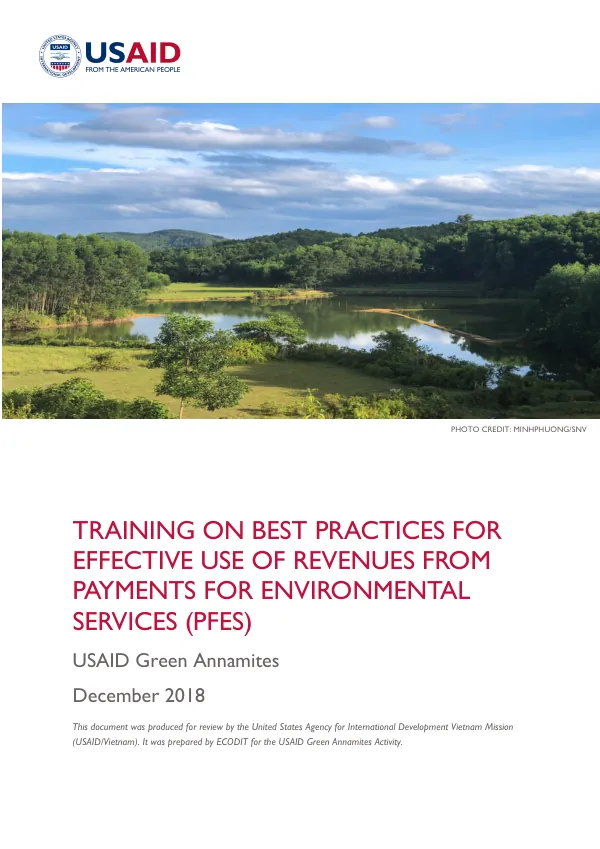
Training on Best Practices for Effective Use of Revenues from Payments for Environmental Services (PFES)
Sign inECODIT, INC.
Training on Best Practices for Effective Use of Revenues from Payments for Environmental Services (PFES)
The USAID Green Annamites Activity assists the provinces of Thua Thien Hue and Quang Nam to protect the region's forests and globally significant biodiversity, while also helping poor ethnic minority communities in and around forested areas to diversify and improve their livelihoods.
2018 · 44 pages
Sign in to readA free account is required to download.
Abstract
The Project includes three interrelated components to: 1) improve low emission land use practices, 2) strengthen biodiversity conservation, and 3) increase resilience for vulnerable communities in the two provinces. Forest ecosystems support biodiversity, provide clean freshwater, prevent soil erosion, and provide many other important environmental services that help build community resilience. Vietnam was one of the first countries to develop a national policy to help fund protection of these services. Vietnam's PFES program is a breakthrough strategy, not only in concept but also through the design, construction, issuance, and implementation of business policy for the country's forestry sector. The national Vietnam Forest Protection and Development Fund (VNFF) administers Vietnam's PFES policy under the Ministry of Agriculture and Rural Development. PFES users include hydropower facilities, water supply companies, and ecotourism businesses. VNFF receives PFES payments and distributes the payments to Provincial Forest Protection and Development Funds (PFPDFs), which provide payments to PFES providers. Providers include owners of forests providing environmental services and the organizations, households, individuals, and local communities that implement forest protection contracts. Since its inception, PFES has been supporting livelihood improvements among poor ethnic minorities who receive PFES payments for helping to protect forests, while also assisting forestry companies to maintain their production in the context of Government requirements to halt natural forest timber harvesting, helping to reduce violations. Three types of forest environmental services have been included in the PFES program since 2011: land protection services, forest ecosystem services, and natural landscapes and biodiversity conservation services. On average, the VNFF mobilizes over 1.3 trillion Viet Nam Dong (VND) (US$55.3 million) each year from PFES fees for forest protection in the watersheds of hydropower and water supply companies. The money collected has contributed to forest protection as well as Vietnam's socio-economic development by managing and protecting 5.87 million hectares of forests each year, accounting for 42% of the country's total forest area, contributing a sustainable source of financing for forest protection, reducing pressure on state budgets, supporting forestry companies to stop exploiting natural wood, increasing incomes of over 410,000 poor households, and promoting the socialization of forestry. A training program and study tour for the province of Thua Thien Hue was implemented by SNV to build capacity on the use and management of revenues from the program for Payment for Environmental Forest Services (PFES). The training program was managed, coordinated, and monitored by SNV, USAID Green Annamites, the province's Forest Protection and Department (FPD), the Provincial Forest Protection and Development Fund (PFPDF), and the Green Annamites Project Management Unit (PMU) via consultation meetings, emails, and phone calls. The training program focused on building capacity on the use and management of revenues from the program for PFES. The training program included a pre-training needs assessment, development of training materials, training locations and trainees, and a study tour to Thanh Hoa Province. The study tour provided an opportunity for participants to learn from PFES implementation in Thanh Hoa Province and apply lessons learned in Thua Thien Hue Province. Evaluation of the training program was conducted through multiple choice tests before and after training, pre- and post-training self-assessment results, and a study tour to Thanh Hoa Province. The evaluation results showed that the training program was effective in building capacity on the use and management of revenues from the program for PFES. The training program improved the capacity of participants to plan PFES revenue use, apply lessons learned, and strengthen gender participation in PFES revenue use. The training program had a positive impact on the use and management of revenues from the program for PFES. The training program improved the capacity of participants to plan PFES revenue use, apply lessons learned, and strengthen gender participation in PFES revenue use. The training program also contributed to the effective use of PFES revenues, transparent system of management and accounting, and improved capacity to plan PFES revenue use.