UGANDA MINISTRY OF FINANCE, PLANNING AND ECONOMIC DEVELOPMENT
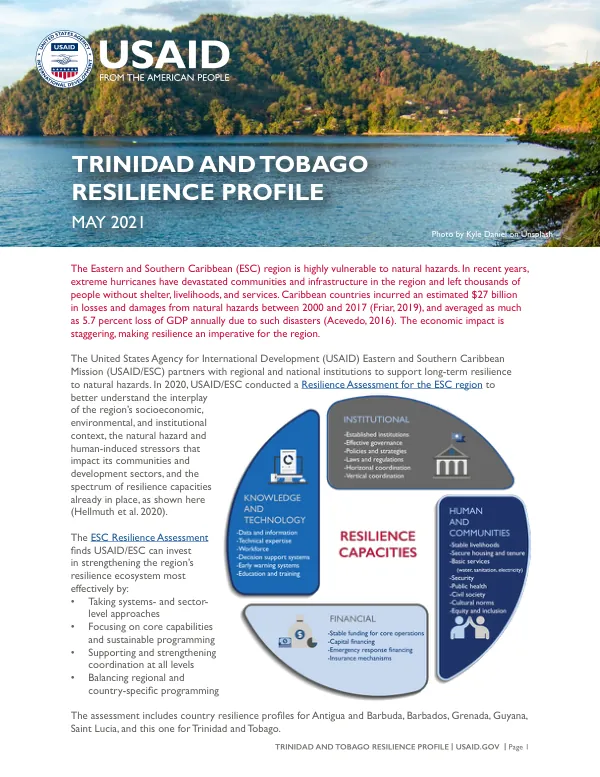
Trinidad and Tobago Resilience Profile
The Eastern and Southern Caribbean (ESC) region is highly vulnerable to natural hazards.
2021 · 7 pages
Sign in to readA free account is required to download.
Abstract
In recent years, extreme hurricanes have devastated communities and infrastructure in the region, leaving thousands of people without shelter, livelihoods, and services. Caribbean countries incurred an estimated $27 billion in losses and damages from natural hazards between 2000 and 2017. The economic impact is staggering, making resilience an imperative for the region. Trinidad and Tobago, a two-island country, boasts a strong industrial economic base and a large contribution to its gross domestic product from its petroleum-based energy sector. The country is slightly south of the Caribbean's hurricane belt, but still experiences droughts, earthquakes, flooding, and landslides. Coastal erosion also has negative impacts on Trinidad's communities and Tobago's tourism. While public institutions around disaster and emergency management are strong, the country lacks an updated legal framework through which to operate. The country's environmental context is characterized by a historical mean annual temperature of 26.1°C and precipitation of 1605 mm. Projections indicate that mean annual temperature will rise by 1.4°C and annual precipitation will decrease by 60 mm by 2040-2059. The population of Trinidad and Tobago is 1.4 million people, with a literacy rate of 98.8 percent. The country is a multi-ethnic, multi-religious country, with a global gender gap index (GGI) of 0.75. The unemployment rate is 3.8 percent, and the economy is largely supported by the petroleum and manufacturing industries, services including tourism, and to a lesser extent agriculture. Trinidad and Tobago's primary disaster management legislation is the Disaster Measures Act of 1978. The Act gives the President authority for proclamation of a disaster area. In addition, there are several other national disaster management-related policies, including the Comprehensive Disaster Management Policy Framework 2007, the Shelter Policy, the National Flood Risk Management Policy, and the Critical Facilities Protection Policy Framework. The country is in the process of revamping its disaster risk reduction policies to be more aligned with comprehensive disaster management and the Sendai Framework. The country's risk and resilience profile is characterized by a high susceptibility to risks from floods and landslides. During the rainy season, the islands experience heavy rains that trigger flooding in low-lying urban centers and agricultural lands as well as landslides along the undulating mountain ranges. Coastal erosion is also a priority risk in the country, with erosion along the coastlines prompting the relocation of several households and entire communities. Tourism is the main revenue earner for the island of Tobago, and many of the beaches in Tobago are impacted by coastal erosion.