CATHOLIC RELIEF SERVICES ORGANIZATION
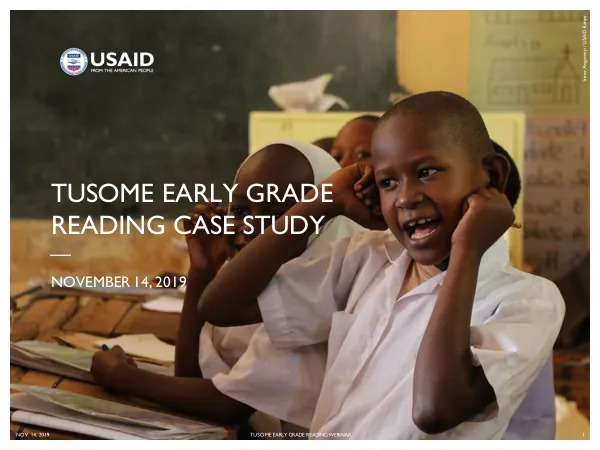
TUSOME EARLY GRADE READING WEBINAR
The Kenya Education Context is characterized by several reforms in the education sector.
2019 · 21 pages
Sign in to readA free account is required to download.
Abstract
Free Primary Education was introduced in 2003, and the National Education Sector Plan (NESP) was implemented in two phases: 2013-2018 and 2018-2022. The Competency-Based Curriculum (CBC) was launched in 2017. Despite these reforms, the quality of education remains low, with low early grade reading scores (literacy outcomes) reported in various studies, including EGRA (2007), NASMLA (2011), and Uwezo (2010-2016). Lower primary education received less attention and interest, highlighting the need for interventions in instructional methods and resources. The TUSOME Early Grade Reading initiative was launched on January 28, 2015, with a strategic focus aligned with the Government of Kenya (GoK) and USAID. The initiative aimed to improve early grade reading outcomes in Kenya. Leadership and coordination were essential components of the program, which worked within the existing GoK systems. The USAID/Kenya Basic Education Programming supported the TUSOME initiative, focusing on improving instructional methods and resources for lower primary education. The TUSOME initiative had a significant impact on early grade reading outcomes. The Primary Math and Reading (PRIMR) Initiative, a component of TUSOME, demonstrated that twice as many children read at benchmark in treatment schools compared to control schools. Furthermore, one year of learning in PRIMR was equivalent to two or more years of learning in control schools. The percentage of children reaching benchmark in reading was significantly higher in treatment schools. The TUSOME initiative had a large scope, targeting 7.6 million early grade learners, 75,000+ teachers, and 23,800 head teachers across Kenya. The program operated in grades 1-3, using both Kiswahili and English languages. Instructional materials were distributed to support the program, with approximately 26 million materials provided. The initiative also engaged coaches from civil society organizations (CSOs) to support the implementation of the program.
Related documents