INTERNATIONAL ORGANIZATION FOR MIGRATION
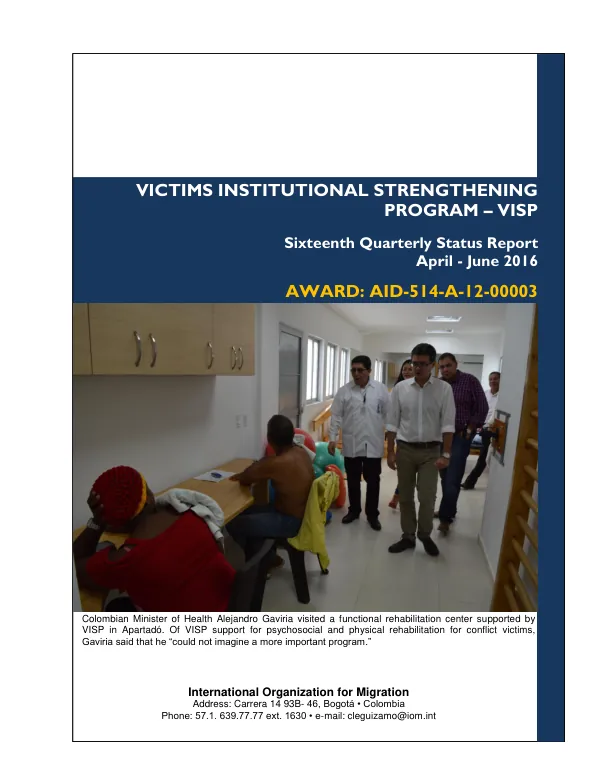
Thirteenth Quarterly Status Report: Victims Institutional Strengthening Program
The Victims Institutional Strengthening Program (VISP) is a strategic initiative aimed at providing accompaniment and technical support for the Government of Colombia's (GoC) policies, systems, and institutions at the national, departmental, and municipal levels.
2015 · 63 pages
Sign in to readA free account is required to download.
Abstract
The program's objective is to strengthen capacities and build necessary competencies for the timely and effective execution and implementation of the Victims Law. During the quarter, significant contextual changes affecting the program's operation included advances in the Victims Point in Havana and their implications in terms of project development, as well as upcoming transition processes between incoming and outgoing local administrations, calling for handover processes. Despite these challenges, VISP made substantial progress in each of its four intermediate results. Intermediate Result 1 focused on improving the GoC's strategic management for the Victims Law. During this quarter, the first phase of workshops called "Preparing to be better leaders for reconciliation and inclusion" were completed in 18 departments with 1,727 participants, including candidates in local elections. VISP also supported adjustments to the Ministry of the Interior's Victims Law Reporting, Monitoring and Coordination System (RUSICST), and accompanied municipalities and governor's offices to complete the report on the first semester of 2015. All 32 targeted municipalities completed the report, and the quality of institutional responses to different requests has been increased, with errors reduced by 55%. Intermediate Result 2 focused on improving the GoC's rehabilitation services for the wellbeing of citizens. During this quarter, 209 workshops were carried out in 10 departments with 1,732 public servants from different local-level institutions responsible for attention and reparation processes with victims. Additionally, three regional encounters were held with 50 grassroots organizations and communities from Bojayá to identify focused psychosocial support actions in the community. Furthermore, 65 functional rehabilitation professionals were trained in Cartagena, Popayán, and Tumaco on the Functional Rehabilitation Model, the Psychosocial Approach, and Do No Harm. Intermediate Result 3 focused on transitional justice processes. During this quarter, the phase assessing the quality of services provided at ten Centers and Points and the Victims Unit's national-level capacity to manage Centers was completed. Additionally, 36 presentations of the theatre production "On the Route" were developed in 17 municipalities with the participation of 3,047 victims. As part of support for memory actions, 76 radio programs were produced and are being played on Bogotá's Memory, Peace, and Reconciliation Center's radio station. The Human Rights Archive Toolbox was socialized in Turbo, Medellín, Pasto, Sincelejo, and Santa Marta with 160 social organizations and victims' organizations, and 236 "memory managers" were certified by IOM and the CNMH. Intermediate Result 4 focused on strengthening the Ombudsperson's Office's Ethnic Affairs Delegate. During this quarter, VISP strengthened the Ombudsperson's Office's Ethnic Affairs Delegate through 48 working sessions with ethnic communities on taking the ethnic collective subject declaration. Additionally, in association with Casa Ensemble and the actress Alejandra Borrero, the monologue and dialogue piece "Rompiendo imaginarios de violencia de género" ("Breaking gender violence imaginaries") was shared with more than 1,300 people in Montería, Cartagena, and San Juan de Nepomuceno. Furthermore, 300 public servants from the judicial branch were trained and taught about guidelines for the Judiciary to provide attention and protection to female victims of sexual violence. The program's financial report for the quarter shows a total confirmed fund of USD 65,452,500, with total federal funds authorized at USD 56,322,579, total cash receipts at USD 41,970,000, and total cash disbursements at USD 43,461,733.