USAID DEC
Sixteenth Quarterly Status Report: Victims Institutional Strengthening Program - VISP
Sign inINTERNATIONAL ORGANIZATION FOR MIGRATION
Sixteenth Quarterly Status Report: Victims Institutional Strengthening Program - VISP
The Victims Institutional Strengthening Program (VISP) is a program aimed at providing accompaniment and technical support for the Government of Colombia's (GoC) policies, systems, and institutions at the national, departmental, and municipal levels to strengthen capacities and build necessary competencies for the timely and effective execution and implementation of the Victims Law.
2016 · 48 pages
Sign in to readA free account is required to download.
Abstract
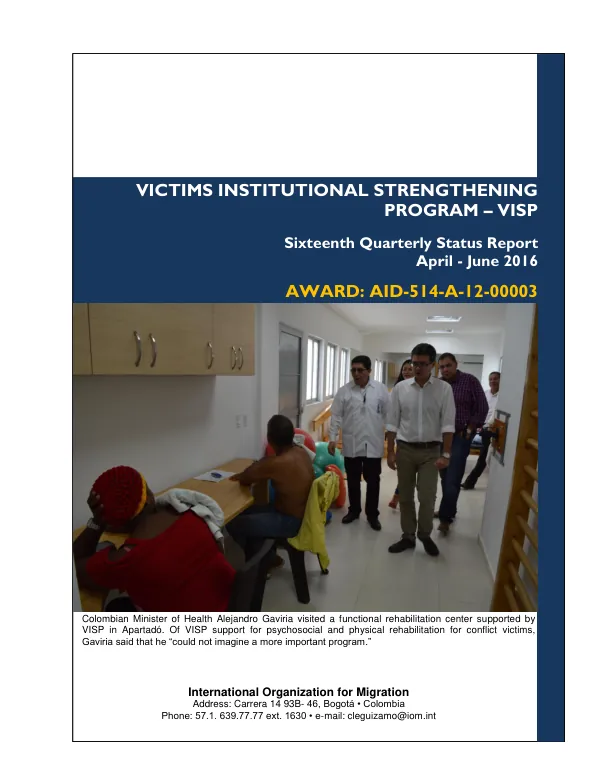
VISP's strategic objective is to provide support for the GoC to strengthen its capacities and build necessary competencies for the timely and effective execution and implementation of the Victims Law. The program's objective is to accompany and provide technical support to the GoC's policies, systems, and institutions at the national, departmental, and municipal levels. During the reporting period of April 1 to June 30, 2016, VISP made significant progress in each of its four intermediate results. Intermediate Result 1 focused on providing support to the Public Employment Service's differential employment strategy to promote victims' inclusion in the job market. An online human rights archive was launched with the National Center for Historical Memory (CNMH), which will increase GoC and public access to documents on the conflict. Intermediate Result 2 involved providing support to the Ministry of Health (MOH) for psychosocial and strengthening projects. Results from four years of these projects were presented to the Minister, who hailed the importance of the program for the MOH. At the regional level, 30 female victims who VISP trained as agents of change replicated the knowledge and skills they learned from the program with 125 female victims from Quibdó, Bojayá, and Riosucio. Intermediate Result 3 focused on producing a video with the Victims Unit that explains the roadmap for comprehensive attention, assistance, and reparation for victims of displacement step-by-step. Additionally, 1,000 copies of the Teachers Toolbox were produced for the CNMH, which will disseminate them with the Ministry of Education, Bogotá's Center for Memory, Peace, and Reconciliation, and regional actors. VISP also supported the CNMH to launch the campaign "No More Violence" to raise awareness of different violations of human rights and types of violence caused by the armed conflict. Intermediate Result 4 involved developing and transferring an interactive game called "Paz a la Voz" ("Peace on the Voice") for children and adolescents to the Victims Unit's Childhood and Youth Group. The game will be installed on 160,000 tablets and 20,000 laptops for children in schools around Colombia. VISP also supported the Red Agenda Caribe to strengthen rehabilitation to conflict victims by exchanging ancestral and local knowledge with ethnic groups. VISP's end state was reached 100% of its close-out phase, including the transfer and appropriation of results obtained by different projects. The program's end state included the capacity of the Victims Unit to evaluate and register victims, as well as to integrate information on victims' attention consolidated by SNARIV entities. Inter-sectorial physical, mental health, and psychosocial services are now articulated between the MOH, Victims Unit, Ministry of Labor, Ministry of Education, and Ministry of Culture to address victims' needs. The program has met its proposed goals, but some projects are still being executed, including support to the negotiating table in Havana, particularly point five, victims, and the humanitarian demining process, as well as to continue decentralizing victims' policies to the regional level.