USAID DEC
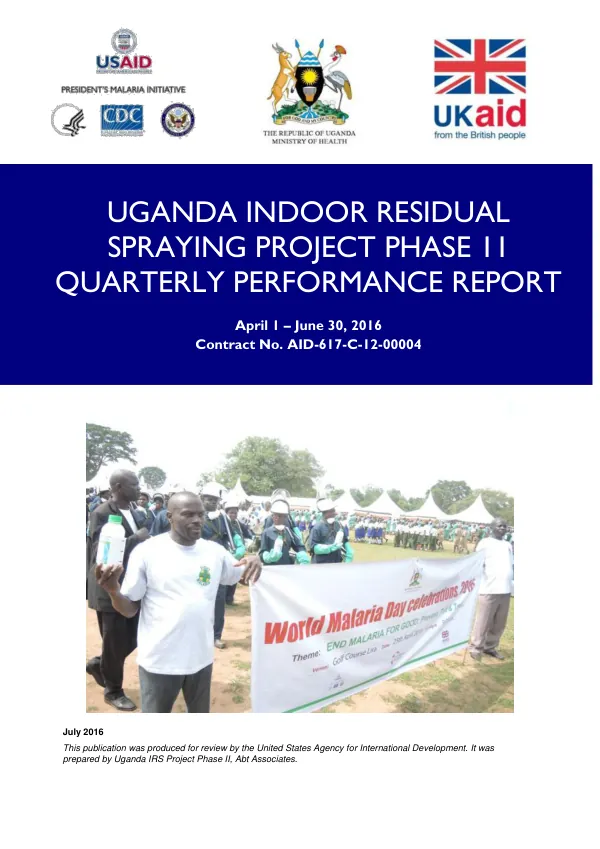
Uganda Indoor Residual Spraying (IRS) Project Phase II Quarterly Performance Report: April 1 through June 30, 2016
Sign inABT ASSOCIATES
Uganda Indoor Residual Spraying (IRS) Project Phase II Quarterly Performance Report: April 1 through June 30, 2016
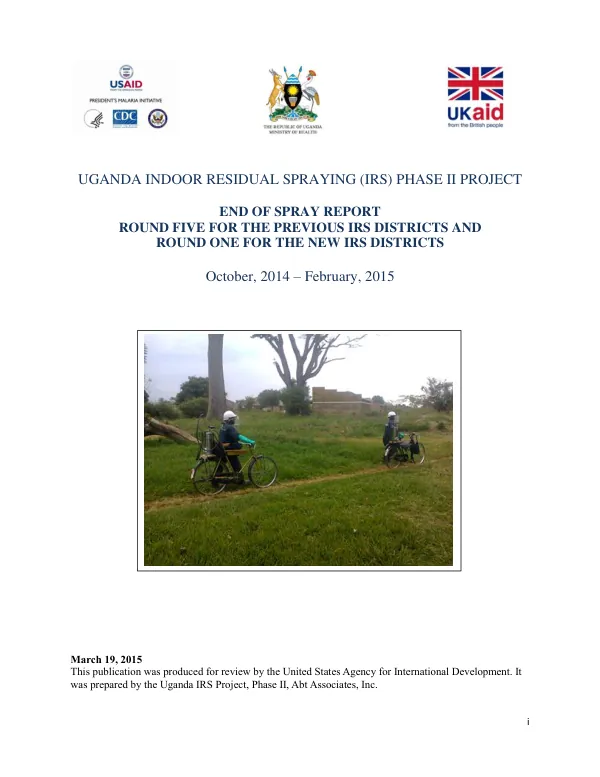
The Uganda Indoor Residual Spraying (IRS) Project Phase II is a program aimed at controlling malaria in Uganda.
2016 · 28 pages
Sign in to readA free account is required to download.
Abstract
The project is implemented in collaboration with the National Malaria Control Program (NMCP) and district officials. The project's primary objective is to implement a high-quality, safe, and effective IRS program. During the reporting period of April 1 to June 30, 2016, the project conducted spraying with pirimiphos-methyl (Actellic 300 CS), a broad-spectrum organophosphate (OP) insecticide. This marked the first time the project used this new insecticide. The project collaborated closely with key stakeholders to transition to this new insecticide and initiate spraying in the group B districts of Butaleja, Dokolo, Kaberamaido, Kibuku, Namutumba, Otuke, and Pallisa on schedule on April 18, 2016. The project's targeted behavior change communications (BCC) interventions, which included interpersonal communication (IPC), community dialogues, and radio announcements, helped disseminate messages about the new insecticide at the community level. These interventions ensured high levels of awareness and acceptance among the target population. The project's technical management, including IRS implementation, capacity development, and monitoring and evaluation (M&E), was a key focus area during this reporting period. The project implemented a comprehensive M&E system to track progress and identify areas for improvement. The M&E system included monitoring and evaluation of the IRS program, capacity building and innovative approaches in IRS, and comprehensive monitoring and evaluation of the IRS program. The project's capacity building and innovative approaches in IRS were also a key area of focus. The project provided technical assistance to Pilgrim Africa to conduct IRS activities and assessed and oriented different cadres of personnel. The project also developed district IRS exit and sustainability plans to ensure the long-term sustainability of the IRS program. The project's business management, project surveillance, cost considerations, successes, challenges, and lessons learned were also documented during this reporting period. The project's successes included the successful transition to the new insecticide and the initiation of spraying in the group B districts. The project's challenges included equipment costs and the need for further capacity building. The project's monitoring and evaluation system tracked progress and identified areas for improvement. The system included monitoring and evaluation of the IRS program, capacity building and innovative approaches in IRS, and comprehensive monitoring and evaluation of the IRS program. The project's M&E system provided valuable insights into the effectiveness of the IRS program and identified areas for improvement. The project's implementation was supported by a range of stakeholders, including the National Malaria Control Program (NMCP), district officials, and local communities. The project's collaboration with these stakeholders ensured the successful implementation of the IRS program and helped to build capacity and promote sustainability. The project's use of pirimiphos-methyl (Actellic 300 CS) as the new insecticide marked a significant milestone in the project's implementation. The project's targeted BCC interventions helped to ensure high levels of awareness and acceptance among the target population. The project's comprehensive M&E system provided valuable insights into the effectiveness of the IRS program and identified areas for improvement. The project's successes included the successful transition to the new insecticide and the initiation of spraying in the group B districts. The project's challenges included equipment costs and the need for further capacity building. The project's lessons learned highlighted the importance of collaboration with stakeholders, capacity building, and innovative approaches in IRS.
Related documents