FINTRAC
USAID-ACCESO Mkts Market Brief #13
The cashew tree (Anacardium occidentale) is a tropical evergreen originating in Brazil and now widely grown throughout the tropics.
2014 · 7 pages
Sign in to readA free account is required to download.
Abstract
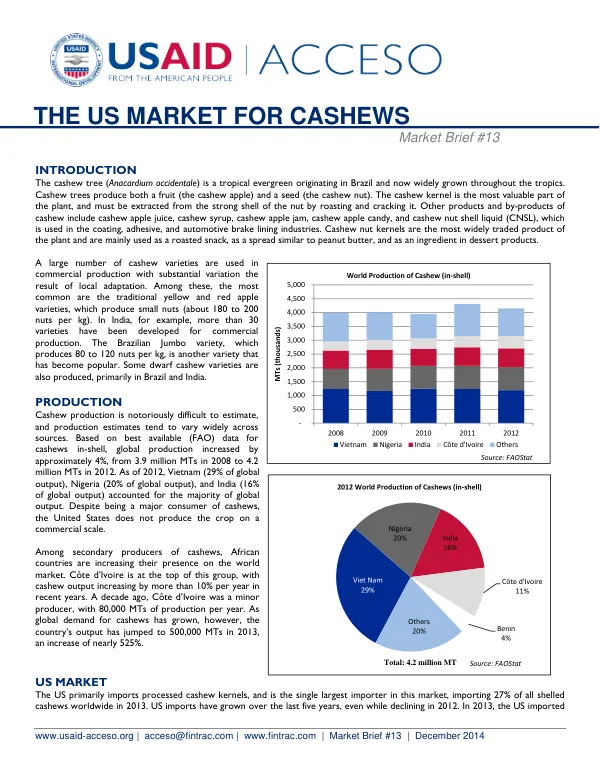
Cashew trees produce both a fruit (the cashew apple) and a seed (the cashew nut). The cashew kernel is the most valuable part of the plant, and must be extracted from the strong shell of the nut by roasting and cracking it. Other products and by-products of cashew include cashew apple juice, cashew syrup, cashew apple jam, cashew apple candy, and cashew nut shell liquid (CNSL), which is used in the coating, adhesive, and automotive brake lining industries. Cashew nut kernels are the most widely traded product of the plant and are mainly used as a roasted snack, as a spread similar to peanut butter, and as an ingredient in dessert products. A large number of cashew varieties are used in commercial production with substantial variation resulting from local adaptation. Among these, the most common are the traditional yellow and red apple varieties, which produce small nuts (about 180 to 200 nuts per kg). In India, for example, more than 30 varieties have been developed for commercial production. The Brazilian Jumbo variety, which produces 80 to 120 nuts per kg, is another variety that has become popular. Some dwarf cashew varieties are also produced, primarily in Brazil and India. Global cashew production increased by approximately 4% from 3.9 million MTs in 2008 to 4.2 million MTs in 2012, according to FAO data. Vietnam accounted for 29% of global output, followed by Nigeria (20%), and India (16%). Despite being a major consumer of cashews, the United States does not produce the crop on a commercial scale. African countries, including Côte d'Ivoire, are increasing their presence on the world market, with Côte d'Ivoire's cashew output increasing by more than 10% per year in recent years. The US primarily imports processed cashew kernels, and is the single largest importer in this market, importing 27% of all shelled cashews worldwide in 2013. US imports have grown over the last five years, even while declining in 2012. In 2013, the US imported 131,647 MTs of shelled cashews at a value of $911 million, representing a 13% increase in shelled cashew import volume, and a 56% increase in value from 2009. Vietnam is the largest supplier of cashews to the US market, with a market share of 57%, followed by India (27%), and Brazil (7%).