PALLADIUM INTERNATIONAL, LLC
USAID Afya Pwani Child Health Program Brief
The USAID Afya Pwani Project aimed to improve and increase access to and use of quality health services in Kenya through strengthened service delivery and institutional capacity of county health systems.
2021 · 6 pages
Sign in to readA free account is required to download.
Abstract
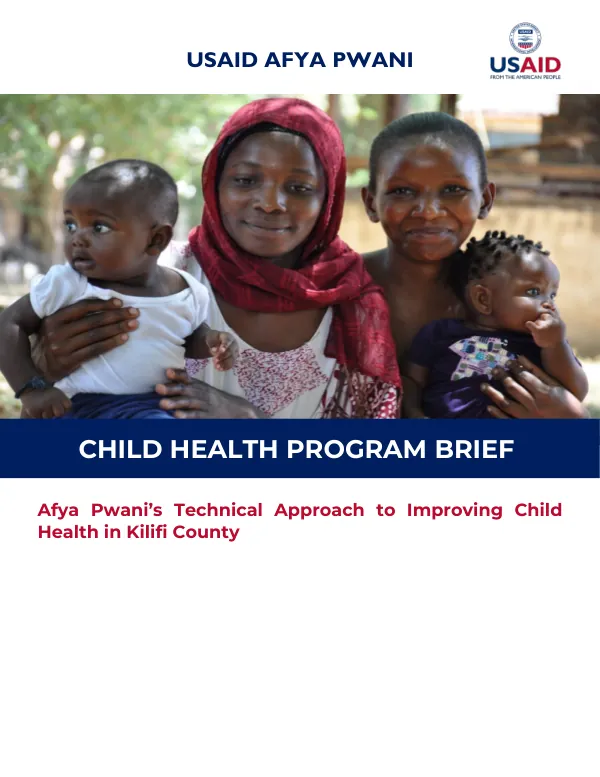
The project, led by Pathfinder International in partnership with Palladium and Plan International, targeted Kilifi County, where children under five years of age make 17.3% of the total population. These children have a heavy burden of respiratory and diarrhea-related diseases, accounting for 55% of comorbidities. The project addressed socio-cultural barriers to uptake of child health services using social and behavior change (SBC) approaches. It engaged the department of health Community health strategy to mobilize communities, address cultural barriers, and cultivate an enabling environment for optimal child health practices. The project developed messages and disseminated information using mass media and digital technology to improve client-provider interactions and bolster linkages between communities and health facilities. Afya Pwani implemented a multi-pronged approach to reach every child while addressing the underlying causes of child morbidity and mortality. The project strengthened management of child health illnesses through implementation of high-impact interventions, increased demand for child health services, and strengthened county and subcounty coordination of child health services. The project also supported the county to implement targeted integrated outreach and integrated community case management (ICCM) to address inequitable access to child health services due to long distances from facilities. The project strengthened the capacity of health care workers to provide quality services through training, clinical mentorship, continued medical education, and whole-site sensitization. Afya Pwani improved the quality of diarrhea management and immunization services through training, clinical mentorship, continued medical education, and whole-site sensitization. The project also supported the dissemination of guidelines and job aids. Afya Pwani supported the county to strengthen commodity and equipment security by training health care providers in forecasting, quantification, documentation, reporting, and inventory management. The project provided technical assistance in immunization microplanning and strengthened the cold chain by supporting preventative maintenance to ensure no interruption of service and potency of the vaccines. The project also supported the county in conducting targeted commodity distribution and redistribution while coupling the intervention with supportive supervision and mentoring. The project integrated hygiene promotion in all child health delivery areas, cognizant of the role of water, sanitation, and hygiene (WASH) in reducing child mortality due to diarrhea and malnutrition. Afya Pwani increased access to clean water and sanitation in targeted communities through school-led total sanitation (SLTS), community-led total sanitation (CLTS), and sanitation marketing. Afya Pwani supported subcounty and county management team's (S/CHMTs) capacity to plan, coordinate, monitor child health services. The project reached county leads through microplanning, supportive supervision, and data quality audits. It updated the county on health system strengthening through leadership and management forums, co-planning meetings, work planning, forecasting, budget analysis, and continuous quality improvement. During the implementation period, Afya Pwani achieved significant results, including strengthening the capacity of health facilities to provide quality services, mentoring 296 health care workers on IMNCI and 118 on EPI, and training 15 trainers in ICCM at the community level to close knowledge and skill gaps. The project supported the county to train 51 health care workers on EPI operational management to improve immunization skills. A total of 155,757 children received DPT3, and 147,723 were fully immunized. The project contributed to reducing the DPT 1 -DPT3 dropout rate from 8.2% at project inception to 5% at project closeout. Afya Pwani implemented ICCM, an equity-focused strategy, in Mulunguni, Mtoroni, and Gandini locations of the Magarini sub-county. The project trained 63 ICCM case managers to conduct household visits, during which they disseminated child health promotion messages to increase demand for child health services among caregivers. They identified 5,076 cases of childhood illnesses, successfully treated 3,042 children at home, and referred 2,034 cases for further clinical assessment and management. They also tracked 4,897 immunization defaulters, whom they referred for immunization services. The project supported the county to provide the correct treatment of diarrhea for 165,438 children under five years. Despite challenges such as perennial vaccine stockouts, staff shortages, industrial strikes, and the COVID-19 pandemic, Afya Pwani's continuous advocacy and support led to significant gains in child health services in Kilifi County.
Related documents