TETRA TECH
USAID AMPR Y2 Q3 Report_FINAL
The Artisanal Mining and Property Rights (AMPR) initiative in the Central African Republic (CAR) aims to improve compliance with Kimberley Process requirements to promote licit economic activities.
2020 · 39 pages
Sign in to readA free account is required to download.
Abstract
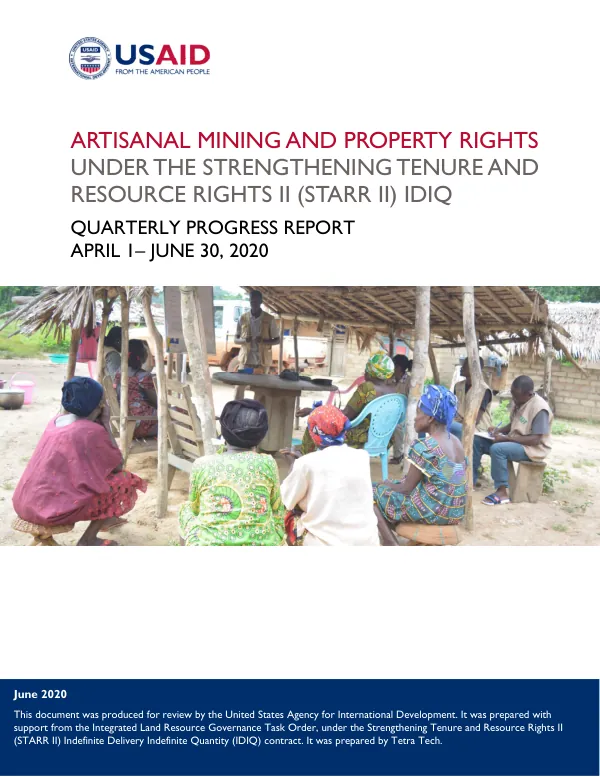
The project focuses on four objectives: assisting the Government of CAR (GoCAR) to improve compliance with Kimberley Process requirements, strengthening community resilience, social cohesion, and response to violent conflict in CAR, increasing awareness and understanding of the opportunities and challenges of establishing responsible gold supply chains in CAR, and improving USAID programming through increased understanding of linkages between artisanal mining and key developments. The project's first objective involves improving the legal, policy, and institutional framework for conflict-free diamond production at domestic and regional levels. Intermediate Result 1.1 aims to improve this framework, while Intermediate Result 1.2 focuses on expanding formalization of land and resource rights in artisanal diamond mining communities. The project also seeks to increase awareness of Kimberley Process requirements among government actors, buying houses, collectors, pit owners, and diggers. The second objective focuses on strengthening community resilience, social cohesion, and response to violent conflict in CAR. Intermediate Result 2.1 supports inclusive community dialogue between different religious and ethnic groups to resolve conflict over land and natural resources. Intermediate Result 2.2 promotes women's economic and social empowerment in ASM communities, while Intermediate Result 2.3 strengthens cooperation between GoCAR ministries and agencies and other stakeholders on social cohesion and Kimberley Process compliance. The third objective aims to increase awareness and understanding of the opportunities and challenges of establishing responsible gold supply chains in CAR. Intermediate Result 3.1 involves researching and communicating recommendations for policy, legal, and institutional reforms at the national and regional levels to key stakeholders. The project also seeks to improve USAID programming through increased understanding of linkages between artisanal mining and key developments. The project's implementation involves various activities, including training programs, infrastructure development, and market linkage facilitation. The project also focuses on inclusion of women and other vulnerable populations, coordination, collaboration, and information sharing with USAID missions and other USAID partners, and security and risk management. The project's performance indicators include the number of communities that have established Kimberley Process-compliant zones, the number of women and other vulnerable populations participating in the project, and the level of awareness and understanding of Kimberley Process requirements among stakeholders. The project also monitors and evaluates its progress through regular reporting and feedback mechanisms. The project's geographic focus is on the Central African Republic, with a specific emphasis on the artisanal diamond and gold mining sectors. The project's timeframes are from April 1 to June 30, 2020, with a submission date of July 15, 2020. The project's recommendations and findings are intended to inform USAID programming and policy decisions related to artisanal mining and property rights in the Central African Republic.