ECODIT, INC.
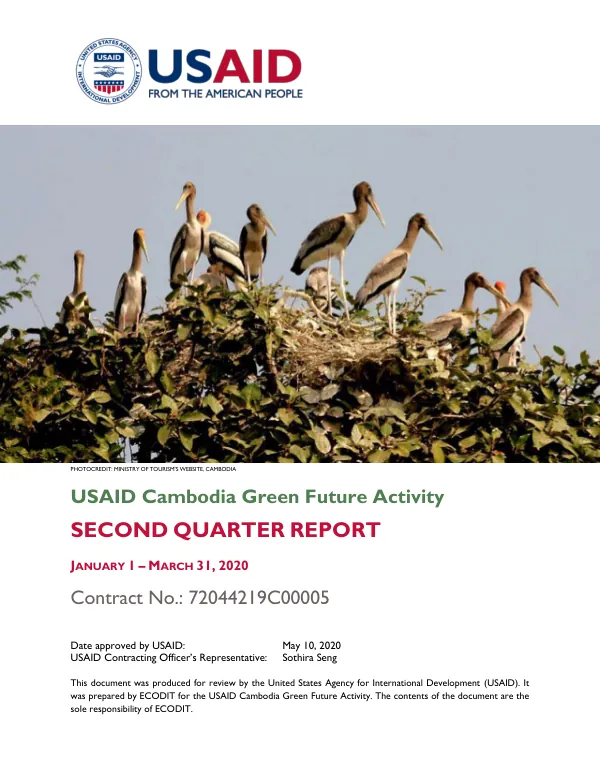
USAID Cambodia Green Future Activity - Q2 Report
The USAID Cambodia Green Future Activity is a project aimed at empowering Cambodian citizens and civil society with the knowledge and skills to use evidence-based communication systems to influence positive actions to support biodiversity conservation, forest protection, and broad sustainable natural resource management.
2020 · 35 pages
Sign in to readA free account is required to download.
Abstract
The project is led by ECODIT with support from a subcontractor, FHI 360, and has a period of performance from October 1, 2019 to September 30, 2024. The project has two outcomes: Activity-Level Outcome 1, which seeks to increase target populations' knowledge and positive attitudes about the benefits of Cambodia's unique and endangered biodiversity and the critical importance of Cambodia's forest ecosystems; and Activity-Level Outcome 2, which aims to increase citizen-led efforts to advocate for and protect biodiversity and forest ecosystems in target areas. The project will have national and landscape audiences and build on successful models of communications throughout Cambodia that engage citizens to protect natural resources. In the second quarter of 2020, the project made significant progress in achieving its contract deliverables. The Year 1 Annual Work Plan (Y1 AWP), Communications Plan, Gender Strategy and Action Plan, Monitoring, Evaluation, and Learning (MEL) Plan, First Quarter Report, and Grants Under Contracts (GUC) Manual were all submitted to USAID on schedule and most were approved. The project also extended and strengthened its network of key partners and stakeholders, which will significantly support implementation over the months and years ahead. The project developed several tools, including a data collection guide, to support the completion of a series of assessments and deliverables that will guide activities. The project is gaining a comprehensive understanding of biodiversity and forestry conservation knowledge in Cambodia, including what gaps remain that need to be filled, who is doing what and where, and what Social and Behavior Change Communication (SBCC) tools, materials, approaches, and messages have been employed in Cambodia to date. The project also conducted surveys, interviews, and focus group discussions with stakeholders and target audiences to inform the project's partnerships, target audiences, areas for synergy, and to provide the basis to develop and implement SBCC strategy and communications and outreach initiatives with the project's stakeholders. A Terms of Reference (TOR) was developed to carry out these exercises, and a solicitation was made to the public, resulting in nine applications received and screened, three potential candidates interviewed, and two highly qualified candidates recommended. In addition, the project established a Social and Behavior Change Communications (SBCC) Working Group, which will mobilize different stakeholders to help the project team develop strategic messages on biodiversity and forest protection and communications strategies, share best practices, and foster coordination and learning. The project also produced communications materials, including factsheets, folders, I-Stand banners, Polo shirts, and big banners, which were developed, approved by USAID, and translated into Khmer for printing and use. The project startup activities in Q2 were completed, including recruiting two key full-time field staff members and one part-time assistant, procuring equipment, furniture, and services, and obtaining a Certificate of Incorporation. The project also created and launched its Facebook page, USAID Cambodia Green Future, and prepared and posted 20 engaging posts.
Related documents