ECODIT, INC.
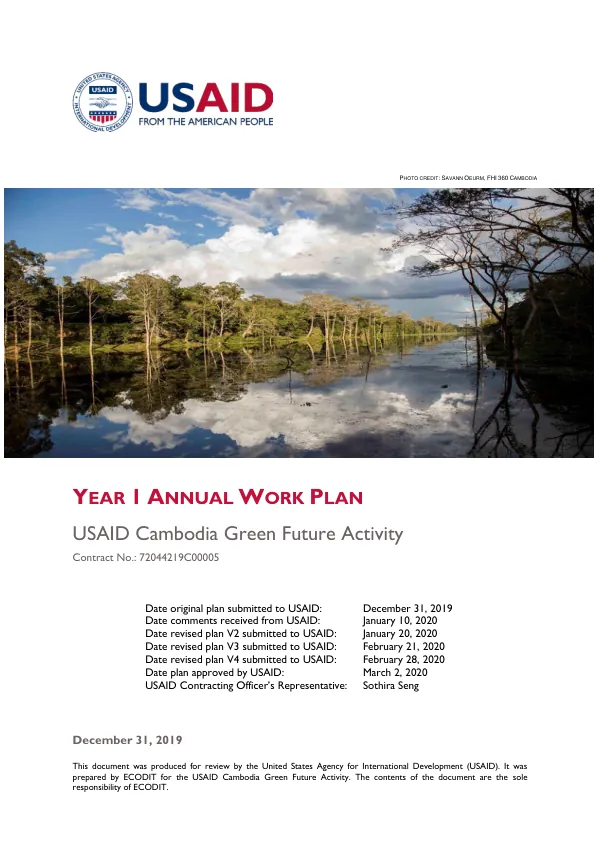
USAID Cambodia Green Future Activity: Year 1 Annual Work Plan
Cambodia is endowed with immense natural resources including land, water, forest ecosystems, wildlife, fish and aquatic resources, among others.
2020 · 29 pages
Sign in to readA free account is required to download.
Abstract
Forest ecosystems, which support biodiversity, are essential to rural communities' livelihoods and provide countless ecosystem services. These ecosystems support the livelihoods of communities, including their economic, social, and cultural wellbeing. Across their nation, Cambodians can increasingly take pride in their natural heritage. However, recent population growth, lifestyle changes, market demand increases, and climate change have threatened such habitats and biodiversity. Conservation and civil society organizations have a long history of raising environmental awareness among key populations, but these efforts have, at times, lacked coordination and rigorous methodological approaches that affect behavior change and can lead to reductions in threats to natural resources. The use of improved tools and increased targeted knowledge will strengthen efforts in biodiversity conservation, sustainable landscapes, and governance. The USAID/Cambodia awarded ECODIT the USAID Cambodia Green Future Activity, with a performance period from October 1, 2019 to September 30, 2024. The project aims to empower Cambodian citizens and civil society with the knowledge and skills to use evidence-based communication systems to influence positive actions to support biodiversity conservation, forest protection, and broad sustainable natural resource management. The project team consulted with relevant stakeholders, including other USAID implementing partners, the Royal Government of Cambodia, non-government organizations, and civil society organizations, to introduce the project's objectives and gather input. The project's objectives are to strengthen the capacity of civil society organizations and community groups to engage in biodiversity conservation and sustainable natural resource management, and to promote the use of evidence-based communication systems to influence positive actions to support biodiversity conservation, forest protection, and broad sustainable natural resource management. The project will achieve these objectives through a range of interventions, including training and capacity building, community engagement and outreach, and the development and dissemination of evidence-based communication materials. The project will focus on several key areas, including the Prey Lang forest, which is home to a diverse range of flora and fauna, and the Tonle Sap Lake, which is an important habitat for fish and other aquatic species. The project will also work with youth and indigenous peoples to promote their involvement in biodiversity conservation and sustainable natural resource management. The project will use a range of approaches, including social and behavior change communication, to promote positive actions to support biodiversity conservation, forest protection, and broad sustainable natural resource management. The project will be implemented over a period of five years, from October 1, 2019 to September 30, 2024. The project team will work closely with stakeholders, including the Royal Government of Cambodia, non-government organizations, and civil society organizations, to ensure that the project is aligned with national priorities and that the project's objectives are achieved. The project will be monitored and evaluated regularly to ensure that it is meeting its objectives and to identify areas for improvement. The project will have several key deliverables, including the development and dissemination of evidence-based communication materials, the training and capacity building of civil society organizations and community groups, and the promotion of the use of evidence-based communication systems to influence positive actions to support biodiversity conservation, forest protection, and broad sustainable natural resource management. The project will also have several short-term technical assistance activities, including the provision of technical assistance to civil society organizations and community groups, and the development of a project monitoring and evaluation plan. The project will be implemented in several provinces in Cambodia, including Kampong Thom, Kampong Cham, and Preah Vihear. The project will work with a range of stakeholders, including civil society organizations, community groups, and government agencies, to achieve its objectives. The project will use a range of approaches, including social and behavior change communication, to promote positive actions to support biodiversity conservation, forest protection, and broad sustainable natural resource management. The project's budget for Year 1 is $1.2 million, which will be used to support the project's interventions, including training and capacity building, community engagement and outreach, and the development and dissemination of evidence-based communication materials. The project will also have several international travel activities, including the provision of technical assistance to civil society organizations and community groups, and the development of a project monitoring and evaluation plan. The project will be monitored and evaluated regularly to ensure that it is meeting its objectives and to identify areas for improvement. The project will use a range of indicators, including the number of civil society organizations and community groups trained, the number of people reached through community engagement and outreach activities, and the number of evidence-based communication materials developed and disseminated. The project will also conduct a midterm evaluation to assess its progress and identify areas for improvement.
Related documents