CONCERN WORLDWIDE INTERNATIONAL
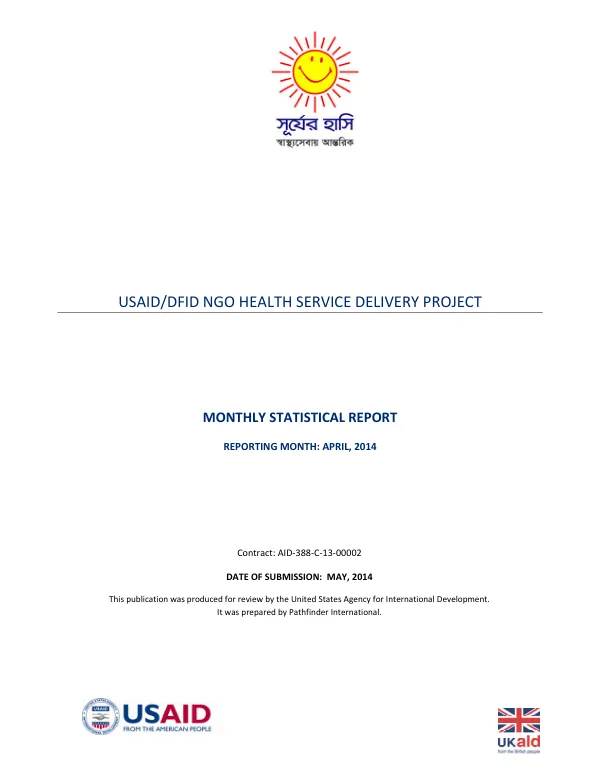
USAID/DFID NGO HEALTH SERVICE DELIVERY PROJECT Monthly Statistical Report
The USAID/DFID NGO Health Service Delivery Project is a collaborative effort between the United States Agency for International Development (USAID) and the Department for International Development (DFID) of the United Kingdom.
2014 · 14 pages
Sign in to readA free account is required to download.
Abstract
The project aims to improve health service delivery in Bangladesh through a network of non-governmental organizations (NGOs). In April 2014, the project's partners convened for a meeting to review project status and achievements. The meeting also served as a platform for discussing new project expansion goals. Additionally, a Memorandum of Understanding (MOU) was signed between the project and Concern Worldwide, a global humanitarian organization, to enhance nutritional knowledge among health workers. The project's media and outreach efforts included participation in the Shorno Kishoree Bangladesh Convention 2014, which aimed to create awareness among adolescent girls in Bangladesh regarding adolescent health and safe motherhood. Surjer Hashi clinics and its community service providers were also featured on the satellite television channel Desh TV as part of the program Jiboner Golpo. The project's expansion efforts included the incorporation of two new clinics into the Surjer Hashi clinic network. The clinics are located in rural areas of Comilla and Hajipur. The project also conducted safe delivery clinical trainings for paramedics who are currently providing safe deliveries at the facility and home level. Institutional strengthening is a key component of the project, and a training on managing direct USAID awards for NHSDP transitioning NGOs was held for Swanirvar and PSTC. The training aimed to cover administration aspects of USAID financial and internal control procedures, regulations, and compliance issues. The project's monthly statistical report for April 2014 contains indicators from Intermediate Result one (IR-1) and data from all 26 NGOs. The report highlights key achievements, including a total of 133,420 Couple Years Protection (CYP) achieved in April 2014, with 83,411 in rural areas and 50,009 in urban areas. The report also notes that the number of poor contacts (excluding NID and Rubella contacts) was 1,260,255 out of a total of 3,246,524 client contacts in April 2014, which constitutes 39% of all contacts. The report also presents data on service contacts, including a total of 3,246,524 service contacts in April 2014, with 2,027,122 in rural areas and 1,219,402 in urban areas. The proportion of poor contacts is 37% in rural areas and 41.9% in urban areas. The report also highlights data on injectables provided, total deliveries, ANC visits, and essential newborn care (ENC) provided in April 2014. The project's data on service contacts to the poor remains almost the same in April 2014, with a total of 1,260,255 poor contacts out of 3,246,524 client contacts. The report also presents data on home and facility deliveries, with a total of 1,998 deliveries in April 2014, including 297 home births and 1,701 facility births. The report also highlights data on ANC visits, with a total of 113,504 ANC visits in April 2014, including 38,152 first visits and 23,641 fourth visits.
Related documents