INTERNEWS NETWORK
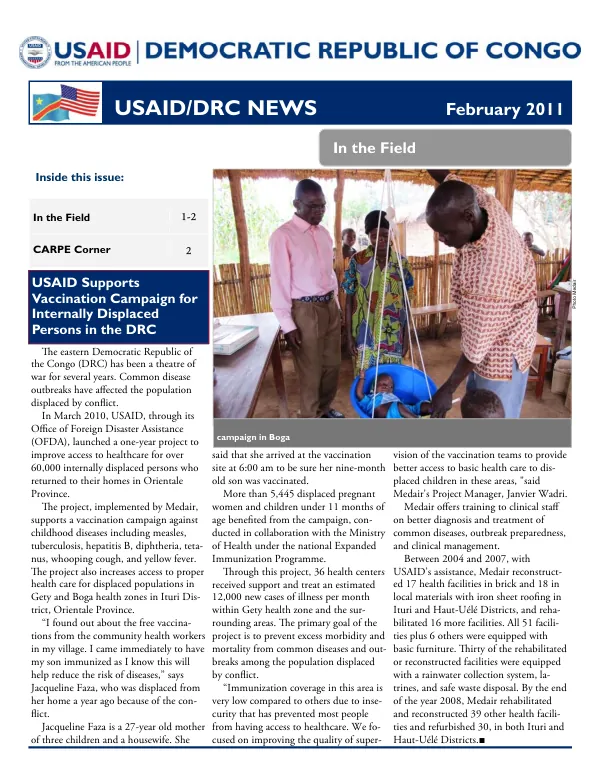
USAID/DRC NEWS February 2011
The eastern Democratic Republic of the Congo (DRC) has been a theatre of war for several years, resulting in common disease outbreaks affecting the population displaced by conflict.
2011 · 2 pages
Sign in to readA free account is required to download.
Abstract
In March 2010, USAID, through its Office of Foreign Disaster Assistance (OFDA), launched a one-year project to improve access to healthcare for over 60,000 internally displaced persons who returned to their homes in Orientale Province. The project, implemented by Medair, supports a vaccination campaign against childhood diseases including measles, tuberculosis, hepatitis B, diphtheria, tetanus, whooping cough, and yellow fever. The project also increases access to proper healthcare for displaced populations in Gety and Boga health zones in Ituri District, Orientale Province. More than 5,445 displaced pregnant women and children under 11 months of age benefited from the campaign, conducted in collaboration with the Ministry of Health under the national Expanded Immunization Programme. Through this project, 36 health centers received support and treated an estimated 12,000 new cases of illness per month within Gety health zone and the surrounding areas. The primary goal of the project is to prevent excess morbidity and mortality from common diseases and outbreaks among the population displaced by conflict. Immunization coverage in this area is very low compared to others due to insecurity that has prevented most people from having access to healthcare. Medair offers training to clinical staff on better diagnosis and treatment of common diseases, outbreak preparedness, and clinical management. Between 2004 and 2007, with USAID's assistance, Medair reconstructed 17 health facilities in brick and 18 in local materials with iron sheet roofing in Ituri and Haut-Uélé Districts, and rehabilitated 16 more facilities. All 51 facilities plus 6 others were equipped with basic furniture. Thirty of the rehabilitated or reconstructed facilities were equipped with a rainwater collection system, latrines, and safe waste disposal. By the end of the year 2008, Medair rehabilitated and reconstructed 39 other health facilities and refurbished 30, in both Ituri and Haut-Uélé Districts. On December 14, 2010, USAID launched three new projects to address Sexual Gender-Based Violence (SGBV) in the Democratic Republic of the Congo's (DRC) eastern provinces of North Kivu, South Kivu, Orientale, and Maniema. The projects, called Care, Access, Safety and Empowerment (CASE), USHINDI, and Bienvenue aux Changements dans la Communauté (BCC), aim to increase access to and quality of medical, psychological, social, legal, and economic services for SGBV in eastern DRC. The first two projects, totaling $32.2 million over five years, will increase access to and quality of medical, psychological, social, legal, and economic services for SGBV in eastern DRC. The third project, BCC, totaling $10 million over five years, is a first-ever prevention project that uses behavior change communications methodology at the community level to try to reduce tolerance and acceptance of SGBV and increase awareness of the 2006 national SGBV law and its consequences. The Central Africa Regional Program for the Environment (CARPE), through its partners, developed and published The Democratic Republic of the Congo from space-Forest cover loss from 2000 to 2010. This Atlas, called Forêt d'Afrique Centrale Evaluée par Télédétection (FACET), will guide forest management interventions to mitigate climate change by providing detailed information on hot spots for forest loss and drivers of deforestation in the DRC, a country that contains over 50% of the Congo Basin tropical forest. Over 8,000 land satellite images were used to produce this Atlas. The Atlas was developed by the Kinshasa-based Observatoire Satellital des Forêts d'Afrique Centrale and the National Aeronautics and Space Agency (NASA), South Dakota State University, and the University of Maryland. This Atlas will provide detailed information on hot spots for forest loss and drivers of deforestation in the DRC, a country that contains over 50% of the Congo Basin tropical forest. USAID is also launching a $15 million program aimed at providing technical assistance and material support to enhance the management capacity of community radio stations and regional radio networks in Katanga, Maniema, South Kivu, and Bandundu provinces. The program, implemented by Internews Network, will provide training to media managers on financial management, radio station organization, editorial policies, and revenue generation. Individual journalists will also receive training on international standards. The program will establish Media Resource and Training Centers in all of the target provinces, which will serve as activity hubs for all project activities.