USAID DEC
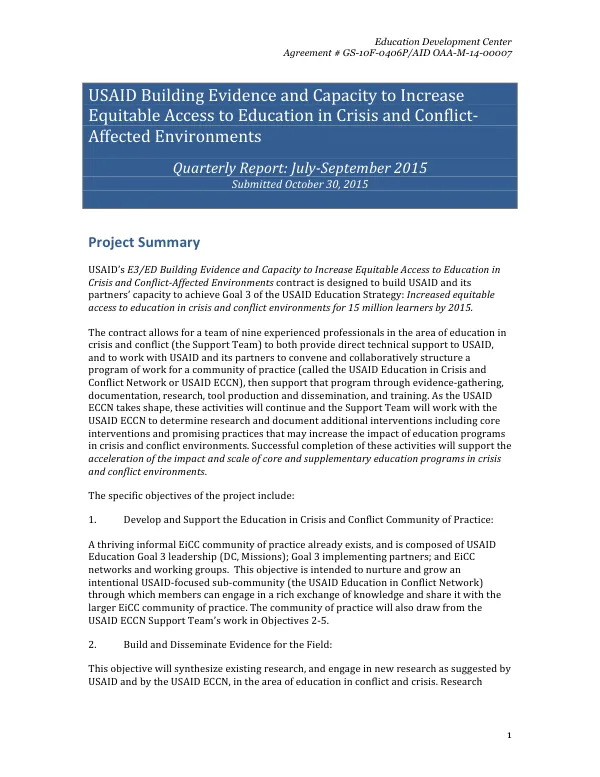
USAID E3/ED Building Evidence and Capacity to Increase Equitable Access to Education in Crisis and Conflict-Affected Environments Quarterly Report: July-September 2015
Sign inCENTER FOR EDUCATIONAL DEVELOPMENT
USAID E3/ED Building Evidence and Capacity to Increase Equitable Access to Education in Crisis and Conflict-Affected Environments Quarterly Report: July-September 2015
The USAID Education in Crisis and Conflict (ECC) contract is designed to build USAID and its partners' capacity to achieve Goal 3 of the USAID Education Strategy: Increased equitable access to education in crisis and conflict environments for 15 million learners by 2015.
2015 · 26 pages
Sign in to readA free account is required to download.
Abstract
The contract allows for a team of nine experienced professionals in the area of education in crisis and conflict to provide direct technical support to USAID and work with USAID and its partners to convene and collaboratively structure a program of work for a community of practice called the USAID Education in Crisis and Conflict Network (ECCN). The specific objectives of the project include developing and supporting the ECCN community of practice, building and disseminating evidence for the field, testing, disseminating, and using guidance, tools, metrics, and theories of change, applying tools in crisis and conflict, and developing, implementing, and assessing training. The project aims to nurture and grow an intentional USAID-focused sub-community through which members can engage in a rich exchange of knowledge and share it with the larger ECC community of practice. The ECCN community of practice is composed of USAID Education Goal 3 leadership, implementing partners, and ECC networks and working groups. The project has established the ECCN launch meeting, identified USAID ECCN Planning Committee Members, and drafted the USAID ECCN Terms of Reference. The Steering Group has also been established, with two co-chairs and five Advisory Group members. The group has begun work planning, with the objective leads reaching out to mini-teams composed of 2-3 SG members to invite input on the Life of Project and annual outcomes. The project has also established a USAID ECCN Learning Agenda through outreach and information gathering. A summary stakeholder baseline report and an internal USAID stakeholder baseline report were delivered in May 2015. However, the development of the ECCN Year 2-5 Learning Agenda was delayed due to the absence of guidance from the Senior Researcher, who left ECCN in July. The replacement for the Senior Researcher will come on board next quarter. The project has made significant progress in establishing the ECCN community of practice and beginning work planning. However, challenges have been encountered in getting SG members' attention and input on ECCN work. The project plans to address this challenge at the next face-to-face SG meeting in October. The project also plans to continue work planning throughout the quarter and hold an SG/AG meeting in October. The project's ultimate goal is to support the acceleration of the impact and scale of core and supplementary education programs in crisis and conflict environments. The project aims to achieve this goal by developing and supporting the ECCN community of practice, building and disseminating evidence for the field, testing, disseminating, and using guidance, tools, metrics, and theories of change, applying tools in crisis and conflict, and developing, implementing, and assessing training.
Related documents