USAID
USAID ECCN Progress Monitoring Report 2016
The USAID ECCN Progress Monitoring Report 2016 aims to track progress toward changing practice in education programs in crisis and conflict-affected environments.
2017 · 24 pages
Sign in to readA free account is required to download.
Abstract
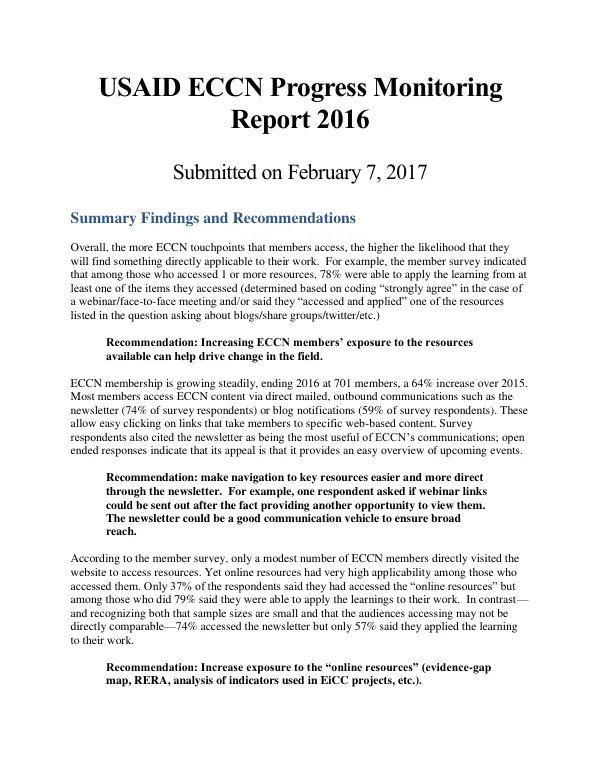
The report focuses on the USAID Education in Crisis and Conflict Network (ECCN), which is designed to build evidence and capacity to increase equitable access to education in these environments. The ECCN has five objectives: developing and supporting the Education in Crisis and Conflict Community of Practice, gathering and consolidating evidence for the field, testing and disseminating guidance, tools, and metrics, developing and applying guidance and tools, and developing, implementing, and assessing professional development opportunities. The report highlights the importance of increasing ECCN members' exposure to resources available through the network. A member survey indicated that among those who accessed 1 or more resources, 78% were able to apply the learning from at least one of the items they accessed. The report recommends increasing exposure to online resources, expanding members' use of Twitter, and increasing participation in Working Groups to drive greater application of knowledge and skills. The ECCN's approach to progress monitoring is designed to track progress toward changed practice by monitoring ECCN members' degree of uptake and use of opportunities, concepts, evidence, tools, and guidance across each of the five work streams. The report presents data related to ECCN's progress during 2016, including the number of members who accessed resources, the number of resources accessed, and the number of members who applied the learning from the resources. The ECCN RESULTS FRAMEWORK outlines the performance monitoring indicators for ECCN, which were selected to measure progress toward stated outcomes at the outcome level. The indicators include metrics such as the number of members who accessed resources, the number of resources accessed, and the number of members who applied the learning from the resources. The report also highlights the importance of tracking progress toward changed practice, which is defined as the guidance, tool, or evidence being reflected in changed practice. The report presents an overview of ECCN's expected outcomes by objective, which are outlined in the Results Framework. The ECCN Progress Monitoring Report 2016 provides a comprehensive overview of the ECCN's progress during 2016 and highlights the importance of increasing ECCN members' exposure to resources available through the network. The report also outlines the ECCN's approach to progress monitoring and presents data related to ECCN's progress during 2016. The ECCN's membership is growing steadily, with 701 members at the end of 2016, a 64% increase over 2015. Most members access ECCN content via direct mailed, outbound communications such as the newsletter (74% of survey respondents) or blog notifications (59% of survey respondents). The newsletter is cited as the most useful of ECCN's communications, with respondents indicating that its appeal is that it provides an easy overview of upcoming events. The report also highlights the importance of increasing exposure to online resources, which had very high applicability among those who accessed them. Only 37% of respondents said they had accessed the "online resources" but among those who did, 79% said they were able to apply the learnings to their work. The report recommends increasing exposure to online resources and expanding members' use of Twitter and participation in Working Groups to drive greater application of knowledge and skills.
Related documents
Documents in this collection
 2015
2015USAID DEC
USAID E3/ED Building Evidence and Capacity to Increase Equitable Access to Education in Crisis and Conflict-Affected Environments Quarterly Report: January 2015 – March 2015
Open record 2015
2015USAID DEC