USAID DEC
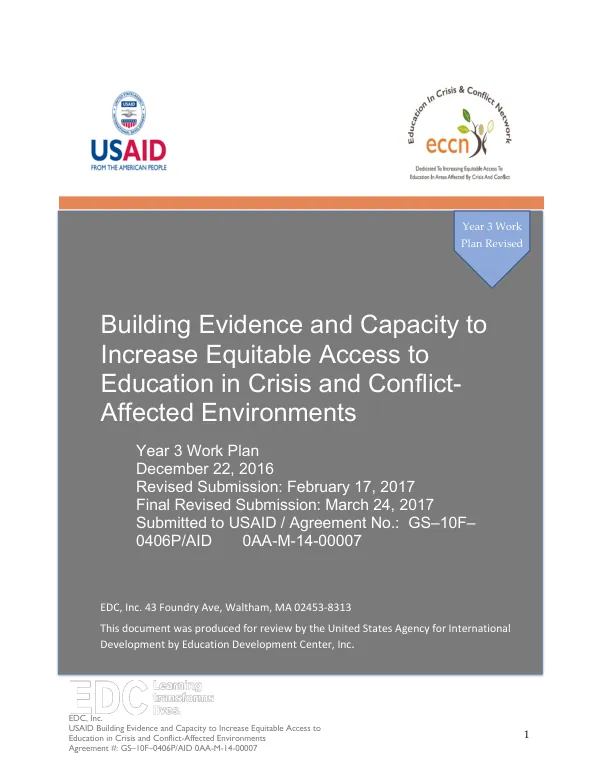
Building Evidence and Capacity to Increase Equitable Access to Education in Crisis and Conflict-Affected Environments
Sign inCENTER FOR EDUCATIONAL DEVELOPMENT
Building Evidence and Capacity to Increase Equitable Access to Education in Crisis and Conflict-Affected Environments
The USAID ECCN project aims to build evidence and capacity to increase equitable access to education in crisis and conflict-affected environments.
2017 · 74 pages
Sign in to readA free account is required to download.
Abstract
The project is structured around five objectives, which include developing and supporting the Education in Crisis and Conflict Community of Practice, gathering and consolidating evidence for the field, testing and disseminating guidance, tools, metrics, and Theories of Change, developing and applying guidance and tools, and developing, implementing, and assessing professional development. The project's objectives are aligned with USAID's Education Strategy, which seeks to increase equitable access to education in crisis and conflict environments for 15 million learners by 2015. The project's specific objectives include developing and supporting the Education in Crisis and Conflict Community of Practice, gathering and consolidating evidence for the field, testing and disseminating guidance, tools, metrics, and Theories of Change, developing and applying guidance and tools, and developing, implementing, and assessing professional development. The project is organized into five priority areas, which include making learning environments safer, improving Education in Crisis and Conflict (EiCC) programming, enhancing equity, strengthening local institutions, and cross-cutting and management activities. Each priority area has a set of outcomes and outputs, which are described in detail in the work plan. In Priority Area 1, Making Learning Environments Safer, the project aims to improve the safety of learning environments by providing ECCN members with access to and application of evidence and tools. This includes finalizing a stand-alone safety assessment tool, developing a safety assessment framework, and conducting a pilot safety assessment in a crisis-affected country. In Priority Area 2, Improving EiCC Programming, the project aims to improve EiCC programming by providing ECCN members with access to and application of evidence and tools. This includes developing a set of core indicators for EiCC programming, conducting a review of EiCC programming in crisis-affected countries, and developing a set of guidance and tools for EiCC programming. In Priority Area 3, Enhancing Equity, the project aims to enhance equity in education in crisis and conflict-affected environments by providing ECCN members with access to and application of evidence and tools. This includes conducting a review of equity in education in crisis and conflict-affected environments, developing a set of guidance and tools for promoting equity in education, and conducting a pilot equity assessment in a crisis-affected country. In Priority Area 4, Strengthening Local Institutions, the project aims to strengthen local institutions in crisis and conflict-affected environments by providing ECCN members with access to and application of evidence and tools. This includes conducting a review of local institutions in crisis and conflict-affected environments, developing a set of guidance and tools for strengthening local institutions, and conducting a pilot institutional assessment in a crisis-affected country. In Cross-Cutting and Management Activities, the project aims to support the overall management and coordination of the ECCN project. This includes developing a set of guidance and tools for managing the ECCN project, conducting a review of the ECCN project's progress, and developing a set of recommendations for improving the ECCN project's effectiveness. The project's work plan is organized into four sections, which include a work plan overview, a description of the project's objectives, a summary of the project's proposed activities, and a detailed description of the project's proposed activities. The project's work plan is supported by a set of annexes, which include an implementation plan, a communications schedule, and a set of guidance and tools for managing the project.
Related documents