USAID DEC
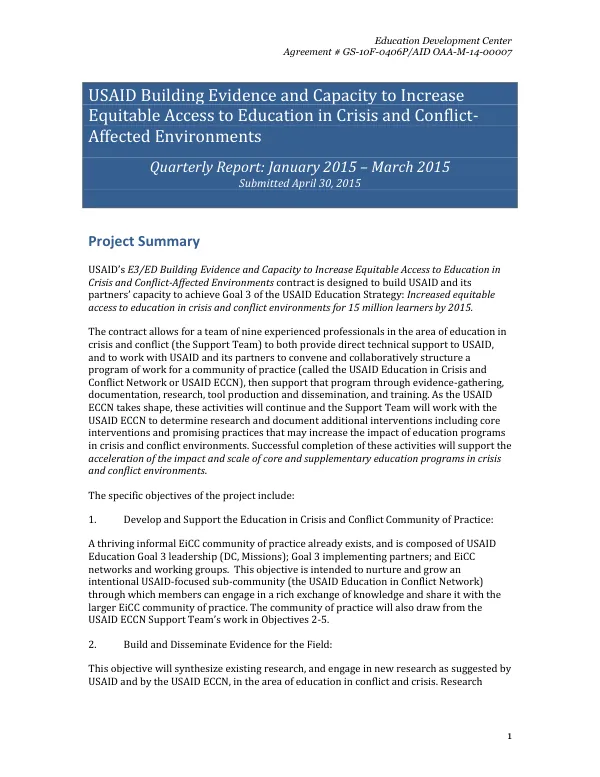
USAID E3/ED Building Evidence and Capacity to Increase Equitable Access to Education in Crisis and Conflict-Affected Environments Quarterly Report: January 2015 – March 2015
Sign inCENTER FOR EDUCATIONAL DEVELOPMENT
USAID E3/ED Building Evidence and Capacity to Increase Equitable Access to Education in Crisis and Conflict-Affected Environments Quarterly Report: January 2015 – March 2015
The USAID Education in Crisis and Conflict (ECC) Network was established to build capacity and increase equitable access to education in crisis and conflict-affected environments.
2015 · 34 pages
Sign in to readA free account is required to download.
Abstract
The network aims to achieve Goal 3 of the USAID Education Strategy, which targets 15 million learners by 2015. The ECC Network is a community of practice that brings together USAID Education Goal 3 leadership, implementing partners, and networks and working groups. The network's objectives include developing and supporting the ECC Community of Practice, building and disseminating evidence for the field, testing and disseminating guidance, tools, metrics, and theories of change, applying tools in crisis and conflict environments, and developing, implementing, and assessing training. The ECC Network's activities are organized around these objectives, with each objective having specific deliverables and outputs. The ECC Network launch meeting took place on January 29, 2015, at the US Institutes for Peace in Washington DC. The meeting introduced the ABE-ACCESS IDIQ mechanism and the USAID ECC Network to USAID partners, and set the stage for increased collaboration and coordination among partners. The launch meeting included presentations by Charles North, Andy Blum, Dean Brooks, Yolande Miller Grandvaux, and Nina Papadopoulus, as well as a keynote speech by Clare Lockhart. The USAID ECC Network Planning Committee was established in January and February to develop the USAID ECC Network Terms of Reference and establish the process for selection of the USAID ECC Network Steering Group. The Planning Committee includes representatives from ABE ACCESS IDIQ consortia, non-IDIQ holding organizations, and the USAID ECC Network Support Team. The committee reviewed and commented on a draft USAID ECC Network Terms of Reference in early March. Task Teams were re-named Knowledge Share Groups (KSGs) after the launch, and the Support Team formed five initial KSGs in February, including Research, Monitoring and Evaluation, Conflict Sensitivity and Peace Building, Teacher Professional Development, and Theories of Change. Each KSG is facilitated by a member of the Support Team and has continued to build its membership since the launch meeting. The East Africa Regional Meeting, initially planned to take place in Nairobi in June 2015, was postponed due to date conflicts and time constraints within USAID. The meeting will be rescheduled at a later date. The ECC Network's activities are focused on building capacity and increasing equitable access to education in crisis and conflict-affected environments. The network's objectives and activities are designed to support the acceleration of the impact and scale of core and supplementary education programs in crisis and conflict environments.
Related documents
Documents in this collection
 2015
2015USAID DEC
USAID E3/ED Building Evidence and Capacity to Increase Equitable Access to Education in Crisis and Conflict-Affected Environments Quarterly Report: July-September 2015
Open record 2017
2017USAID DEC