USAID DEC
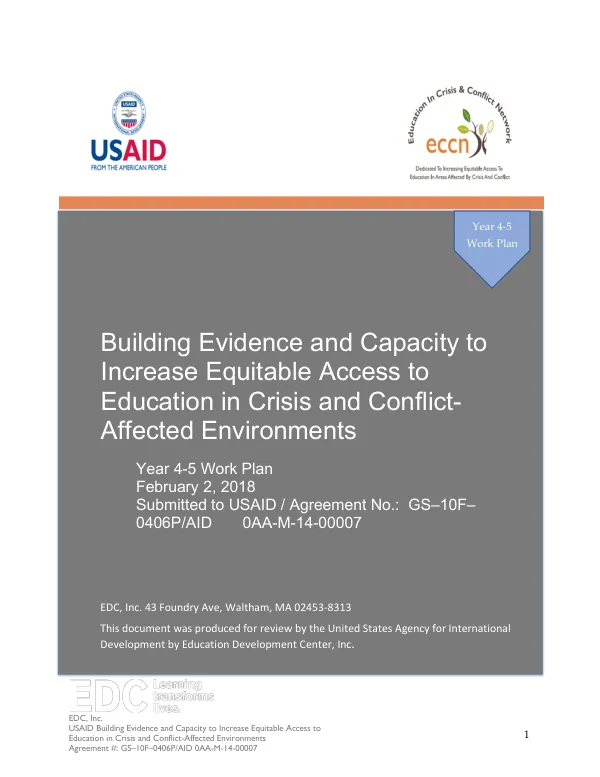
Building Evidence and Capacity to Increase Equitable Access to Education in Crisis and Conflict-Affected Environments
Sign inCENTER FOR EDUCATIONAL DEVELOPMENT
Building Evidence and Capacity to Increase Equitable Access to Education in Crisis and Conflict-Affected Environments
The USAID-funded initiative, Building Evidence and Capacity to Increase Equitable Access to Education in Crisis and Conflict-Affected Environments, aims to build USAID and its partners' capacity to achieve Goal 3 of the USAID Education Strategy.
2018 · 89 pages
Sign in to readA free account is required to download.
Abstract
The contract, held by Education Development Center, Inc. (EDC), is designed to support the acceleration of the impact and scale of core and supplementary education programs in crisis and conflict environments. The project's specific objectives include developing and supporting the Education in Crisis and Conflict Community of Practice, gathering and consolidating evidence for the field, testing and disseminating guidance, tools, metrics, and Theories of Change, developing and applying guidance and tools, and developing, implementing, and assessing professional development opportunities. The project will focus on five priority areas: making learning environments safer, improving Education in Crisis and Conflict (EiCC) programming, enhancing equity, strengthening local institutions, and cross-cutting activities. The project will also convene and collaboratively structure a program of work for a community of practice, called the USAID Education in Crisis and Conflict Network (ECCN), to support the development of evidence-based education programs in crisis and conflict environments. The ECCN will comprise a team of nine experienced professionals in the area of education in crisis and conflict, who will provide direct technical support to USAID and work with USAID and its partners to convene and structure the program of work for the community of practice. The ECCN will also support the development of research and documentation of additional interventions, including core interventions and promising practices, to increase the impact of education programs in crisis and conflict environments. The project will be implemented over a period of one full project year, plus seven months of another project year, and will be supported by a Performance Management Plan (PMP) to ensure the achievement of the project's objectives. The project will also be subject to regular monitoring and evaluation to assess its progress and impact. The project's work plan is organized into four sections, including a project description, an overview of the ECCN's proposed work, a summary of the project's objectives, and a detailed description of the proposed activities. The project will also be supported by four annexes, including an implementation plan, a deliverables schedule, a dissemination and engagement plan, and a communications schedule for training activities. The project's objectives are aligned with USAID's Education Strategy, which aims to increase equitable access to education in crisis and conflict environments for 15 million learners by 2015. The project's success will contribute to the achievement of this goal and support the acceleration of the impact and scale of core and supplementary education programs in crisis and conflict environments. The project will also contribute to the development of evidence-based education programs in crisis and conflict environments, which will be essential for improving the quality and effectiveness of education programs in these challenging environments. The project's focus on equity, local institutions, and cross-cutting activities will also support the development of more inclusive and effective education programs that address the needs of diverse learners in crisis and conflict environments. Overall, the project's objectives and activities are designed to support the achievement of USAID's Education Strategy and contribute to the development of more effective and inclusive education programs in crisis and conflict environments.
Related documents