USAID DEC
USAID Education in Crisis & Conflict Network (ECCN) Monitoring and Evaluation Plan and Performance Indicator Reference Sheets (PIRS)
Sign inCENTER FOR EDUCATIONAL DEVELOPMENT
USAID Education in Crisis & Conflict Network (ECCN) Monitoring and Evaluation Plan and Performance Indicator Reference Sheets (PIRS)
The USAID Education in Crisis and Conflict Network (ECCN) Monitoring and Evaluation Plan and Performance Indicator Reference Sheets (PIRS) is a comprehensive framework for tracking progress toward achieving the objectives and expected outcomes of the ECCN.
2017 · 40 pages
Sign in to readA free account is required to download.
Abstract
The plan serves as a tool for planning, implementing, tracking, and documenting progress toward achieving the objectives and expected outcomes of the ECCN. The ECCN is designed to build USAID and its partners' capacity to achieve Goal 3 of the USAID Education Strategy: Increased equitable access to education in crisis and conflict environments for 15 million learners. The project's overarching goal is to create, enable, and support a USAID Goal 3 Community of Practice that improves policy, planning, and practice for increasing equitable access to education in conflict and crisis-affected environments. The ECCN's approach to progress monitoring is tailored to the Results Framework and Theory of Change. The monitoring system aims to ultimately measure CoP members' uptake of ECCN outputs and how effectively they contribute to changing programmatic practice. This monitoring will enable adaptation of our outputs to CoP members' emerging needs and interests. The ECCN will track ECCN's success in delivering outputs associated with each Priority Area, including Crosscutting. These outputs will be determined on an annual basis, through the work planning process, and ECCN's delivery progress will be noted through quarterly reports, then summarized at year's end through an annual progress report. If certain outputs require a longer delivery timeframe than one year, these will be continued into the subsequent year; if their delivery is complete, or is deemed to no longer be necessary, these outputs will be discontinued. The ECCN has broken out progress into stages, which correspond to the five IF and THEN statements in the Theory of Change. These stages for monitoring are: guidance, tool, or opportunity is produced (output); guidance, tool, or opportunity is made available (output); members access (outcome, level 1); members 'apply' or use to inform (outcome, level 2); and guidance, tool, or evidence is reflected in changed practice (goal or impact level). The ECCN has developed a set of custom indicators to track progress toward achieving the objectives and expected outcomes of the ECCN. The indicators are organized into three categories: program output and sub-output indicators, outcome indicators, and impact indicators. The indicators are designed to measure the ECCN's success in delivering outputs, tracking progress toward changed practice, and ultimately achieving the project's goal of increasing equitable access to education in conflict and crisis-affected environments. The ECCN's Performance Indicator Reference Sheets (PIRS) provide further details on each indicator, including the data collection methods and indicators. The PIRS are located in the annex of the Monitoring and Evaluation Plan and Performance Indicator Reference Sheets. The ECCN's monitoring and evaluation system is designed to provide a common understanding of the monitoring and evaluation structure, functions, and capabilities. The system will enable the ECCN to track progress toward achieving the objectives and expected outcomes of the ECCN, identify gaps and strategize for improvements in activity design and delivery, and ultimately achieve the project's goal of increasing equitable access to education in conflict and crisis-affected environments.
Related documents
Documents in this collection
 2015
2015USAID DEC
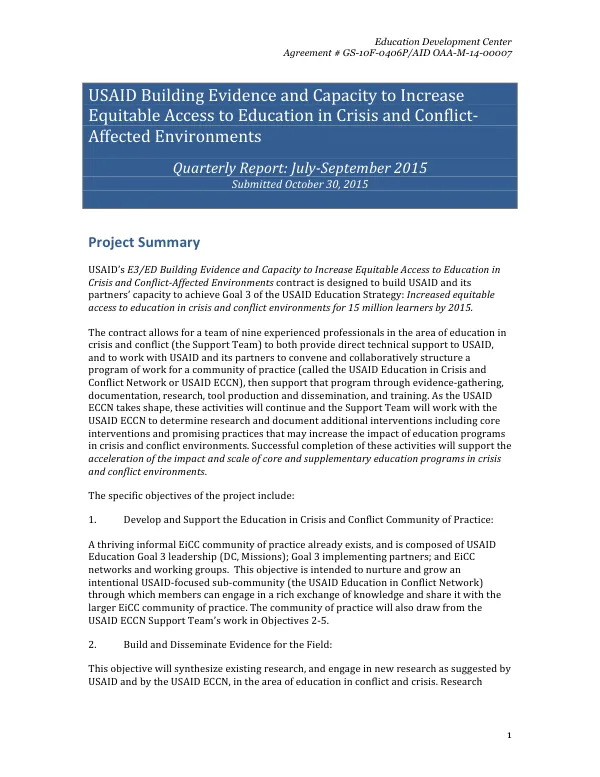
USAID E3/ED Building Evidence and Capacity to Increase Equitable Access to Education in Crisis and Conflict-Affected Environments Quarterly Report: July-September 2015
Open record 2015
2015USAID DEC