USAID
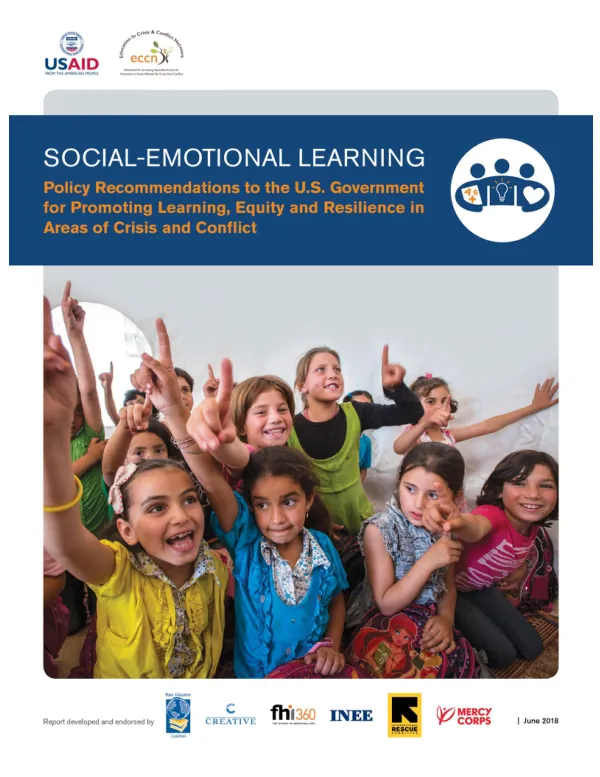
Social-Emotional Learning: A Primer for Education in Conflict and Crisis
Social-emotional learning (SEL) is a critical component of education, particularly in conflict and crisis contexts.
2018 · 13 pages
Sign in to readA free account is required to download.
Abstract
Decades of research have highlighted the importance of SEL for success in school, career, and life. Students who participate in SEL programs perform measurably better in school than their peers without exposure to SEL. They engage in fewer risky or unhealthy behaviors, are less likely to get married or have children before 18, are more likely to be employed, earn more, show more resilience, and are better able to manage conflicts non-violently. SEL is a proven pathway to enhanced wellbeing, equity, and learning outcomes, affecting both individuals and societies in the short and long term. In conflict and crisis settings, SEL is critical for mitigating the effects of toxic stress, which can damage brain development and harm a child's health, behavior, relationships, and ability to learn. SEL opportunities provided in safe educational environments, with nurturing teachers and other caregivers, have been shown to help reduce or reverse the detrimental effects of toxic stress. SEL fosters a quality, inclusive, and safe learning environment where education can restore children's sense of stability, dignity, and hope. It increases students' attachment to school, making them less vulnerable to violence, abuse, exploitation, and recruitment into armed groups or crime. SEL also develops inhibitory control, self-awareness, positive self-image, awareness of and empathy for others, healthy relationships, and problem-solving and responsible decision-making, all of which reduce tensions and the likelihood of violence between groups. SEL is intrinsically supported by the Reinforcing Education Accountability in Development (READ) Act of 2017, which calls for basic education programs that respond to the needs and capacities of developing countries, expand access to safe learning environments, and promote education as a foundation for economic growth. The READ Act prioritizes assistance for countries where there is the greatest opportunity to reduce childhood and adolescence exposure to or engagement in violent extremist ideologies, areas where SEL could make the greatest difference. Hundreds of studies document the value of SEL, with most conducted in the United States and an increasing body of evidence emerging from developing countries. Academic achievement is significantly improved in SEL programs, with students showing an 11-percentage-point gain in grades and test scores. SEL interventions also increase students' commitment to school, leading to better attendance and higher graduation rates. A recent study from the International Rescue Committee found that students in both Lebanon and Niger who participated in an SEL-based tutoring program achieved higher literacy and numeracy scores than their peers who did not participate in this program. Equity is a critical component of SEL, promoting social cohesion and stability. SEL is a powerful pathway to equity, with two decades of randomized, controlled trials showing that the most marginalized youth benefit the most from SEL, especially in academic outcomes. Conversely, a recent study found causality in both directions between educational inequalities and violent conflict, with inequality in education rising, so does the risk of violent conflict, which in turn exacerbates inequality in education. The United States Government should include skills-based SEL in all education programming, with special attention to conflict and crisis contexts. USAID should set initial standards for the field by ensuring that all SEL interventions include at least three key components: a safe learning environment, care for teacher as well as student wellbeing, and implementation of high-quality skills-based SEL programming. USAID should also provide the leadership to advance the field of SEL through investments in research, particularly in crisis and conflict contexts.
Related documents
Documents in this collection
 2017
2017USAID DEC
USAID Education in Crisis & Conflict Network (ECCN) Monitoring and Evaluation Plan and Performance Indicator Reference Sheets (PIRS)
Open record 2015
2015USAID DEC