USAID DEC
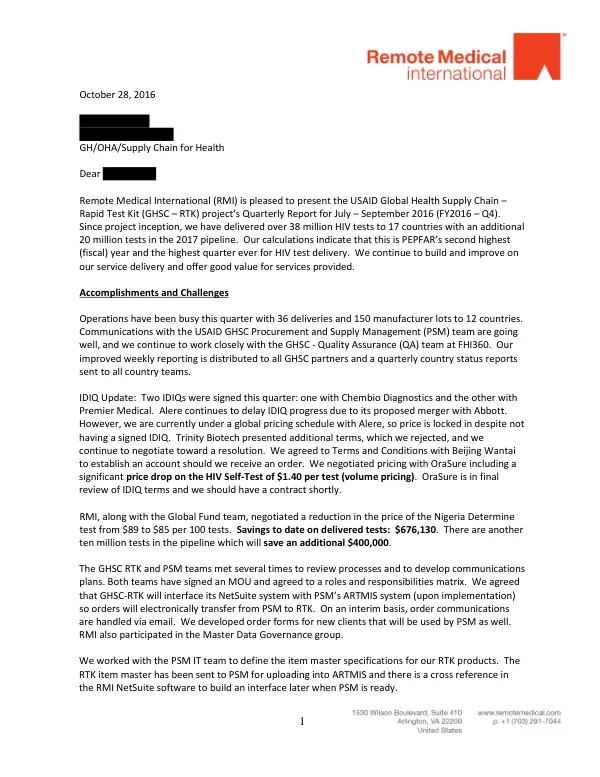
USAID Global Health Supply Chain – Rapid Test Kit (GHSC – RTK) project’s Quarterly Report for July – September 2016 (FY2016 – Q4)
Sign inFHI360
USAID Global Health Supply Chain – Rapid Test Kit (GHSC – RTK) project’s Quarterly Report for July – September 2016 (FY2016 – Q4)
The USAID Global Health Supply Chain – Rapid Test Kit (GHSC – RTK) project, managed by Remote Medical International (RMI), has made significant progress in delivering HIV tests to 17 countries.
2016 · 14 pages
Sign in to readA free account is required to download.
Abstract
Since project inception, over 38 million HIV tests have been delivered, with an additional 20 million tests in the 2017 pipeline. This represents the second-highest fiscal year and the highest quarter ever for HIV test delivery under the PEPFAR program. Operations have been busy, with 36 deliveries and 150 manufacturer lots to 12 countries. Communications with the USAID GHSC Procurement and Supply Management (PSM) team are going well, and RMI continues to work closely with the GHSC - Quality Assurance (QA) team at FHI360. Improved weekly reporting is distributed to all GHSC partners, and quarterly country status reports are sent to all country teams. RMI has signed two IDIQs this quarter: one with Chembio Diagnostics and the other with Premier Medical. Alere continues to delay IDIQ progress due to its proposed merger with Abbott, but RMI is currently under a global pricing schedule with Alere, ensuring locked-in prices despite the delay. Negotiations with Trinity Biotech are ongoing, and RMI has agreed to terms and conditions with Beijing Wantai to establish an account should an order be received. RMI has also negotiated a significant price drop on the HIV Self-Test with OraSure, from $1.40 per test to a volume pricing rate. The GHSC RTK and PSM teams have met several times to review processes and develop communications plans. Both teams have signed a Memorandum of Understanding (MOU) and agreed to a roles and responsibilities matrix. RMI has also developed order forms for new clients that will be used by PSM, and the two teams have agreed to interface their NetSuite system with PSM's ARTMIS system upon implementation. RMI has worked with the PSM IT team to define the item master specifications for RTK products, and the RTK item master has been sent to PSM for uploading into ARTMIS. An SOP has been developed for communications processes between RTK and PSM as they take over field operations, and the process is currently operating effectively. RMI has also shipped two SD Bioline orders for Tanzania via ocean, resulting in freight savings of $266,400.23. The GHSC-RTK project has continued to improve its financial reporting capabilities, reformulating and uploading BI&A data from project inception to align with contract requirements. The Monthly Financial Summaries (MFS) have been consolidated into a single file, eliminating discrepancies between BI&A reports and MFS reports. GHSC-RTK is now able to report based on funding source (COP vs. Core) and has performed an audit on all orders to ensure proper coding. RMI has requested and received incremental funding of $25 million dollars in early September to carry the project through the next several months of orders. Discussions with USAID have begun to explore options for additional funding, with the formal process to begin in January 2017. GHSC-RTK has also reached out to all its GHSC vendors to improve the process for invoicing and payment, resulting in strong relationships with these vendors on the finance side. Pre-shipment QA sampling has officially begun for orders placed after April 1, and new shipments are sampled pre-shipment. Suppliers have adapted to the new process, but challenges around sampling time have resulted in delays, which are considered unacceptable and are listed as late on the on-time delivery (OTD) report. Trinity Biotech experienced manufacturing problems in the early part of the year, resulting in delayed orders, but normal production schedules have resumed.
Related documents