CARE
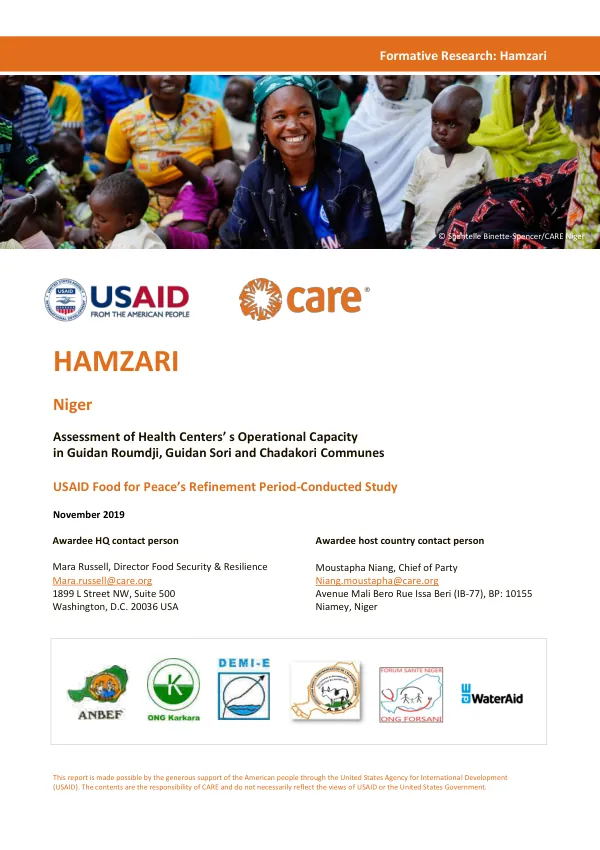
USAID Hamzari Health Facilities Report
The assessment of health center operational capacity in Guidan Roumdji, Guidan Sori, and Chadakori communes in Niger was conducted to evaluate the quality of services offered to mothers and children under five.
2019 · 13 pages
Sign in to readA free account is required to download.
Abstract
The research aimed to identify the main indicators for the initial use and continuity of services provided by health centers in these communes during a child's first thousand days. Niger, a Sahelian country frequently confronted with natural disasters, faces significant development challenges, including ensuring food and nutritional security for its populations. The country's rural food security assessment revealed that 14.5% of households are food insecure, 2.6% are severely food insecure, and 11.9% are moderately food insecure. Maradi is among the regions with the highest vulnerability rates, with chronic malnutrition at 60.3% and overall acute malnutrition at 15.7%. The USAID Hamzari program, led by CARE, aims to ensure sustainable, equitable, and resilient food security for vulnerable groups in Maradi, particularly in the department of Guidan Roumdji. The program's first year is devoted to refining the intervention strategy through formative research, studies, and assessments, including an in-depth assessment of the operational capacities of existing health centers. The research objective was to assess the service quality offered to mothers and children by health centers in the communes of Guidan Roumdji, Guidan Sori, and Chadakori. The specific objectives were to determine the main indicators for the initial use and continuity of services provided to mothers and children under five, analyze determinants of service delivery, assess the quality of services offered, and explore ways for collaboration with other partners. The research methodology involved assessing all public health facilities in the communes, including the Guidan Roumdji Health District, Guidan Sori Health Center, and Chadakori Health Center. The assessment covered availability and geographical accessibility of services, quality of services offered, conditions of existing infrastructure, and functionality of community participation structures. The research questions focused on the determinants of demand for main services offered by health centers, the level of service indicators in health centers, and the quality of services offered to mothers and children under five. The assessment aimed to provide recommendations for improving the health and nutritional status of children under five, adolescent girls, and women of childbearing age. The assessment revealed that the health centers in Guidan Roumdji, Guidan Sori, and Chadakori communes face significant challenges in providing quality services to mothers and children under five. The main indicators for the initial use and continuity of services provided by health centers include availability and geographical accessibility of services, quality of services offered, and conditions of existing infrastructure. The assessment also highlighted the need for improving the health and nutritional status of children under five, adolescent girls, and women of childbearing age. Recommendations included strengthening community participation structures, improving the quality of services offered, and enhancing the availability and geographical accessibility of services. The assessment was conducted with the technical support of the Monitoring and Evaluation team and the active participation of government services, including the Guidan Roumdji Health District and the Maradi Regional Public Health Department. The research aimed to provide a comprehensive understanding of the operational capacity of health centers in Guidan Roumdji, Guidan Sori, and Chadakori communes and to inform the development of strategies for improving the health and nutritional status of vulnerable populations.
Related documents