USAID DEC
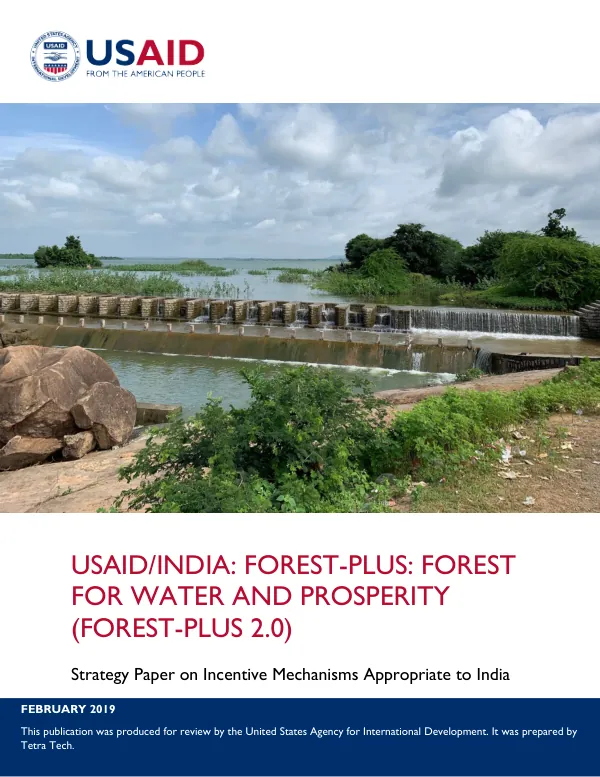
USAID/India: Forest PLUS: forest for water and prosperity (Forest-PLUS 2.0): Strategy Paper on Incentive Mechanisms Appropriate to India
Sign inTETRA TECH
USAID/India: Forest PLUS: forest for water and prosperity (Forest-PLUS 2.0): Strategy Paper on Incentive Mechanisms Appropriate to India
The Forest-Plus 2.0 initiative in India aims to enhance ecosystem services through incentive-based mechanisms.
2019 · 75 pages
Sign in to readA free account is required to download.
Abstract
Ecosystem services refer to the benefits derived from forests, including water, ecotourism, recreation, carbon sequestration, and product value chains. Incentive-based mechanisms are designed to encourage conservation and sustainable management of forests. The Forest-Plus 2.0 strategy paper identifies several case studies of experiments and experiences with incentive-based mechanisms for forest conservation. These include water conservation, ecotourism and recreation, carbon sequestration, product value chains, and multiple ecosystem services. Lessons learned from these case studies highlight the importance of addressing competing fiscal policies, free riders, and leakages to ensure the effectiveness of incentive-based mechanisms. The legal and policy framework in India plays a crucial role in enabling incentive-based mechanisms. The Forest Rights Act, 2006, and the Draft National Policy for Women, 2016, are key policies that support forest conservation and sustainable management. However, competing fiscal policies and free riders can undermine the effectiveness of incentive-based mechanisms. Designing incentive mechanisms for Forest-Plus 2.0 landscapes involves identifying priority ecosystem services, stakeholders, and their roles. Landscape analysis and critical ecosystem services assessments are essential in identifying priority ecosystem services. Stakeholders include ecosystem service beneficiaries, providers, regulators, and intermediaries. Incentive-based mechanisms can be designed to address the needs and roles of these stakeholders. The Forest-Plus 2.0 strategy paper identifies several potential incentive mechanisms for prioritized ecosystem services in project landscapes. These include the Medak, Thiruvananthapuram, and Gaya landscapes. In the Medak landscape, identified incentive-based mechanisms include payment for ecosystem services, community-led forest management, and ecotourism development. In the Thiruvananthapuram landscape, identified incentive-based mechanisms include payment for ecosystem services, forest certification, and sustainable forest management. The Forest-Plus 2.0 initiative aims to enhance ecosystem services through incentive-based mechanisms. The strategy paper provides a framework for designing and implementing incentive mechanisms that address the needs and roles of stakeholders in project landscapes. The initiative has the potential to promote sustainable forest management and conservation in India. The Forest-Plus 2.0 initiative has identified several potential financial opportunities for incentive-based mechanisms. These include public financing sources, private financing sources, and market-based approaches. Public financing sources include government funding and international aid. Private financing sources include corporate funding and philanthropy. Market-based approaches include carbon credits and payment for ecosystem services. The Forest-Plus 2.0 initiative also identifies opportunities and risks associated with incentive schemes. Opportunities include promoting sustainable forest management and conservation, improving livelihoods of forest-dependent communities, and enhancing ecosystem services. Risks include free riders, leakages, and competing fiscal policies. Monitoring and evaluation are essential components of the Forest-Plus 2.0 initiative. The initiative aims to monitor and evaluate the effectiveness of incentive-based mechanisms in promoting sustainable forest management and conservation. Monitoring and evaluation will help identify areas for improvement and ensure that the initiative achieves its objectives. The Forest-Plus 2.0 initiative has the potential to promote sustainable forest management and conservation in India. The initiative's focus on incentive-based mechanisms and stakeholder engagement can help address the complex challenges of forest conservation and management in India.
Related documents