DAI
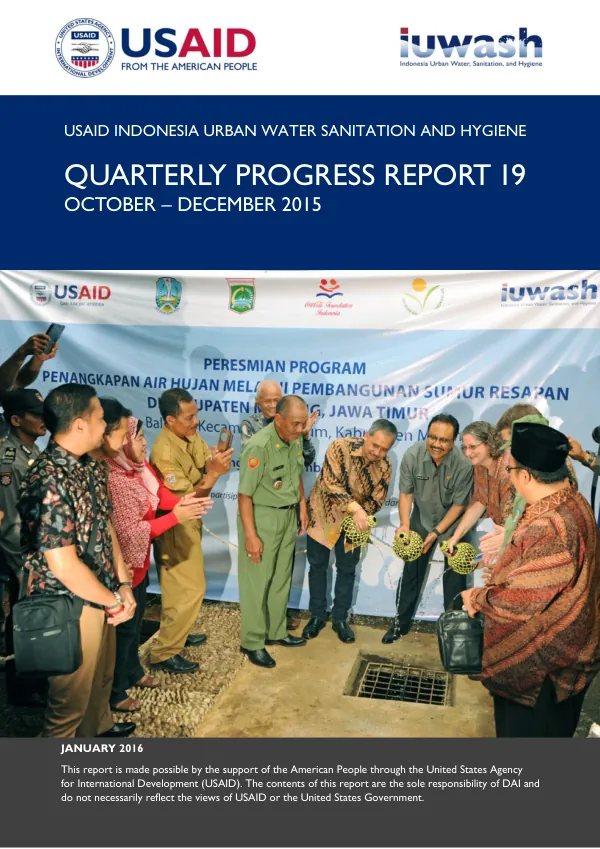
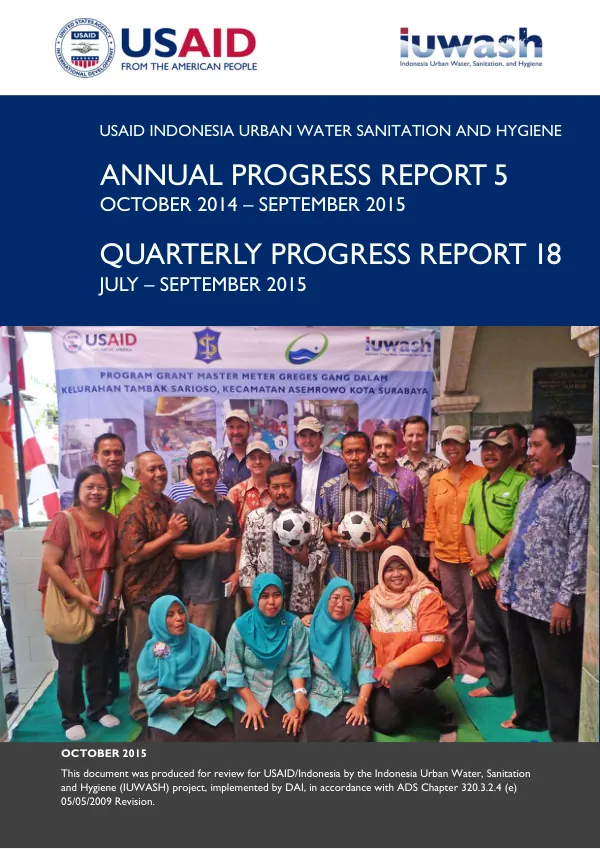
USAID Indonesia Urban Water Sanitation and Hygiene Annual Progress Report 5
The USAID Indonesia Urban Water Sanitation and Hygiene (IUWASH) project began its fifth year of implementation in October 2014, with a focus on optimizing performance and informing policy.
2015 · 165 pages
Sign in to readA free account is required to download.
Abstract
The project's overall goal is to improve access to safe drinking water, sanitation, and hygiene (WASH) services in urban areas of Indonesia. IUWASH is implemented by DAI and is funded by USAID/Indonesia Office of Environment. During Project Year 5 (PY5), IUWASH continued to work with local governments, water utilities, and other stakeholders to improve the performance of the water supply sector. The project's water supply sector programs focused on improving the technical, financial, and customer aspects of water utilities, as well as addressing raw water and climate change adaptation. Key achievements in the water supply sector include the installation of Master Meters in Surabaya, which connected approximately 260 households to the water utility's piping clean water service. In the sanitation sector, IUWASH worked to improve access to improved sanitation through individual household systems, communal systems, and off-site sanitation (sewerage). The project also focused on improving urban septage management and establishing and developing wastewater management operators. Key achievements in the sanitation sector include the construction of new sanitation facilities and the improvement of existing ones, resulting in increased access to improved sanitation for thousands of people. IUWASH also worked on cross-cutting sector programs, which aimed to increase the number of local government policies, local government budgets, and citizen engagement. The project also focused on gender mainstreaming and mobilizing corporate social responsibility (CSR) funding. Key achievements in the cross-cutting sector include the development of new policies and regulations, increased local government budgets, and improved citizen engagement. In addition to its sector-specific programs, IUWASH also worked on grants and national activities. The project provided grants to local governments and other stakeholders to support WASH-related activities, and also worked on national activities, such as media advocacy and monitoring and evaluation. Key achievements in these areas include the development of new media campaigns and the improvement of monitoring and evaluation systems. Overall, IUWASH's fifth year of implementation was marked by significant achievements in the water supply and sanitation sectors, as well as in cross-cutting sector programs. The project's focus on optimizing performance and informing policy has helped to improve access to safe drinking water, sanitation, and hygiene services in urban areas of Indonesia.