DAI GLOBAL, LLC
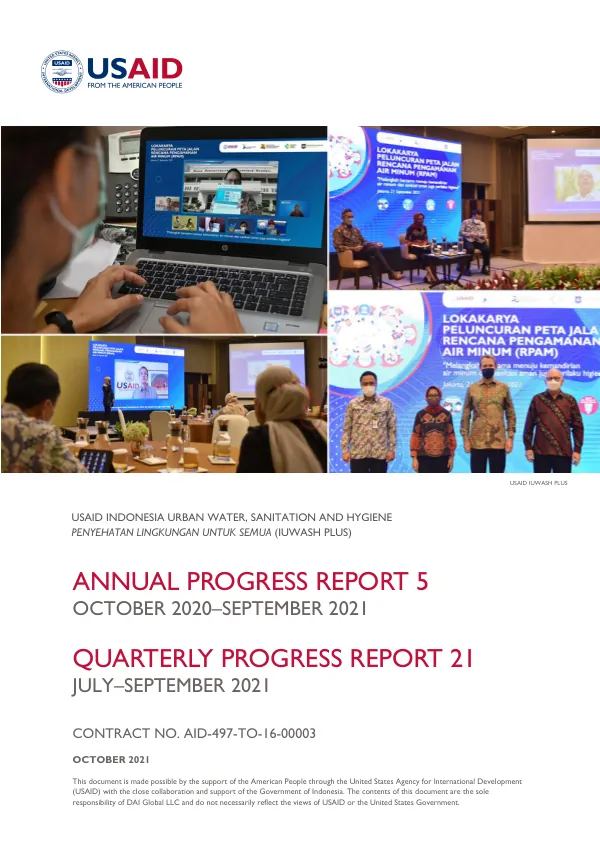
Annual Progress Report 5: October 2020–September 2021
The USAID IUWASH PLUS program is a collaborative effort between the United States Agency for International Development (USAID) and the Government of Indonesia to improve access to safely managed drinking water and sanitation in Indonesia.
2021 · 498 pages
Sign in to readA free account is required to download.
Abstract
The program is implemented by DAI Global LLC and is supported by the Ministry of National Development Planning/Bappenas, the Ministry of Public Works and Housing (MPWH), the Ministry of Health, and the Ministry of Home Affairs. A key strategy for achieving the program's goals is the implementation of Water Safety Plans (RPAM), which aim to ensure that drinking water is safe for consumption. To support this effort, the program organized an institutionalization workshop on water safety plans in September 2021, which brought together representatives from the four ministries, local governments, and other stakeholders. The workshop resulted in the launch of a roadmap for the expansion of RPAM implementation from 2021 to 2025. The roadmap outlines the roles and responsibilities of the four ministries in implementing RPAM, including the preparation of policy and strategy, funding, and monitoring. The Ministry of National Development Planning will prepare policy and strategy, while the MPWH will prepare regulations, guidelines, and technical instructions on RPAM implementation. The Ministry of Health will issue standards on drinking water quality and supervise their fulfillment, and the Ministry of Home Affairs will promote safe water access and RPAM implementation at the national and regional levels. In addition to the institutionalization workshop, the program also conducted a master of trainer (MOT) training on water safety plan (WSP) in Bandung city from October 4-13, 2021, to create a pool of national trainers. The training aimed to equip trainers with the knowledge and skills needed to implement WSP in their respective areas. The program has made significant progress in improving access to safely managed drinking water and sanitation in Indonesia. According to the program's quarterly progress report, the PY4 Wealth Quintile Survey showed that the program has made significant gains in improving access to safely managed drinking water and sanitation, particularly in the wealthier quintiles. The program has also made progress in strengthening household wash services, city and district wash institutional performance, and the wash financing environment. The program has also made progress in advancing national wash advocacy, coordination, and communication, as well as in promoting local sustainability and innovation. The program's gender programming has also made significant progress, with a focus on promoting gender equality and empowering women in the wash sector. The program has also made progress in regional areas, including North Sumatra, West Java, DKI Jakarta, and Tangerang, Central Java, East Java, and South Sulawesi and Eastern Indonesia. The program's regional progress report highlights the achievements and challenges faced by the program in each region. In terms of program management, the program has made progress in program management and coordination, monitoring and evaluation, environmental compliance, and project monitoring and evaluation. The program has also made progress in implementing its local sustainability and innovation component (LSIC) and in promoting gender programming. Overall, the USAID IUWASH PLUS program has made significant progress in improving access to safely managed drinking water and sanitation in Indonesia. The program's collaborative approach and commitment to institutionalization and capacity building have been key factors in its success.
Related documents