USAID DEC
USAID Integrated Health Services Activity Benin Program Year 1, Quarter 4 Progress Report
Sign inDIMAGI, INC.
USAID Integrated Health Services Activity Benin Program Year 1, Quarter 4 Progress Report
The USAID Integrated Health Services Activity (IHSA) in Benin is a five-year Activity financed by the United States Agency for International Development (USAID).
2019 · 41 pages
Sign in to readA free account is required to download.
Abstract
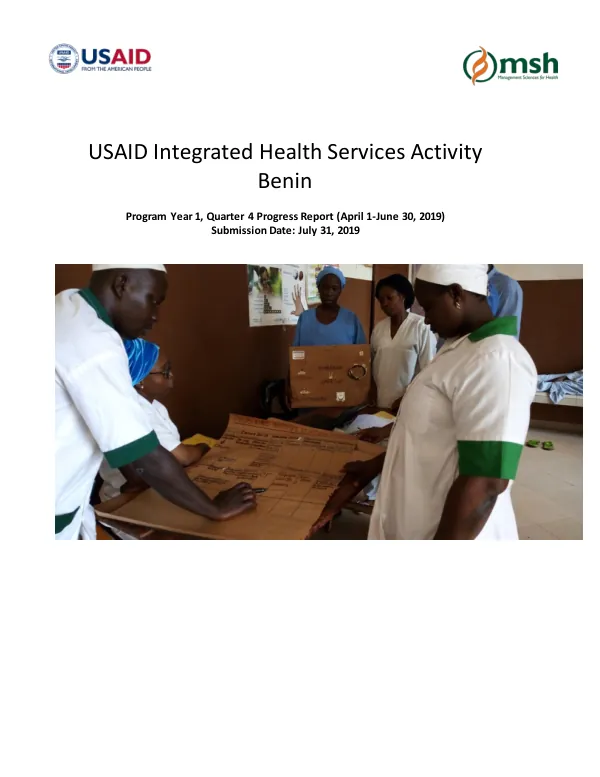
The Activity is implemented by Management Sciences for Health (MSH) with international partner Dim and four local partners: Centre de Réflexions et d’Actions pour le Développement Intégré et la Solidarité (CeRADIS), Centre de Recherche en Reproduction Humaine et en Démographie (CERR), Organisation pour le Développement Durable, le Renforcement et l’Autopromotion des Communes (DEDRAS), and Association Pour l’Education, la Sexualité et la Santé en Afrique (APESSA). The purpose of IHSA is to strengthen the delivery of high-impact malaria, family planning, maternal and child health, and gender-based violence services in the public sector in four departments in Benin. The Activity aims to contribute to the reduction of maternal, newborn, child, and adolescent girls’ mortality and morbidity, with strong government and citizen engagement in the health sector. The IHSA incorporates the guiding principles of USAID/Benin’s strategic framework, as well as strategies that seek to strengthen health systems, improve service delivery quality, transform gender relations, increase demand for high-impact health services, and reduce barriers to health and health-seeking behaviors. The Activity is implemented in the four departments of Alibori, Atacora, Ouémé, and Plateau, and also conducts central-level technical assistance activities in Cotonou with the Benin Ministry of Health (MOH) to support IR4. Key achievements of the Activity include the validation of the IHSA baseline by the MOH, the conduct of quarterly performance review workshops by the four departments, and the provision of support to the MOH to complete initial revisions to the integrated on-site training and supportive supervision (OTSS) tool. The revised OTSS tool includes malaria, maternal and child health, and family planning aspects, and was tested in ten health centers in the Plateau department. In addition, IHSA supported the Programme National de Lutte Contre le Paludisme (PNLP) and the Atacora DDS to implement a post-retreat of the indoor residual spraying (IRS) contingency plan in the Kouandé-Kérou-Pehounco health zone. The Activity also assisted in producing an epidemiological bulletin to raise awareness and promote action among stakeholders to address the alarming increase in malaria cases. Furthermore, IHSA continues to support the PNLP and the DDS in Atacora and Alibori to implement the Seasonal Malaria Chemoprevention (SMC) campaign. Key accomplishments ahead of the campaign include the orientation of health zones teams and communes on technical and operational procedures, and the training of 1,448 community health workers, 501 local supervisors, and 95 Crieurs publics. The IHSA also supported the MOH to complete initial revisions to the integrated OTSS tool, which includes malaria, maternal and child health, and family planning aspects. The revised tool was tested in ten health centers in the Plateau department and will be validated and rolled out in the four departments in the next quarter. In terms of malaria activities, IHSA played a key role in supporting the PNLP and the Atacora DDS to implement a post-retreat of the IRS contingency plan in the Kouandé-Kérou-Pehounco health zone. The Activity also assisted in producing an epidemiological bulletin to raise awareness and promote action among stakeholders to address the alarming increase in malaria cases. The Activity also strengthened the capacity of departments and health zones to conduct quarterly on-site supervision and coaching using existing tools validated by the MOH. The IHSA team continued to work closely with the MOH, local leaders, civil society organizations, and community-based organizations to ensure effective implementation of activities. In terms of technical and operational support, IHSA provided coaching support to health facilities that were identified as performing poorly, and worked with departments and health zones to conduct routine data quality sampling. The Activity also supported the MOH to complete initial revisions to the integrated OTSS tool, which includes malaria, maternal and child health, and family planning aspects. The IHSA also supported the PNLP and the DDS in Atacora and Alibori to implement the S