USAID DEC
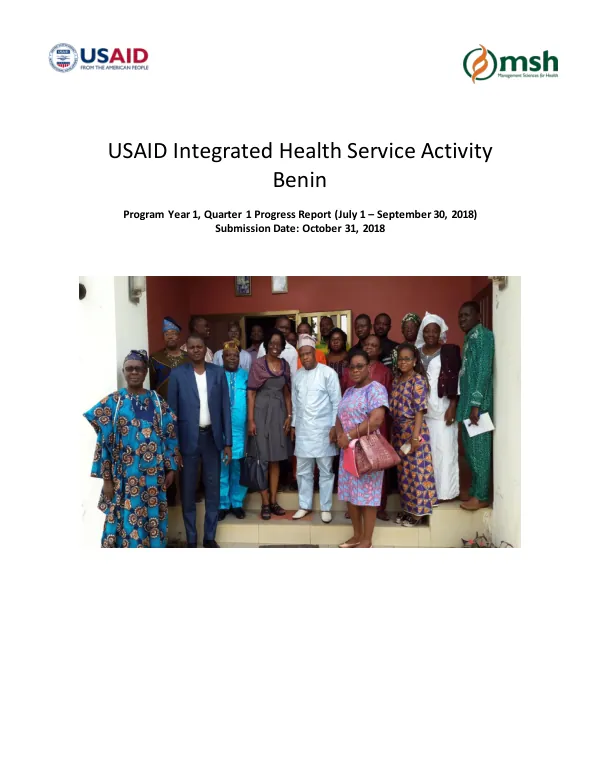
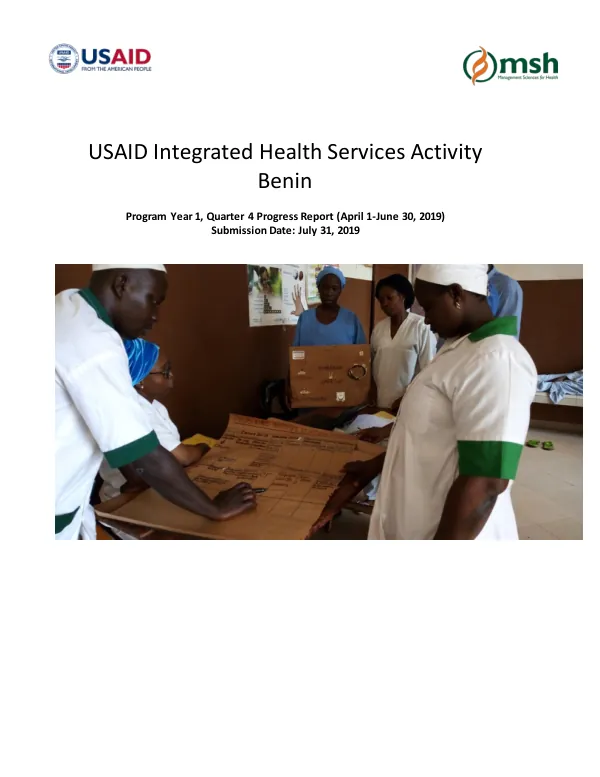
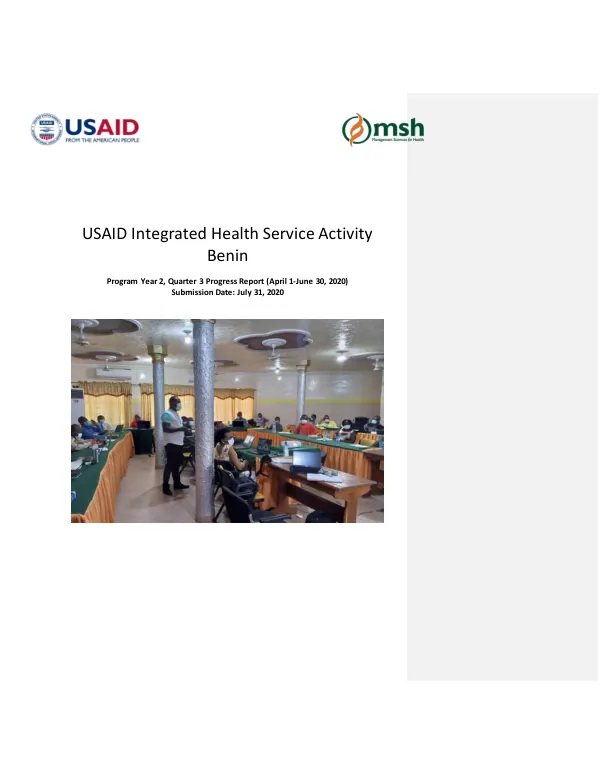
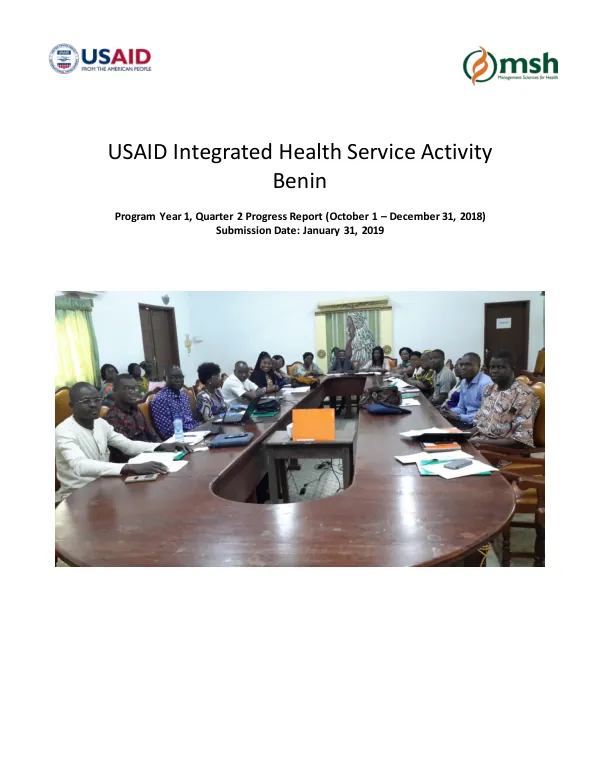
USAID Integrated Health Services Activity (IHSA) in Benin: Program Year 1, Quarter 2 Progress Report
Sign inDIMAGI, INC.
USAID Integrated Health Services Activity (IHSA) in Benin: Program Year 1, Quarter 2 Progress Report
The USAID Integrated Health Services Activity (IHSA) in Benin is a five-year program aimed at strengthening the delivery of high-impact health services in the public sector.
2019 · 25 pages
Sign in to readA free account is required to download.
Abstract
The program is implemented by Management Science for Health (MSH) in collaboration with international and local partners. IHSA's primary objective is to contribute to the reduction of maternal, newborn, child, and adolescent girls' mortality and morbidity in four departments in Benin, namely Alibori, Atacora, Ouémé, and Plateau. IHSA's guiding principles are aligned with USAID/Benin's strategic framework, focusing on strengthening health systems, improving service delivery quality, transforming gender relations, increasing demand for high-impact services, and reducing barriers to improved health and health-seeking behaviors. The program is implemented in 29 communes, 169 arrondissements, 11 health zones, and 285 public health centers, serving a population of 3,362,501 people, representing 34 percent of Benin's total population. During Project Year 1, Quarter 2, IHSA technical staff participated in regular coordination meetings with health teams and partners to discuss progress, challenges, and plan for technical activities and support. The IHSA leadership team conducted an introductory orientation for all staff to present the Activity's goals and objectives and create a shared vision for strengthening Benin's health system. Representatives from the USAID mission in Benin attended the event to meet the technical team and conduct an initial orientation on Family Planning compliance and Protecting Life in Global Health Assistance (PLGHA) compliance. IHSA conducted an Activity-wide scanning exercise from November 11-December 18, 2018, to assess the current health situation and context of each targeted health zone. The scanning exercise findings, combined with results from the IHSA baseline study, will inform future workplanning and program implementation. IHSA staff conducted a desk review to assess the quality of MCH, FP, malaria, and GBV indicators across the four departments, using data from annual health statistics and yearly health performance reviews. The team selected 21 health facilities with the weakest performance indicators to collect data through direct observation, review of available documentation, and interviews with healthcare providers, community health workers, and local officials. IHSA collaborates closely with the Benin Ministry of Health (MOH), local leaders, civil society organizations, and community-based organizations to ensure effective implementation of activities. The program's intermediate results include increased quality of high-impact services, increased uptake of high-impact health services, strengthened local leadership, management, governance, and stewardship of health services, and supported central government planning and coordination of high-impact health interventions. IHSA's implementation in the four departments is expected to contribute to the reduction of maternal, newborn, child, and adolescent girls' mortality and morbidity, with strong government and citizen engagement in the health sector. The program's success will be measured through the achievement of its intermediate results, which will be used to inform future workplanning and program implementation.