USAID
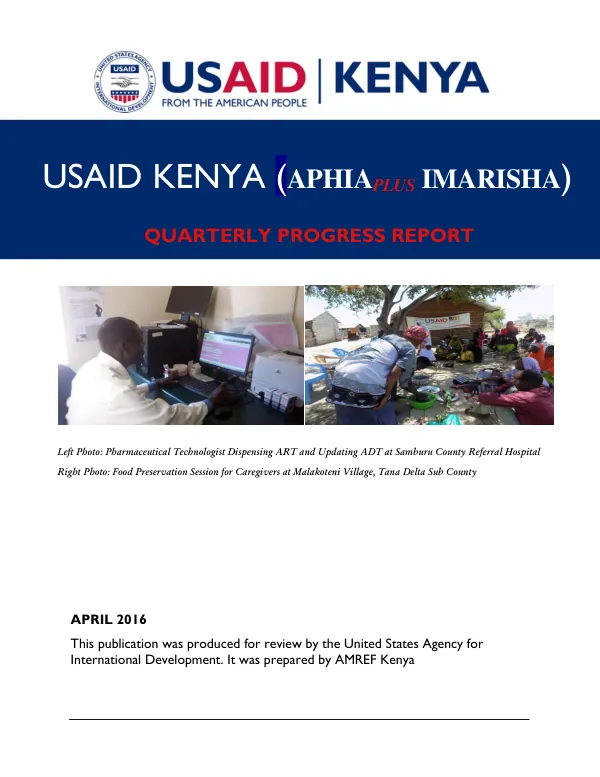
USAID/KENYA APHIAPLUS IMARISHA QUARTERLY PROGRESS REPORT FOR FY 2016
APHIAplus IMARISHA, a program funded by the United States Agency for International Development (USAID), implemented various health interventions in Kenya from January to March 2016.
2016 · 171 pages
Sign in to readA free account is required to download.
Abstract
The program focused on improving access to HIV testing and treatment, as well as providing care and support services to people living with HIV (PLHIV). Key achievements during this period included the identification and enrollment of 1,234 PLHIV into care, with 1,043 of them initiated on antiretroviral therapy (ART). The program also conducted 1,444 HIV testing services (HTS) across eight counties, with a testing rate of 85%. The number of PLHIV on care versus those on highly active antiretroviral therapy (HAART) increased, with 1,043 PLHIV initiated on HAART. The program implemented various interventions to improve maternal and neonatal health, including the provision of antenatal care and delivery services. A total of 1,111 pregnant women received antenatal care, and 1,044 deliveries were conducted by skilled birth attendants. The program also implemented interventions to improve child health, including the administration of vitamin A supplementation and immunization services. A total of 1,444 children were immunized, and 1,044 children received vitamin A supplementation. In addition to health interventions, the program implemented economic strengthening activities to support vulnerable populations, including orphans and vulnerable children (OVC). A total of 1,234 OVC caregivers received economic strengthening support, including livestock trade and viable economic strengthening activities. The program also implemented water, sanitation, and hygiene (WASH) interventions, including the development of WASH hardware and the promotion of open defecation-free (ODF) villages. A total of 15 villages were declared ODF, and 1,044 households received WASH hardware. The program collaborated with other USAID programs and government agencies to leverage resources and expertise. The program also implemented a gender strategy to address the needs of women and girls, including the provision of reproductive health services and the promotion of women's empowerment. The program's performance monitoring system tracked progress against key indicators, including HIV testing rates, ART initiation rates, and maternal and child health outcomes. Overall, APHIAplus IMARISHA made significant progress in improving access to health services and supporting vulnerable populations in Kenya during the first quarter of 2016. The program's interventions had a positive impact on HIV testing and treatment rates, maternal and child health outcomes, and economic strengthening activities.
Related documents