USAID DEC
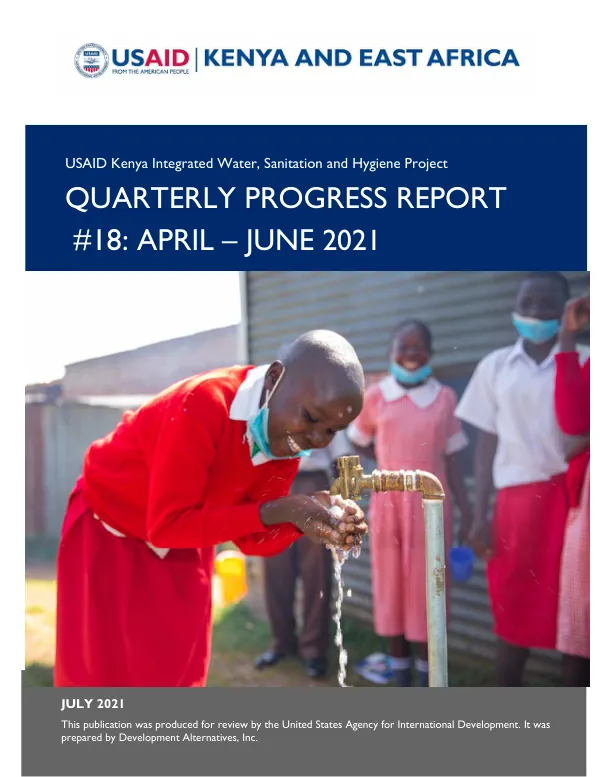
USAID/Kenya Integrated Water, Sanitation and Hygiene Project Quarterly Progress Report for Q2 FY 2021
Sign inDEVELOPMENT ALTERNATIVES, INC./FINNET
USAID/Kenya Integrated Water, Sanitation and Hygiene Project Quarterly Progress Report for Q2 FY 2021
The Kenya Integrated Water, Sanitation, and Hygiene Project (KIWASH) is a one-year response and recovery program implemented from October 2020 to September 2021 to address the COVID-19 pandemic.
2021 · 83 pages
Sign in to readA free account is required to download.
Abstract
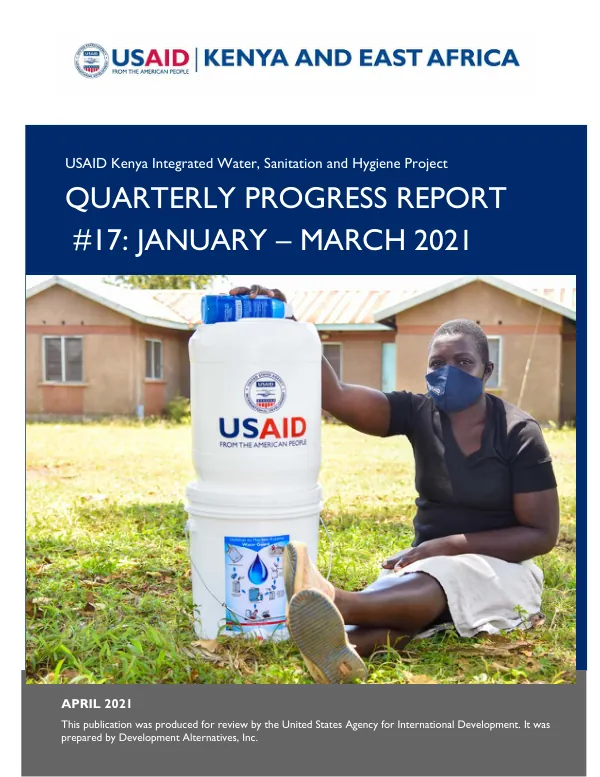
The project focuses on improving access to water, sanitation, and hygiene services (WASH) for 140,000 Kenyan citizens while reducing the spread of COVID-19. During the reporting period, KIWASH collaborated with nine partner county governments to scale up activities aimed at fast-tracking access to WASH services. KIWASH, in collaboration with USAID's Resilience Learning Activity (RLA), developed and disseminated a case study and policy brief on WASH governance in Makueni and Kitui counties. The documents provide salient successes, opportunities, and policy recommendations for county governments and WASH stakeholders. The policy recommendations aim to create formalized associations to govern and strengthen the capacity of rural water enterprises, promote government and donor funding for the expansion and improvement of WASH enterprises, and domesticate national water policies and standards in each county. In Kitui County, KIWASH hosted the first South-Eastern Kenya (SEK) Coordination Mechanism Meeting, where KIWASH was selected as the lead partner for all USAID activities in the county. The SEK mechanism aims to strengthen collaboration using data, evidence, and collaborative efforts for maximum return in Makueni, Kitui, and Taita Taveta counties. This is central to the USAID co-creation strategy, which calls for a new way of working with county governments, private sectors, and communities through integrated work planning, implementation, and reporting. KIWASH also rolled out the UKENYA campaign in nine counties, which is a Social Behavior Change (SBC) campaign jointly developed by KIWASH and county health, water, and education departments. The campaign aims to entrench national hygiene values that are sustainable, simple, and endearing to trigger behavior change at the household, institutional, and policy levels. The campaign features five pillars: hygiene, sanitation, water, COVID-19 response, and inclusion. Seven Water Service Providers (WSPs) developed business continuity plans (BCPs) to promote the continuity of essential water supply functions within the WSPs. The WSPs conducted a thorough analysis of the impact of COVID-19 on essential functions and formulated co-ordinated responses to ensure the continuity of water supply services. During the reporting period, KIWASH distributed hygiene kits to 3,985 vulnerable people in nine project counties. The kits were issued at Kapiyo Health Centre in Siaya County, as seen in the cover photo. This distribution is part of KIWASH's efforts to improve access to WASH services and reduce the spread of COVID-19 in the country. KIWASH's activities are focused on improving access to WASH services, promoting sustainable WASH sector programming, and strengthening the capacity of rural water enterprises. The project's impact will be measured through the implementation of key performance indicators (KPIs) and the achievement of project objectives.