TETRA TECH
USAID LAND FOR PROSPERITY ACTIVITY: YEAR 1 COMMUNICATIONS AND OUTREACH PLAN
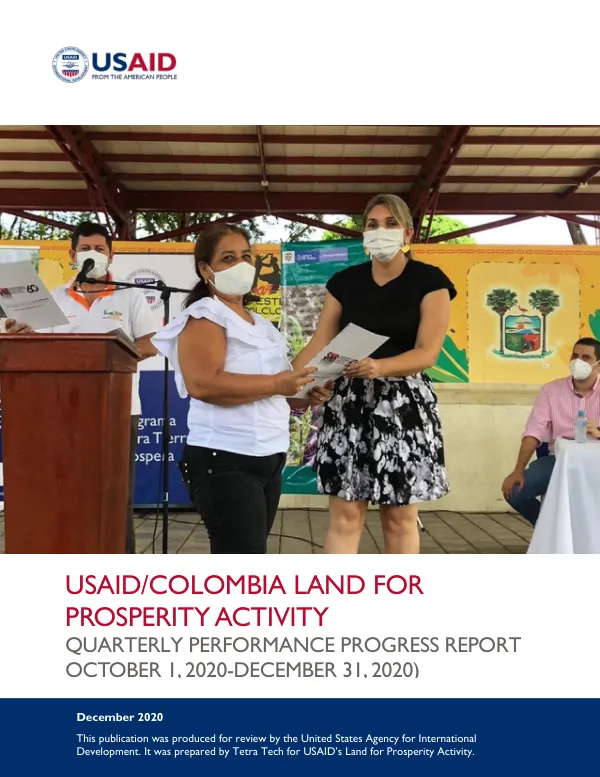
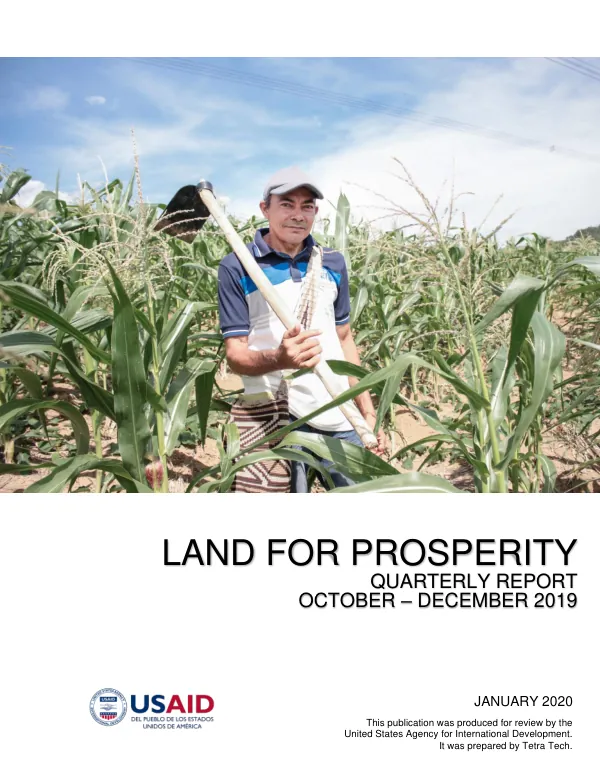
The Land for Prosperity Activity is a USAID-funded program aimed at providing conflict-affected rural households in Colombia with formal land tenure and property rights.
2019 · 16 pages
Sign in to readA free account is required to download.
Abstract
This objective will be achieved through a series of interrelated activities under three components: Component 1, which advances massive land titling in rural areas and continues land restitution support; Component 2, which strengthens local capacity to maintain formalized land transactions; and Component 3, which strengthens land governance and economic development through strategic public-private partnerships. A comprehensive learning, knowledge management, and communication strategy will support the project to achieve its goals. This strategy will articulate how strategic communications will bolster project activities in pursuit of the expected project results. The project will leverage the communications foundation and networks built under the USAID Land and Rural Development Program, using diverse communications approaches, a range of communications materials, and "wrap" project activities in communication packages that support activity goals. The project will articulate how LFP support to land policy at the national and regional levels is linked to improved small farmer economies in target regions. As a cross-cutting programmatic function, communications will also support the operationalization of the Land for Prosperity Activity's Guiding Principles and Policies, including Gender, Ethnic Minorities, and Youth Integration, Environmental Considerations, Coordination, High-level Dialogues, Transition of Knowledge, Skills, and Abilities, Citizen Security, and Evidence-Based Policy. The project will use communications to disseminate information, research, and data related to the environmental implications of land formalization and development to key stakeholders, including implementers, project partners, and the Government of Colombia. Through policy and advocacy communication efforts, the project will advocate for environmental stewardship and the uptake of best practices and mitigation measures related to land formalization, development, and resettlement issues. The Land for Prosperity Activity will coordinate high-level dialogues with the Government of Colombia, using these meetings and events as a strategic opportunity to tell the project's story, demonstrate successes and "proof of concept" for land formalization activities, advocate for legal and administrative reform, and motivate gender, ethnic, and youth integration in policy and program design, implementation, monitoring, and evaluation, and reporting. The project will disseminate tangible "how-to" guidance, manuals, and trainings, as well as case studies, international best practices, and lessons learned with communities, local organizations, academia, and implementing partners, transferring skills that will ensure the sustainability of land formalization efforts and build local capacity to sustainably implement interventions with direct funds from USAID. The Land for Prosperity Activity will use communication to clarify and increase citizen understanding of their land rights under the law, how to access land formalization activities, and the benefits of land formalization. Working closely with an experienced social and behavior change implementing partner, the project will use communication to change knowledge, attitudes, and behaviors related to land tenure, increase the number of title holders, and reduce risks of displacement and dispossession, and increasing land investments and productivity, thereby improving livelihoods. The project will use communication to support the uptake of evidence-based policies by producing materials that present concrete evidence of the relationship between improved administrative, policy, and legal reforms and reduced time and costs, mitigated risks, and improved participation and inclusion of vulnerable groups in land transactions. The Land for Prosperity Activity's communication efforts will effectively engage target audiences at the community, regional, and national levels to build stakeholder buy-in, commitment, and forward progress on land formalization, land restitution, sustainable land management, and economic development in rural areas. The project will implement a series of sensitive activities in a politically charged environment, taking into account the politicized nature of land issues in Colombia. The project will disseminate succinct, factual, non-polarizing information that describes how massive formalization works and the benefits, addressing gaps in knowledge of key stakeholders and generating the multi-level attitude and behavioral shifts needed to push massive land formalization.