CHEMONICS
USAID LISHE MTAMBUKA (CROSSCUTTING NUTRITION) PROJECT | KNOWLEDGE AND LEARNING PLAN
The USAID Lishe Mtambuka (Crosscutting Nutrition) Project is a five-year, $39.9 million project that aims to improve the nutritional status of women of reproductive age and children under five in Tanzania through a multi-sectoral approach.
2023 · 19 pages
Sign in to readA free account is required to download.
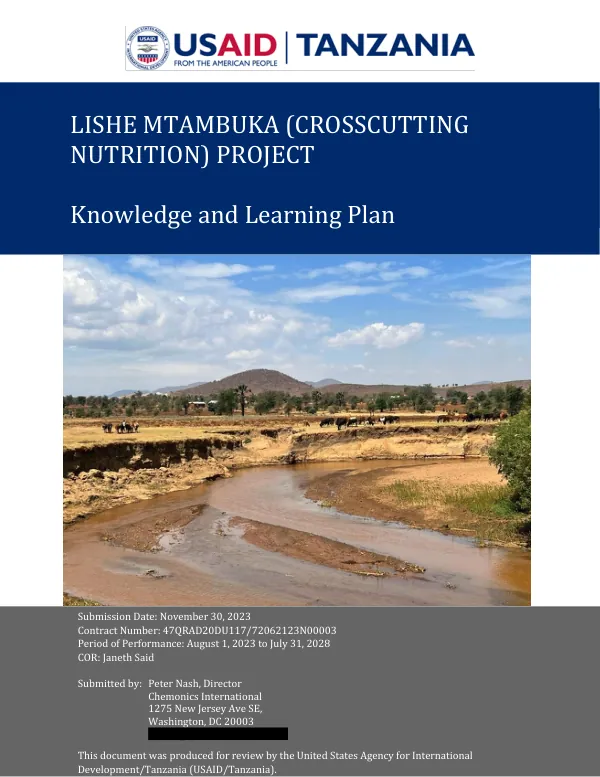
Abstract
The project is part of the U.S. Government's Global Food Security Strategy 2022-2026, which promotes global food security, resilience, and nutrition, and the USAID global health initiative to prevent maternal and child deaths. The project's purpose is to strengthen health and food market systems that promote the adoption of optimal nutrition-related behaviors across various stakeholders in targeted areas. This purpose will be achieved through four intermediate results: improving coverage of quality nutrition services at health facilities and community levels, enhancing water, sanitation, and hygiene services in communities, increasing consumption of safe and nutritious foods, and increasing capacity of councils to utilize data, plan, and deliver quality nutrition services. The project's theory of change is based on the assumption that if coverage of quality nutrition services is improved, water and sanitation services and hygiene behaviors are enhanced, consumption of safe foods is increased, and capacity of councils is strengthened, then the health and food market systems will effectively enable optimal nutrition-related behaviors, leading to improved nutritional status of children and women. The project's implementation approach is multi-sectoral, focusing on health, agriculture, and water, sanitation, and sanitation (WASH) sectors. The project's knowledge and learning plan is embedded in the Monitoring, Evaluation, and Learning (MEL) framework, aiming to ensure that staff and stakeholders have the right information to make informed decisions. The plan focuses on creating systems, tools, and channels to identify, create, and share knowledge throughout the project lifecycle. The project will generate, curate, organize, share, and use knowledge to drive results and add value to the operational context. The key objectives of the knowledge and learning plan are to identify and gather knowledge relevant to the project's scope, ensure that knowledge is accessible and decodable by intended users, promote structures that strengthen sharing and utilization of knowledge, and contribute to expanding sectoral knowledge. The project will collaborate with local government authorities and implementing partners to share knowledge, share knowledge products and datasets, and engage in joint monitoring and learning visits. The project will also utilize online platforms, including USAID's Development Experience Clearinghouse (DEC) and DevResults, to share knowledge and facilitate collaboration. The project's learning approach recognizes the importance of creating structures and spaces for staff and partners to engage with, process, and take action on data outside of performance indicators. The project will also upload all required data and datasets to USAID's DDL and DEC. The project's knowledge management system will be managed through a cloud-based repository, initially using Google Drive, and will be developed further in coordination with USAID. The project will also utilize SharePoint Libraries for project staff and DevResults for indicator tracking and progress tracking.
![Measurement Approaches for Effective Coverage Estimation [MR31]](https://covers.devme.ai/gen/138167.webp)