USAID DEC
USAID LuzonHealth Project: Improving Demand for and Supply of Family Planning and Maternal, Neonatal, Child Health and Nutrition (FP/MNCHN) Services in Taguig City
Sign inRTI INTERNATIONAL
USAID LuzonHealth Project: Improving Demand for and Supply of Family Planning and Maternal, Neonatal, Child Health and Nutrition (FP/MNCHN) Services in Taguig City
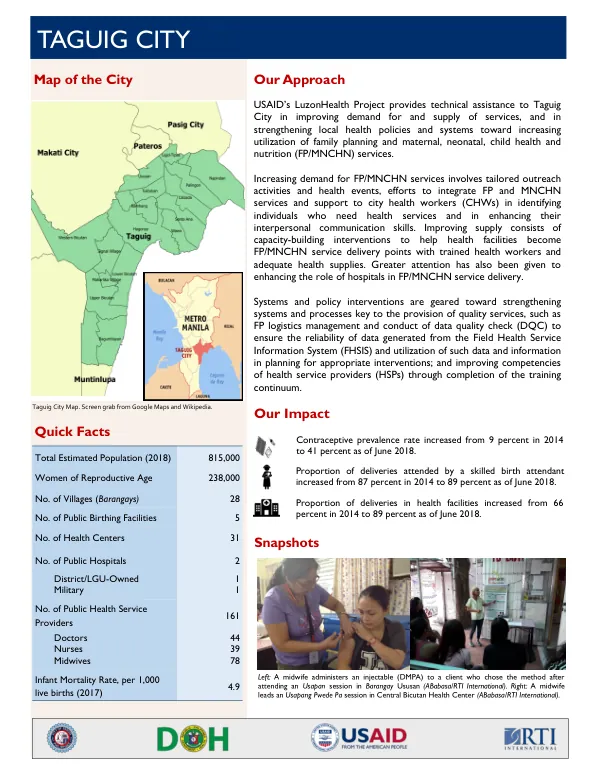
The USAID LuzonHealth Project provides technical assistance to Taguig City in improving demand for and supply of family planning and maternal, neonatal, child health and nutrition (FP/MNCHN) services.
2018 · 2 pages
Sign in to readA free account is required to download.
Abstract
The project aims to increase utilization of FP/MNCHN services by strengthening local health policies and systems. Increasing demand for FP/MNCHN services involves tailored outreach activities and health events, efforts to integrate FP and MNCHN services, and support to city health workers (CHWs) in identifying individuals who need health services and enhancing their interpersonal communication skills. Improving supply consists of capacity-building interventions to help health facilities become FP/MNCHN service delivery points with trained health workers and adequate health supplies. Systems and policy interventions are geared toward strengthening systems and processes key to the provision of quality services, such as FP logistics management and data quality check (DQC) to ensure the reliability of data generated from the Field Health Service Information System (FHSIS). The project also aims to improve competencies of health service providers (HSPs) through completion of the training continuum. The project has achieved significant results, including a 32% increase in contraceptive prevalence rate from 9% in 2014 to 41% as of June 2018. The proportion of deliveries attended by a skilled birth attendant increased from 87% in 2014 to 89% as of June 2018, and the proportion of deliveries in health facilities increased from 66% in 2014 to 89% as of June 2018. The project's flagship technical intervention program is the revitalization of FP services in the Taguig-Pateros District Hospital (TPDH). The project has assisted the TPDH in strengthening its FP program, including the formulation of a Hospital Order outlining guidelines for organizing the FP core team, financing mechanisms for FP service provision, and recording and reporting of FP accomplishments. The project has also supported the TPDH's efforts in developing staff competencies, including training and certification of health service providers in IUD insertion, postpartum and interval IUD insertion, and bilateral tubal ligation by minilaparotomy under local anesthesia (BTL-MLLA). The hospital has set up a dedicated FP area in the Out-Patient Department where counseling and selected procedures are conducted. The project's key interventions and activities include increasing demand for FP/MNCHN services through integration of FP and ANC messages during child immunization services, organizing Usapan sessions, and intensifying FP client generation in hospitals through in-reach activities. The project also strengthens supply by supporting the training of HSPs in various skills, ensuring FP commodities are available and delivered on time, and supporting the establishment of FP in targeted hospitals. The project has built the capacity of health facilities as FP service delivery points (SDPs), with 35 FP SDPs in the City, including 31 health centers, 3 private facilities, and 1 hospital. The project has also improved the training system, which encompasses training needs assessment, conduct of training, supportive supervision, and post-training evaluation (PTE). Since 2013, 17 trained HSPs in basic emergency obstetric and newborn care (BEmONC), three in IUD insertion, eight in postpartum IUD insertion, and two in BTL-MLLA have undergone a PTE, with eight (IIUD: 2, PPIUD: 3, and BTL-MLLA: 2) certified by the Department of Health and now PhilHealth-accredited.
Related documents
Documents in this collection
 2018
2018USAID DEC
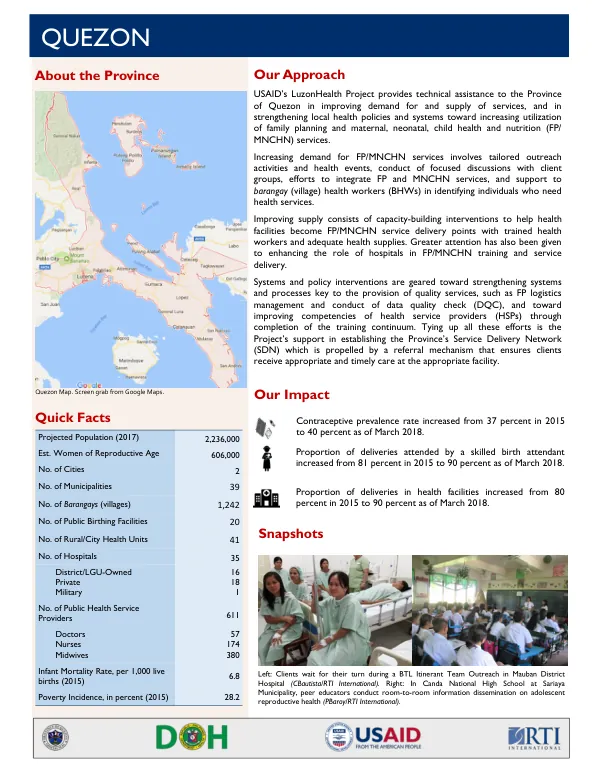
USAID’s LuzonHealth Project: Improving Demand for and Supply of Family Planning and Maternal, Neonatal, Child Health and Nutrition (FP/MNCHN) Services in the Province of Quezon
Open record 2018
2018USAID DEC