USAID DEC
USAID’s LuzonHealth Project: Strengthening Family Planning and Maternal, Neonatal, Child Health and Nutrition (FP/MNCHN) Services in Rizal Province
Sign inRTI INTERNATIONAL
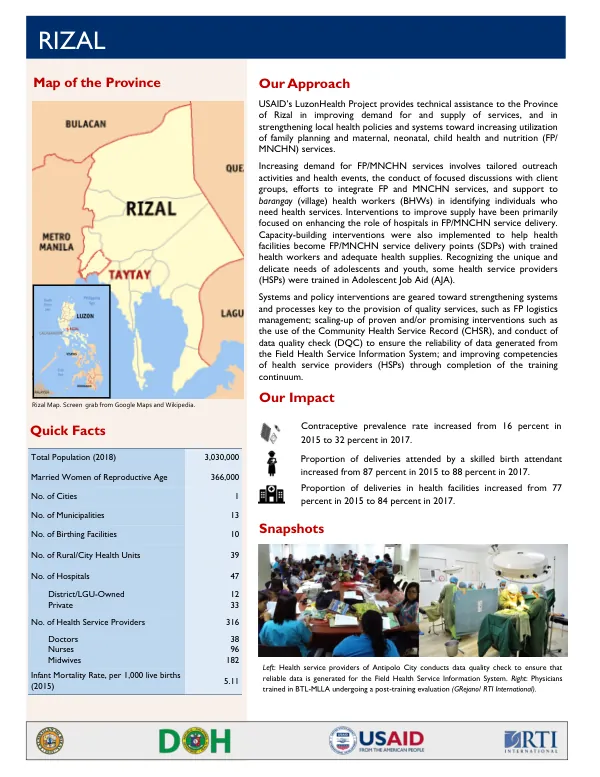
USAID’s LuzonHealth Project: Strengthening Family Planning and Maternal, Neonatal, Child Health and Nutrition (FP/MNCHN) Services in Rizal Province
The USAID's LuzonHealth Project aims to improve demand for and supply of family planning and maternal, neonatal, child health and nutrition (FP/MNCHN) services in the Province of Rizal.
2018 · 2 pages
Sign in to readA free account is required to download.
Abstract
The project provides technical assistance to strengthen local health policies and systems, increasing utilization of FP/MNCHN services. Increasing demand for FP/MNCHN services involves tailored outreach activities and health events, focused discussions with client groups, and support to barangay (village) health workers (BHWs) in identifying individuals who need health services. Interventions to improve supply have been primarily focused on enhancing the role of hospitals in FP/MNCHN service delivery. Capacity-building interventions were implemented to help health facilities become FP/MNCHN service delivery points (SDPs) with trained health workers and adequate health supplies. Systems and policy interventions are geared toward strengthening systems and processes key to the provision of quality services, such as FP logistics management, scaling-up of proven and/or promising interventions, and improving competencies of health service providers (HSPs) through completion of the training continuum. The project has also implemented data quality check (DQC) to ensure the reliability of data generated from the Field Health Service Information System. Key indicators have shown improvements in the Province of Rizal. The contraceptive prevalence rate increased from 16 percent in 2015 to 32 percent in 2017. The proportion of deliveries attended by a skilled birth attendant increased from 87 percent in 2015 to 88 percent in 2017. The proportion of deliveries in health facilities increased from 77 percent in 2015 to 84 percent in 2017. The project's primary technical intervention program in Rizal Province is the strengthening of FP services in Casimiro Ynares, Sr. Memorial Hospital and Rizal Provincial Hospital System (RPHS), composed of three constituent hospitals. The project assisted the management in formulating FP policies, particularly on organization and financing. A Hospital Order was issued to create an FP Core Team, headed by the FP Medical Coordinator, to ensure efficient and effective FP service provision in the hospital. The hospital set up a dedicated FP clinic where counseling and FP procedures are conducted. An in-reach strategy is implemented to provide FP information and services to all prospective and eligible FP clients. BTL-MLLA is now regularly offered on Tuesdays and Thursdays, while post-partum IUD insertion is offered from Monday to Friday. Twelve HSPs were trained in FP recording and reporting, while two HSPs were oriented on the different FP services that can be reimbursed under the PhilHealth program. As of June 2018, 2,205 women have become FP acceptors in the RPHS-Morong. Of these, 1,462 (66%) underwent a BTL-MLLA procedure, 124 (6%) chose pills, 212 (10%) had IUD insertion, 331 (15%) opted for an injectable, and 76 (3%) chose Progestin Subdermal Implant. The project's key interventions and activities include increasing demand for FP services through integration of FP and ANC messages in child immunization services, organizing Usapan sessions, and promoting the use of the Community Health Service Record (CHSR). Strengthening supply involves supporting the training of HSPs in various skills, ensuring FP commodities are available and delivered on time, and supporting the establishment of FP in targeted hospitals. Improving systems and policy involves strengthening systems and processes key to the provision of quality services, building the capacity of health facilities as FP SDPs, and building competencies of HSPs through improving the training system.
Related documents
Documents in this collection
 2018
2018USAID DEC
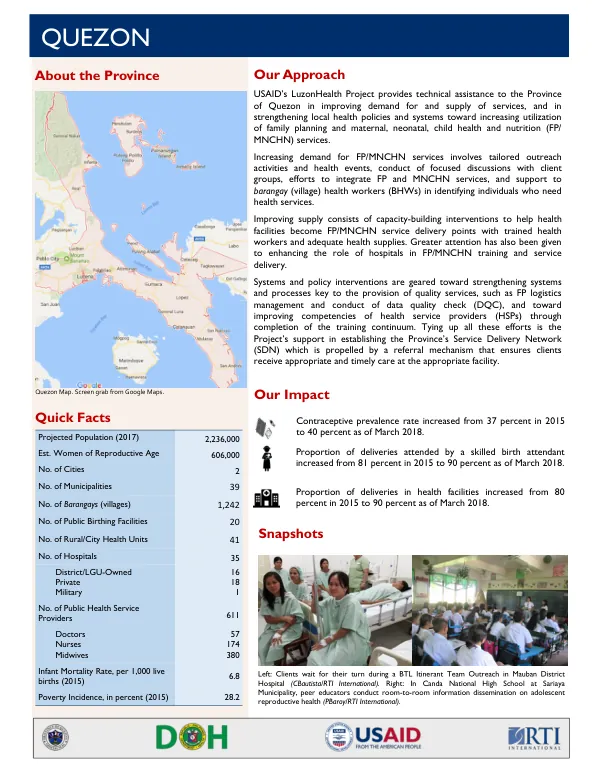
USAID’s LuzonHealth Project: Improving Demand for and Supply of Family Planning and Maternal, Neonatal, Child Health and Nutrition (FP/MNCHN) Services in the Province of Quezon
Open record 2018
2018USAID DEC