USAID DEC
USAID’s LuzonHealth Project: Improving Demand for and Supply of Family Planning and Maternal, Neonatal, Child Health and Nutrition (FP/MNCHN) Services in Malabon City
Sign inRTI INTERNATIONAL
USAID’s LuzonHealth Project: Improving Demand for and Supply of Family Planning and Maternal, Neonatal, Child Health and Nutrition (FP/MNCHN) Services in Malabon City
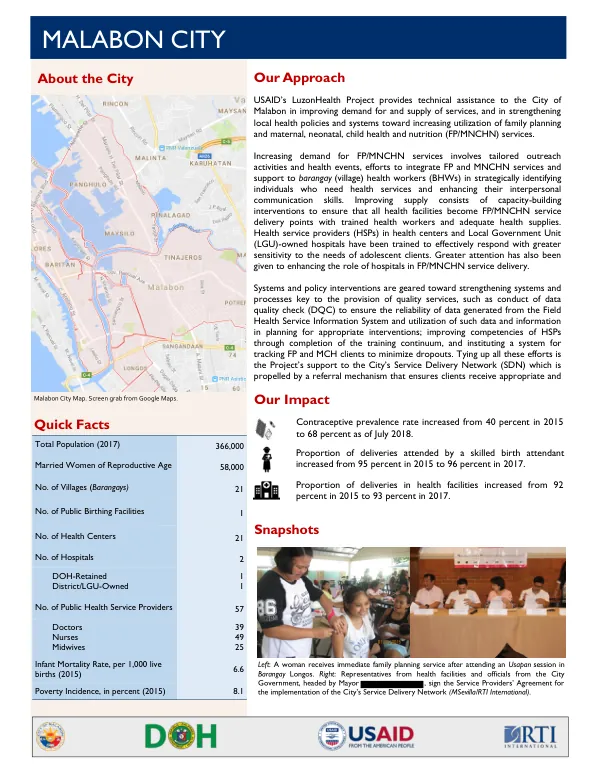
In Malabon City, the total population as of 2017 was 366,000, with 58,000 married women of reproductive age.
2018 · 2 pages
Sign in to readA free account is required to download.
Abstract
The city has 21 villages, 1 public birthing facility, 21 health centers, and 2 hospitals. The infant mortality rate in 2015 was 6.6 per 1,000 live births, and the poverty incidence was 8.1 percent. USAID's LuzonHealth Project provides technical assistance to the City of Malabon in improving demand for and supply of family planning and maternal, neonatal, child health and nutrition (FP/MNCHN) services. The project involves tailored outreach activities and health events, efforts to integrate FP and MNCHN services, and support to barangay health workers in identifying individuals who need health services and enhancing their interpersonal communication skills. Implementation of the project focused on three key interventions: increasing demand for FP/MNCHN services, improving supply of FP/MNCHN services, and strengthening systems and policy. The project trained health service providers in health centers and Local Government Unit (LGU)-owned hospitals to effectively respond to the needs of adolescent clients. The project also enhanced the role of hospitals in FP/MNCHN service delivery. The project's systems and policy interventions aimed to strengthen systems and processes key to the provision of quality services, such as conducting data quality checks and utilizing data and information in planning for appropriate interventions. The project also built the capacity of health facilities as FP service delivery points and improved the training system for health service providers. The contraceptive prevalence rate increased from 40 percent in 2015 to 68 percent as of July 2018. The proportion of deliveries attended by a skilled birth attendant increased from 95 percent in 2015 to 96 percent in 2017. The project's integrated Reaching Every Purok (REP) and enhanced Usapan strategy aimed to increase the proportion of reproductive-aged women using a family planning method from 27 percent in 2014 to 68 percent as of July 2018. The strategy involved community health teams profiling each household, giving FP/MNCHN information, and identifying target clients with unmet need. The project also trained volunteer workers in integrating FP and MNCHN services and in logistics management for efficient and effective implementation of the program. The project's key interventions and activities included integrating FP in provision of maternal and child health services, organizing Usapan sessions, supporting training of health service providers in various skills, ensuring FP commodities are available and delivered on time, and strengthening systems and processes key to the provision of quality services. The project also built the capacity of health facilities as FP service delivery points and improved the training system for health service providers.
Related documents
Documents in this collection
 2018
2018USAID DEC
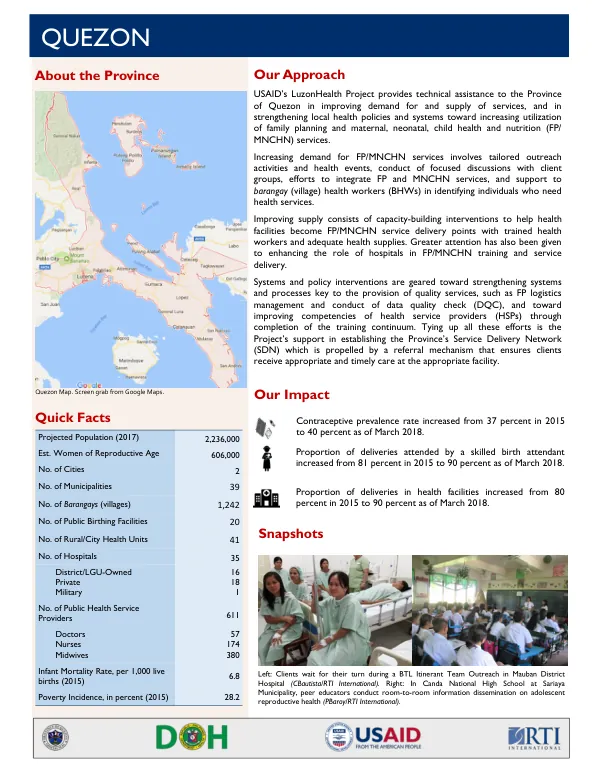
USAID’s LuzonHealth Project: Improving Demand for and Supply of Family Planning and Maternal, Neonatal, Child Health and Nutrition (FP/MNCHN) Services in the Province of Quezon
Open record 2018
2018USAID DEC