USAID DEC
USAID’s LuzonHealth Project: Improving Demand for and Supply of Family Planning and Maternal, Neonatal, Child Health and Nutrition (FP/MNCHN) Services in the Province of Quezon
Sign inDEPARTMENT OF HEALTH
USAID’s LuzonHealth Project: Improving Demand for and Supply of Family Planning and Maternal, Neonatal, Child Health and Nutrition (FP/MNCHN) Services in the Province of Quezon
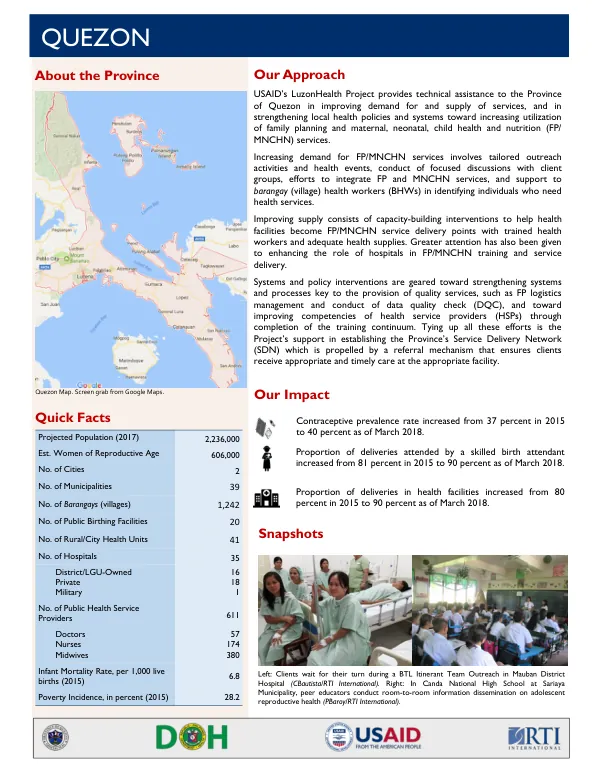
The Province of Quezon is located in the Philippines and has a population of approximately 2.2 million people, with 606,000 women of reproductive age.
2018 · 2 pages
Sign in to readA free account is required to download.
Abstract
The province is divided into 2 cities and 39 municipalities, with a total of 1,242 barangays (villages). There are 20 public birthing facilities, 41 rural and city health units, and 35 hospitals in the province, including 16 district/LGU-owned, 18 private, and 1 military hospital. The infant mortality rate in Quezon is 6.8 per 1,000 live births, and the poverty incidence is 28.2 percent. The Province of Quezon has a high demand for family planning and maternal, neonatal, child health, and nutrition (FP/MNCHN) services, which is being addressed through the USAID's LuzonHealth Project. The LuzonHealth Project provides technical assistance to the Province of Quezon to improve demand for and supply of FP/MNCHN services, and to strengthen local health policies and systems. The project's approach involves increasing demand for FP/MNCHN services through tailored outreach activities, health events, and focused discussions with client groups, as well as supporting barangay health workers in identifying individuals who need health services. The project also focuses on improving supply by capacity-building interventions to help health facilities become FP/MNCHN service delivery points with trained health workers and adequate health supplies. The project has assisted the Provincial Health Office in forming an itinerant team to provide bilateral tubal ligation (BTL) services to women in underserved areas. The team has conducted 24 itinerant medical outreach activities, enabling 356 women to undergo the BTL-MLLA procedure. The project has also supported the training of health service providers in various skills, including BTL-MLLA, family planning competency-based training, basic emergency obstetric and newborn care, and interval and post-partum IUD insertion. The project has also ensured the availability and delivery of family planning commodities on time by operationalizing a system for recording and tracking the flow of commodities. In addition, the project has supported the establishment of family planning services in public hospitals, made family planning and maternal, neonatal, child health, and nutrition services more accessible to adolescents in schools and communities, and built the capacity of health facilities as family planning service delivery points. The project has also strengthened systems and processes key to the provision of quality services, particularly health information systems, family planning logistics management, and health financing. The project has achieved several key outcomes, including an increase in contraceptive prevalence rate from 37 percent in 2015 to 40 percent as of March 2018, an increase in the proportion of deliveries attended by a skilled birth attendant from 81 percent in 2015 to 90 percent as of March 2018, and an increase in the proportion of deliveries in health facilities from 80 percent in 2015 to 90 percent as of March 2018. The project has also established a Service Delivery Network to ensure clients receive appropriate and timely care at the appropriate facility.
Related documents