USAID
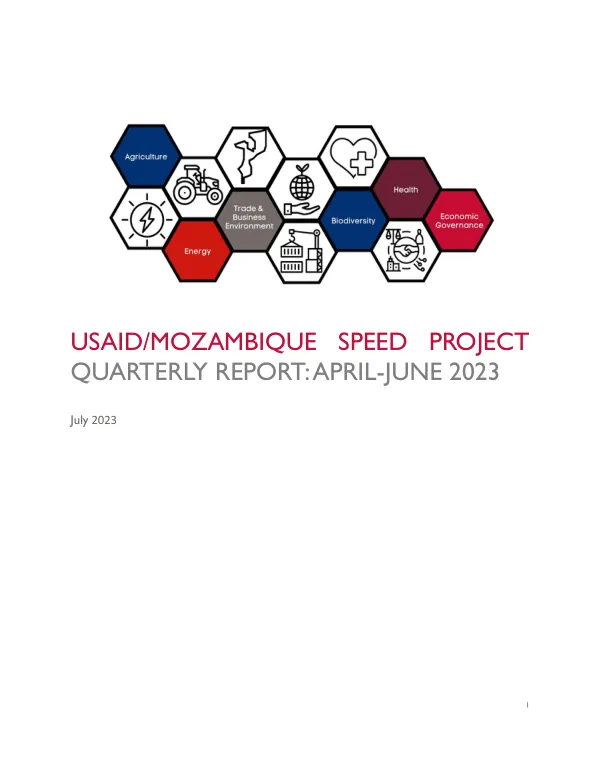
USAID/MOZAMBIQUE SPEED PROJECT QUARTERLY REPORT: APRIL-JUNE 2023
The Supporting the Policy Enabling Environment for Development (SPEED) activity is a 4.5-year project designed to improve Mozambique's business enabling environment and enhance the role of the private sector in agriculture, trade facilitation, energy, biodiversity conservation, and health.
2023 · 38 pages
Sign in to readA free account is required to download.
Abstract
The project aims to strengthen economic governance and public financial management, while enhancing the role of civil society, thereby improving the country's ability to plan, manage, and finance its own development. During the quarter from April to June 2023, SPEED implemented a suite of 22 activities to advance policy reform and implementation across all portfolios. The project issued two new grants: one to Centro de Aprendizagem e Capacitação da Sociedade Civil (CESC) that responded to the Annual Programme Statement (APS) for Public Finance Management/ Extractives/ Sovereign Wealth Fund (SFW), and another to Associação do Meio Ambiente (AMA) that responded to the Request for Applications (RFA) for Marine Biodiversity Grants. As of the end of June, SPEED grantee Gapi had issued loans under the Micro, Small and Medium-sized Enterprise (MSME) Resilience Fund. SPEED had committed 76% of the current grants fund and disbursed as of the end of the reporting period. In the Agriculture portfolio, USAID and SPEED refined a list of four priority reforms as fundamental to improving productivity and competitiveness in the agriculture sector in Year 3. The project advanced land governance activities through technical analysis of the Land Law, support to provincial consultations, and design of key dissemination messages. SPEED also advanced implementation of the suite of reforms within the Economic Acceleration Package (PAE), with particular progress on visa reform, allocation of 10% of extractive industry tax revenues to the provinces, and biofuels. In the Biodiversity portfolio, the team built relationships with the Investigative Police (SERNIC), the newest partner in the wildlife crime prosecution chain, and trained an additional 19 judges (7 women and 12 men) to adjudicate and convict wildlife criminals. The project also advanced co-management of coastal and marine areas, promoted identification and mainstreaming of coastal and marine key biodiversity areas (KBAs) in Mozambique, and improved access to information on coral reef ecosystems in Mozambique. In Economic Governance, SPEED continued to deliver reform-focused technical assistance to the Ministry of Economy and Finance (MEF) and refined four Scopes of Work (SOWs) for targeted training in 2023-2024. The project also completed the co-design of two priority SOWs with the Supreme Audit Institution (Tribunal Administrativo - TA) to build audit capacity and supported all three civil society grantees to advance budget transparency and accountability, with special reference to clarifying community benefit-sharing arrangements related to extractive revenues and advancing civil society engagement on the development of the Sovereign Wealth Fund (SWF).