USAID
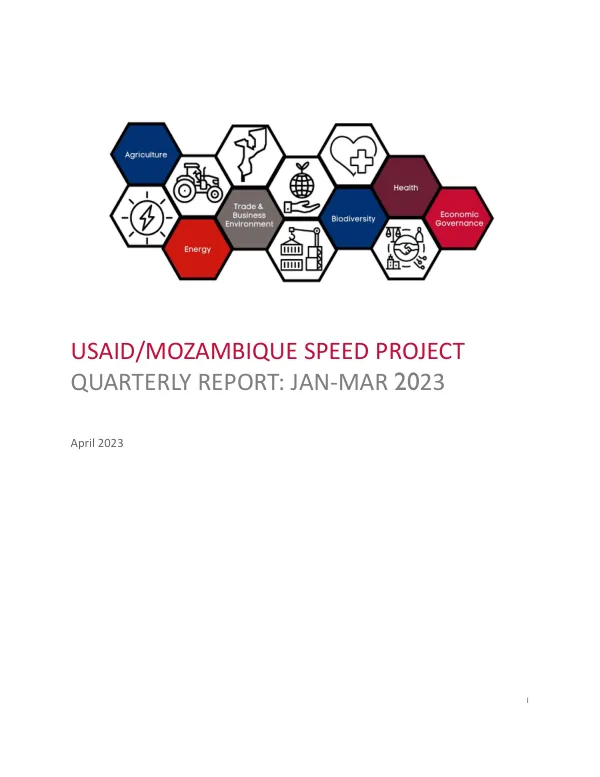
USAID/MOZAMBIQUE SPEED PROJECT Quarterly Report: Q2 FY2023
The Supporting the Policy Enabling Environment for Development (SPEED) activity is a five-year project designed to improve Mozambique's business enabling environment and enhance the role of the private sector in agriculture, trade facilitation, energy, biodiversity conservation, and health.
2023 · 34 pages
Sign in to readA free account is required to download.
Abstract
The project aims to strengthen economic governance and public financial management, while enhancing the role of civil society, thereby improving the country's ability to plan, manage, and finance its own development. During the quarter from January to March 2023, SPEED ramped up technical activities significantly through the design and implementation of grants, subcontracts, and technical assistance to advance program objectives. The contract amendment includes an increase for the grants under contract fund, enabling SPEED to initiate staffing up its technical team in line with its original management plan. SPEED issued two grants that responded to the Annual Programme Statement (APS) for Public Finance Management/Extractives/Sovereign Wealth Fund and two grants that responded to the Request for Applications (RFA) for Marine Biodiversity Grants. In the Agriculture portfolio, the Ag Policy Map was refined to highlight nine priority reforms as fundamental to improving productivity and competitiveness in the agriculture sector. SPEED and USAID agreed on further prioritizing four reforms in Q3/Q4 and FY 2024. SPEED continued to deliver reform-focused technical assistance to the Ministry of Economy and Finance (MEF) through PFM expert Nádia Hassamo and SPEED's Adviser to MEF, Fábio Scala, on implementation of the suite of reforms within the Economic Acceleration Package (PAE). In the Biodiversity portfolio, the team built relationships with new SPEED partner, the Investigative Police (SERNIC), who joined the ongoing capacity building on countering wildlife crimes (CWC). During the quarter, an additional 19 judges (12 women and 7 men) were trained with improved capacity to adjudicate and convict wildlife criminals. In Economic Governance, two of three grants were issued to civil society organizations to advance budget transparency and accountability. The project's management team has also undergone changes, with COP Kate Heuisler returning to work on February 1, 2023, and DCOP - Operations John McElwaine starting work with SPEED in January 2023. This Q2 report includes Quarterly Highlights and Technical Activities, and two Annexes: the Financial/LOE Summary and MEL report. The Agriculture portfolio has made significant progress in refining the Ag Policy Map to highlight nine priority reforms. These reforms aim to improve productivity and competitiveness in the agriculture sector. SPEED and USAID have agreed to further prioritize four of these reforms in Q3/Q4 and FY 2024. The project has also continued to deliver reform-focused technical assistance to MEF through PFM expert Nádia Hassamo and SPEED's Adviser to MEF, Fábio Scala, on implementation of the suite of reforms within the Economic Acceleration Package (PAE). In the Biodiversity portfolio, the team has built relationships with new SPEED partner, the Investigative Police (SERNIC), who joined the ongoing capacity building on countering wildlife crimes (CWC). During the quarter, an additional 19 judges (12 women and 7 men) were trained with improved capacity to adjudicate and convict wildlife criminals. This training is a significant step towards strengthening the country's ability to combat wildlife crimes. In Economic Governance, two of three grants were issued to civil society organizations to advance budget transparency and accountability. This is a critical step towards strengthening the country's public financial management systems and promoting transparency and accountability in government spending. The project's management team has also undergone changes, with COP Kate Heuisler returning to work on February 1, 2023, and DCOP - Operations John McElwaine starting work with SPEED in January 2023. This change in leadership is expected to bring new energy and direction to the project, and will help to ensure its continued success in achieving its objectives. The project has made significant progress in advancing its objectives, particularly in the Agriculture and Biodiversity portfolios. The project's technical team has been strengthened, and new partnerships have been established with key stakeholders. The project's management team has also undergone changes, with new leadership bringing new energy and direction to the project. Overall, the project is on track to achieve its objectives and make a significant impact in improving Mozambique's business enabling environment and promoting economic growth and development.