USAID DEC
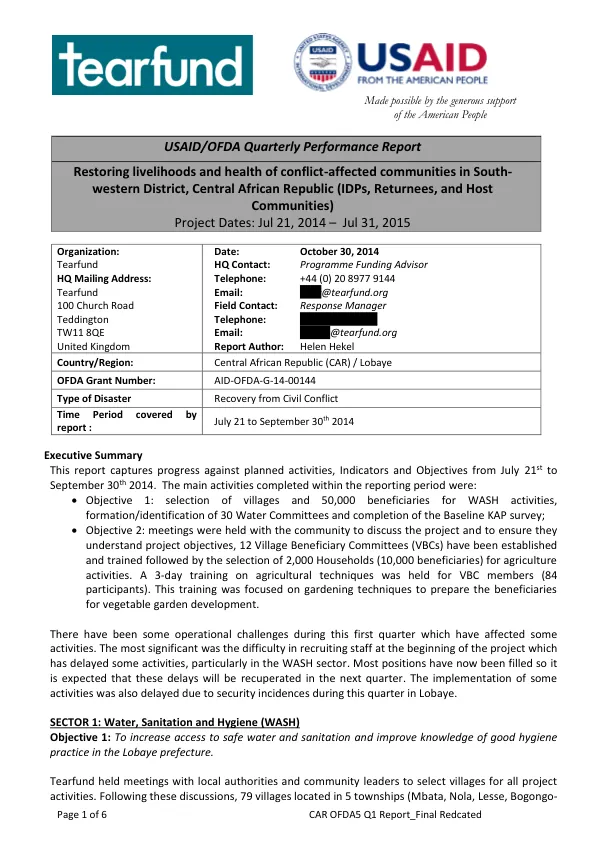
USAID/OFDA Quarterly Performance Report: Restoring livelihoods and health of conflict-affected communities in South-western District, Central African Republic (IDPs, Returnees, and Host Communities)
Sign inTEARFUND INTERNATIONAL
USAID/OFDA Quarterly Performance Report: Restoring livelihoods and health of conflict-affected communities in South-western District, Central African Republic (IDPs, Returnees, and Host Communities)
In the Central African Republic, the USAID/OFDA-funded project, implemented by Tearfund, aimed to restore livelihoods and health of conflict-affected communities in South-western District.
2014 · 6 pages
Sign in to readA free account is required to download.
Abstract
The project focused on Water, Sanitation, and Hygiene (WASH) and Agriculture and Food Security sectors. The project dates were July 21, 2014, to July 31, 2015. The WASH sector aimed to increase access to safe water and sanitation and improve knowledge of good hygiene practice in the Lobaye prefecture. Tearfund held meetings with local authorities and community leaders to select villages for project activities. A total of 79 villages located in 5 townships were selected for project activities. Tearfund carried out an initial Baseline KAP survey in selected villages, interviewing 481 households and investigating water usage and latrine coverage in 4,718 households. The Agriculture and Food Security sector targeted beneficiary households with training on agricultural techniques, including gardening techniques to prepare beneficiaries for vegetable garden development. A 3-day training on agricultural techniques was held for Village Beneficiary Committee members, with 84 participants. The project also aimed to increase access to safe water and sanitation and improve knowledge of good hygiene practice in the Lobaye prefecture. Implementation of project activities was delayed due to operational challenges, including difficulty in recruiting staff at the beginning of the project and security incidents in Lobaye. The project expected to recover from these delays in the next quarter. The project also faced challenges in implementing activities in schools due to the delay in the start of the school year. The project made progress in selecting villages and beneficiaries for WASH activities, establishing Water Committees, and conducting a Baseline KAP survey. The project also made progress in selecting beneficiaries for agriculture activities and conducting a 3-day training on agricultural techniques. However, some activities were delayed due to operational challenges and security incidents. The project's impact indicators showed that 56,438 beneficiaries were identified, with 12,203 being IDPs. The project also established 30 Water Committees, with 102 women representing 34% of committee members. The project's hygiene promotion activities included training for WASH committees, water point maintenance and repair, and hygiene promotion training for 50 promoters in 25 communities. The project's water supply infrastructure activities included rehabilitation of boreholes, protection of shallow wells, and training of pump mechanics. The project's agriculture and food security activities included training on agricultural techniques, including gardening techniques to prepare beneficiaries for vegetable garden development. The project's impact indicators showed that 0 people directly benefited from the sanitation infrastructure program, with a target of 40,000 people. The project's hygiene promotion activities showed that 0 people received direct hygiene promotion, with a target of 50,000 people.
Related documents