USAID DEC
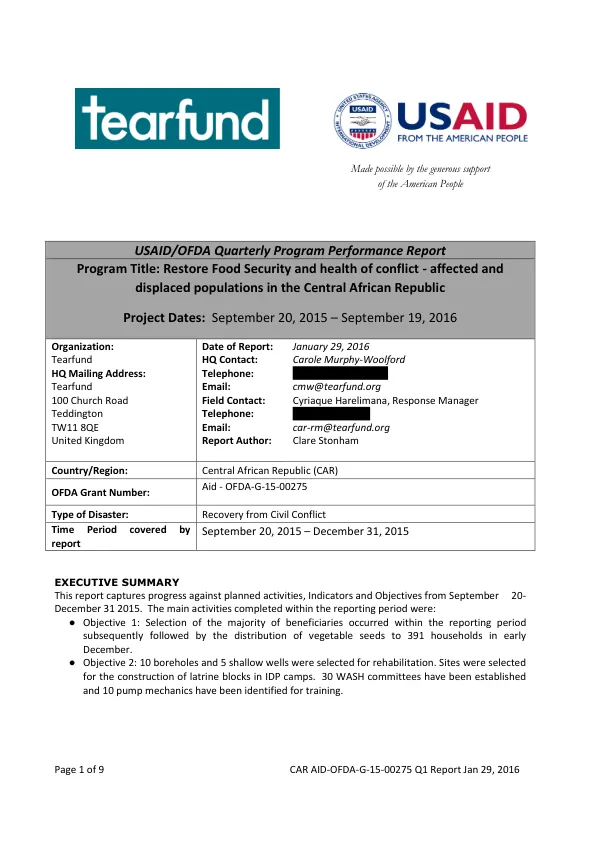
USAID/OFDA Quarterly Program Performance Report: Restore Food Security and health of conflict-affected and displaced populations in the Central African Republic
Sign inTEARFUND INTERNATIONAL
USAID/OFDA Quarterly Program Performance Report: Restore Food Security and health of conflict-affected and displaced populations in the Central African Republic
The Restore Food Security and Health of Conflict-Affected and Displaced Populations in the Central African Republic project, funded by USAID/OFDA, aims to restore food security and health among conflict-affected and displaced populations.
2016 · 9 pages
Sign in to readA free account is required to download.
Abstract
The project, implemented by Tearfund, targets 2,250 households in the Central African Republic. The project's main activities include beneficiary selection, formation of Village Beneficiary Committees (VBCs), crop and vegetable seeds distribution, and training on agricultural techniques and nutrition. Beneficiary selection was completed in the first quarter, with 11,874 individuals selected from 1,971 vulnerable households. The selection process involved community meetings, where community leaders, men, women, and young people participated in explaining the project's objectives and selecting beneficiaries. The project aims to distribute seeds to 2,000 households and livestock to 500 households, with 250 households receiving both seeds and livestock. Crop and vegetable seeds distribution began in early December, with 391 households receiving seeds in 8 farmers' groups. Additional seed distributions are planned for February 2016. The procurement of remaining vegetable seeds has been completed, and the acquisition of crop seeds and livestock is ongoing. Land preparation for vegetable planting is on track, with planting expected to commence at the beginning of quarter two and continue through the planting season. Training on agricultural techniques and nutrition was postponed due to the threat of unrest resulting from the referendum and elections. However, preparations for these trainings were at an advanced stage, and they will be completed in early January and February 2016 to ensure that the maximum number of VBCs receive the agricultural training before vegetable seed distribution. The project has made progress in improving agricultural production and food security, with 11,874 beneficiaries selected and 391 households receiving seeds. The project aims to increase the number of months of food self-sufficiency due to distributed seed systems/agricultural inputs for beneficiary households from 3.4 to 4. The project also aims to increase the number of people benefiting from seed systems/agricultural input activities, with a target of 11,250 people. In the Water, Sanitation, and Hygiene (WASH) sector, beneficiary selection has been undertaken through the mapping and selection of water supply infrastructure to rehabilitate. The project aims to restore access to potable water supply and sanitation facilities among conflict-affected communities. The project has identified 10 boreholes and 5 shallow wells for rehabilitation, and sites have been selected for the construction of latrine blocks in IDP camps.
Related documents