USAID DEC
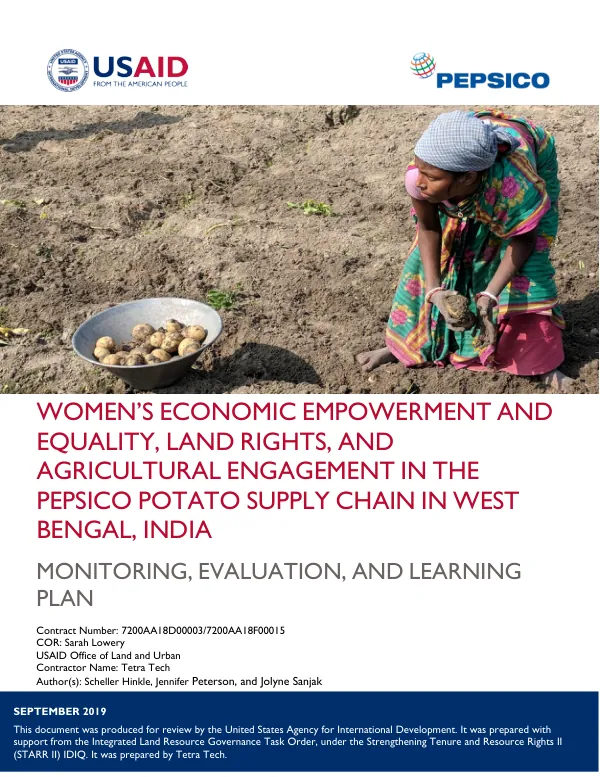
Women’s Economic Empowerment and Equality, Land Rights, and Agricultural Engagement in the PepsiCo Potato Supply Chain in West Bengal, India: Monitoring, Evaluation, and Learning Plan
Sign inLANDESA
Women’s Economic Empowerment and Equality, Land Rights, and Agricultural Engagement in the PepsiCo Potato Supply Chain in West Bengal, India: Monitoring, Evaluation, and Learning Plan
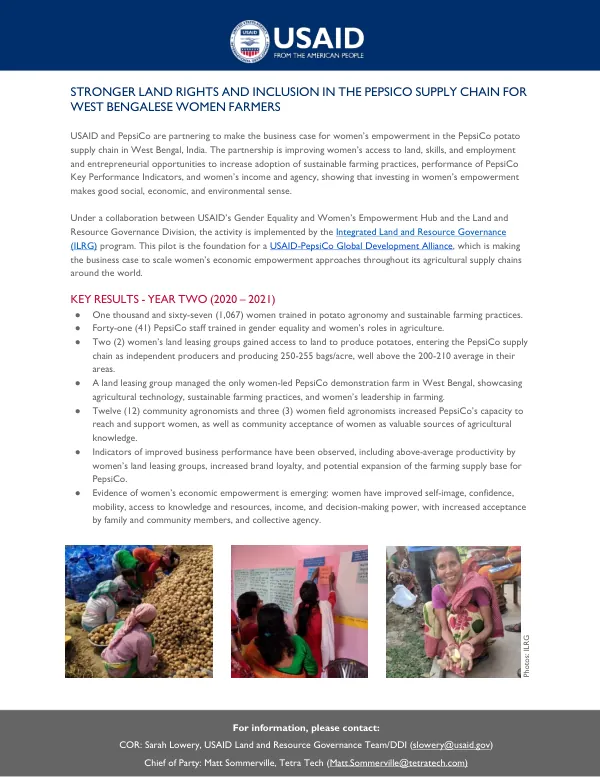
The agricultural development initiative in West Bengal, India, aims to promote women's economic empowerment and equality in the PepsiCo potato supply chain.
2019 · 69 pages
Sign in to readA free account is required to download.
Abstract
The project focuses on three critical and interrelated approaches to reach, benefit, and empower women in the supply chain. These approaches include farm-level outcomes, strengthening PepsiCo's gender knowledge and capacity, and developing plans for scaling and sustainability. Farm-level outcomes involve providing gender-sensitive training activities to men and women in potato-producing families, ensuring access to productive resources, and facilitating land leasing schemes. The project also aims to support women's empowerment in communities through norms change approaches and broad community engagement. Strengthening PepsiCo's gender knowledge and capacity involves integrating gender into staff workstreams and promoting a culture of inclusivity. This approach aims to increase the adoption of sustainable farming practices and improve PepsiCo's business model in India. The project also focuses on developing plans for scaling and sustainability, leveraging government, non-governmental organizations, and private sector partnerships. This approach aims to demonstrate the benefits of women's empowerment in the PepsiCo supply chain and promote a culture of inclusivity. The monitoring, evaluation, and learning (MEL) plan is designed to track progress and identify areas for improvement. The plan includes performance indicators, data collection forms, and a framework for evaluating the effectiveness of the project. The MEL plan also includes a "Reach, Benefit, and Empower" framework, which aims to test the hypothesis that empowering women will result in improved performance within the PepsiCo supply chain in West Bengal, India. The project's overall purpose is to make the business case for women's empowerment within the PepsiCo supply chain. The project aims to increase the adoption of sustainable farming practices, improve PepsiCo's key performance indicators, and strengthen the company's business model in India. The project's geographic focus is on West Bengal, India, where PepsiCo operates a potato supply chain. The project's timeframes are not specified, but it is expected to run for several years. The project's recommendations include scaling up tools and scaling up tools and activities, leveraging government, non-governmental organizations, and private sector partnerships, and promoting a culture of inclusivity. The project's key findings and conclusions include: * Women's economic empowerment and equality are critical to improving the adoption of sustainable farming practices and PepsiCo's key performance indicators. * The project's approaches to reach, benefit, and empower women in the supply chain are effective in promoting women's empowerment and improving the adoption of sustainable farming practices. * The project's MEL plan is designed to track progress and identify areas for improvement. * The project's recommendations include scaling up tools and scaling up tools and activities, leveraging government, non-governmental organizations, and private sector partnerships, and promoting a culture of inclusivity. The project's implementation involves several stakeholders, including USAID, PepsiCo, Tetra Tech, and Land. The project's budget and resources are not specified, but it is expected to be funded by USAID and PepsiCo. The project's timeline and milestones are not specified, but it is expected to run for several years.
Related documents
Documents in this collection
 2021
2021USAID DEC
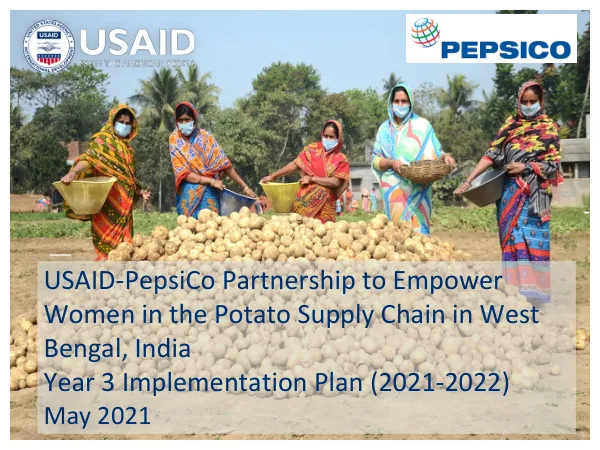
USAID-PepsiCo Partnership to Empower Women in the Potato Supply Chain in West Bengal, India Year 3 Implementation Plan (2021-2022)
Open record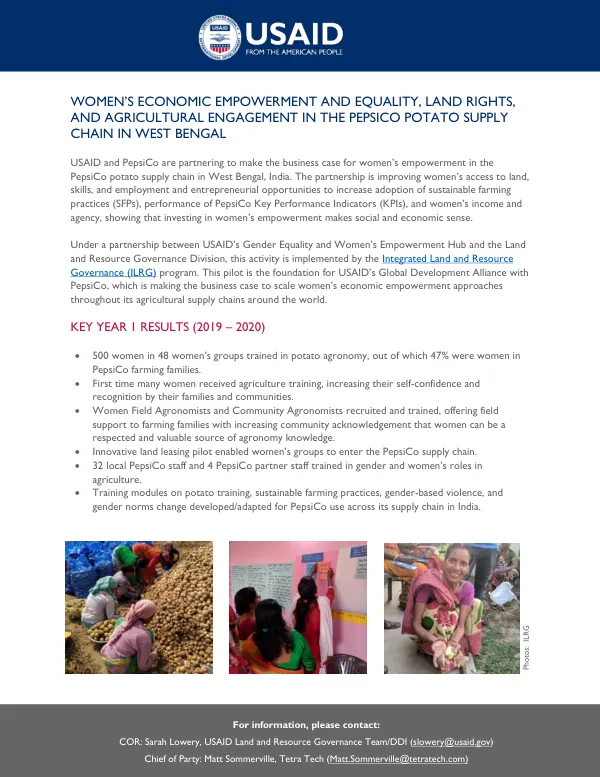 2021
2021USAID DEC