USAID DEC
USAID Policy Regulatory Support for Economic Growth Project: It Pays to Protect the Environment
Sign inUSAID
USAID Policy Regulatory Support for Economic Growth Project: It Pays to Protect the Environment
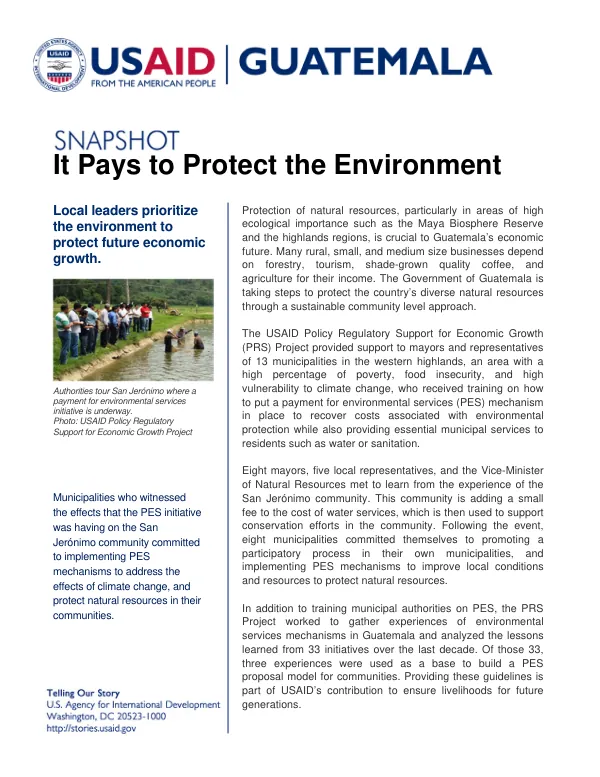
The payment for environmental services initiative in San Jerónimo is a community-led effort to protect natural resources and promote sustainable economic growth.
2015 · 1 pages
Sign in to readA free account is required to download.
Abstract
Local leaders prioritize environmental protection to safeguard the future economic well-being of their communities. Municipalities that have witnessed the positive impacts of the PES initiative in San Jerónimo have committed to implementing similar mechanisms to address the effects of climate change and protect natural resources in their areas. Protection of natural resources, particularly in regions of high ecological importance such as the Maya Biosphere Reserve and the highlands, is crucial to Guatemala's economic future. Many rural, small, and medium-sized businesses in the country depend on forestry, tourism, shade-grown quality coffee, and agriculture for their income. The Government of Guatemala is taking steps to safeguard the country's diverse natural resources through a sustainable community-level approach. This approach involves implementing payment for environmental services mechanisms to recover costs associated with environmental protection while providing essential municipal services to residents. The USAID Policy Regulatory Support for Economic Growth Project provided training to mayors and representatives of 13 municipalities in the western highlands on how to establish payment for environmental services mechanisms. This region is characterized by high levels of poverty, food insecurity, and vulnerability to climate change. The training aimed to equip local authorities with the knowledge and skills necessary to implement PES mechanisms that would support conservation efforts and provide essential municipal services to residents. Following the training, eight municipalities committed to promoting a participatory process in their own municipalities and implementing PES mechanisms to improve local conditions and resources. The PRS Project also worked to gather experiences of environmental services mechanisms in Guatemala and analyzed the lessons learned from 33 initiatives over the last decade. Three of these experiences were used as a base to develop a PES proposal model for communities. This model provides guidelines for implementing PES mechanisms and is part of USAID's contribution to ensuring livelihoods for future generations. The PES initiative in San Jerónimo serves as a model for other municipalities in Guatemala. By adding a small fee to the cost of water services, the community is able to support conservation efforts and promote sustainable economic growth. The success of this initiative has inspired other municipalities to adopt similar approaches, highlighting the potential of PES mechanisms to address the effects of climate change and protect natural resources in Guatemala.