USAID DEC
USAID Public Policy Program, Achieving the Goal for Rural Development: The Transformation of the INCODER
Sign inUSAID
USAID Public Policy Program, Achieving the Goal for Rural Development: The Transformation of the INCODER
The Colombian Rural Development Institute (INCODER) plays a key role in the success of the agrarian reform and rural development policy undertaken by the Government of Colombia.
2013 · 2 pages
Sign in to readA free account is required to download.
Abstract
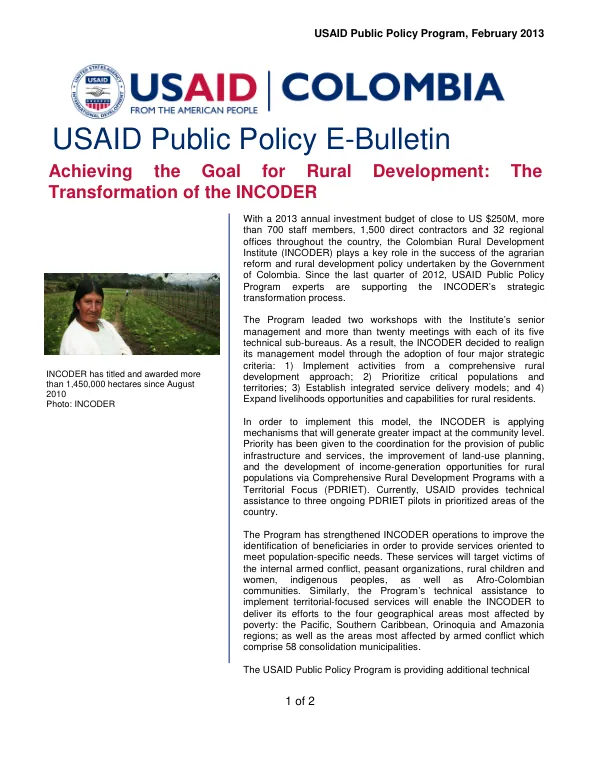
With a 2013 annual investment budget of close to US $250M, more than 700 staff members, 1,500 direct contractors, and 32 regional offices throughout the country, INCODER is responsible for implementing activities from a comprehensive rural development approach. The INCODER has adopted four major strategic criteria to realign its management model: implementing activities from a comprehensive rural development approach, prioritizing critical populations and territories, establishing integrated service delivery models, and expanding livelihoods opportunities and capabilities for rural residents. To implement this model, INCODER is applying mechanisms that will generate greater impact at the community level, including the coordination for the provision of public infrastructure and services, the improvement of land-use planning, and the development of income-generation opportunities for rural populations via Comprehensive Rural Development Programs with a Territorial Focus (PDRIET). The USAID Public Policy Program is providing technical assistance to INCODER in several areas, including effectively awarding land titles throughout priority areas and populations, regulating and transferring irrigation districts, providing comprehensive assistance for productive projects in accordance with territorial characteristics, and awarding titles for historically recognized ethnic territories. Additionally, INCODER has redefined its goals, including strengthened social organizations, access to markets and information, proper water management, rural job-generating chains, and sustainable rural territories. The INCODER has identified priority areas for its services, including the Pacific, Southern Caribbean, Orinoquia, and Amazonia regions, as well as areas most affected by armed conflict, which comprise 58 consolidation municipalities. The Program has strengthened INCODER operations to improve the identification of beneficiaries in order to provide services oriented to meet population-specific needs, targeting victims of the internal armed conflict, peasant organizations, rural children and women, indigenous peoples, and Afro-Colombian communities. The USAID Public Policy Program is also supporting a workshop on "The Media and Transitional Justice in Colombia" to be held on February 16 and 17, 2013, at the Instituto de Ciencia Política Hernán Echavarría Olózaga (ICP). The workshop aims to sensitize participants to the importance of the Victims' Law and the concrete problems and challenges that Colombian society will face in relation to the transitional justice system. The workshop will feature six segments on sub-topics including general aspects of transitional justice in Colombia, transitional justice from the ground up, truth, memory, and forgiveness, the economic and institutional impact of the implementation of transitional justice mechanisms, and communication measures and victims of the armed conflict.