USAID DEC
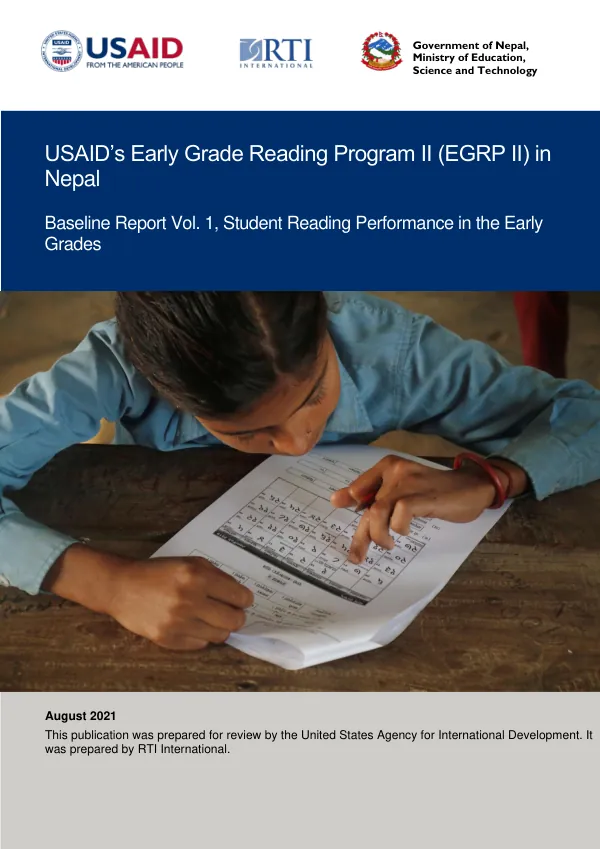
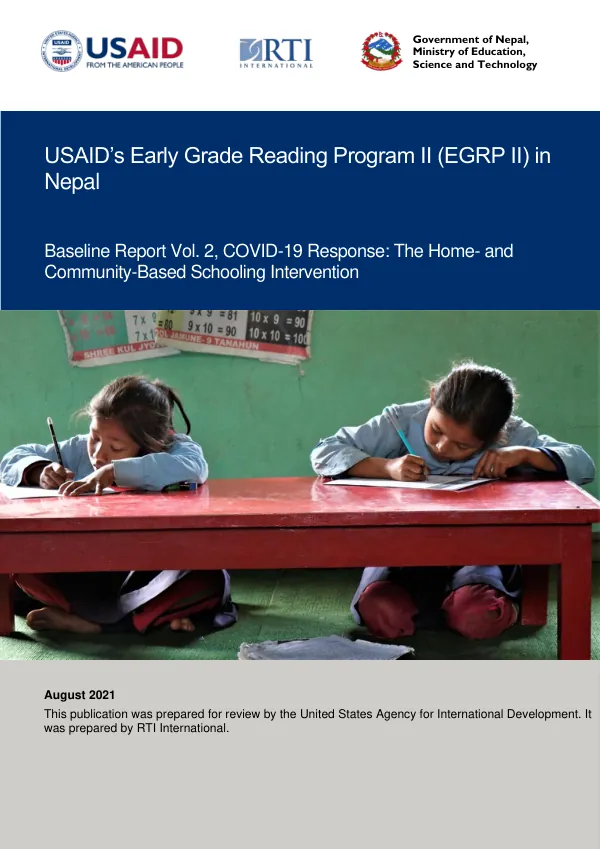
USAID’s Early Grade Reading Program II (EGRP II) in Nepal: Baseline Report Vol. 2, COVID-19 Response: The Home- and Community-Based Schooling Intervention
Sign inRTI INTERNATIONAL
USAID’s Early Grade Reading Program II (EGRP II) in Nepal: Baseline Report Vol. 2, COVID-19 Response: The Home- and Community-Based Schooling Intervention
The Early Grade Reading Program II (EGRP II) in Nepal implemented a home- and community-based schooling intervention in response to the COVID-19 pandemic.
2021 · 62 pages
Sign in to readA free account is required to download.
Abstract
The program aimed to improve reading achievement among grade 2 and 3 students in Province 2. The baseline report, released in August 2021, presents findings from the initial assessment conducted in Province 2. The study design involved a sample of 1,200 students in grade 2 and 1,200 students in grade 3, with a total of 2,400 students participating in the assessment. The sample size was determined to achieve a desired level of precision, as shown in Figure 1. The study instruments included the Community-Based Early Grade Reading Assessment (CB-EGRA) tool, which was administered to students in both grades. The CB-EGRA tool assesses reading achievement through various subtasks, including letter/matra identification, word and sentence identification, vocabulary, dictation, listening comprehension, and reading comprehension. The baseline findings indicate that grade 2 students performed poorly in reading achievement, with average item scores ranging from 0.35 to 0.65 across the subtasks. Table 4 shows the average item scores for the grade 2 letter/matra identification subtask, while Table 5 presents the average item scores for the grade 2 word and sentence identification subtask. The findings also suggest that girls performed better than boys in reading achievement, as shown in Table 11. Grade 3 students also performed poorly in reading achievement, with average item scores ranging from 0.45 to 0.75 across the subtasks. Table 12 shows the average item scores for the grade 3 word and sentence identification subtask, while Table 13 presents the average item scores for the grade 3 vocabulary subtask. The findings also suggest that girls performed better than boys in reading achievement, as shown in Table 19. The baseline report also presents equivalent CB-EGRA scores for emergent and fluent benchmarks, as shown in Table 20. The report also presents the percentage of learners from the home- and community-based schooling intervention who met the reading benchmark, as shown in Table 21. The findings suggest that the program response to COVID-19 had a positive impact on reading achievement, with a potential effect size difference of 0.25, as shown in Table 23. The study limitations are discussed in Chapter 6, and the references are listed in the Annex. The report concludes that the EGRP II program in Nepal has the potential to improve reading achievement among grade 2 and 3 students in Province 2, and that further research is needed to evaluate the program's effectiveness.