USAID DEC
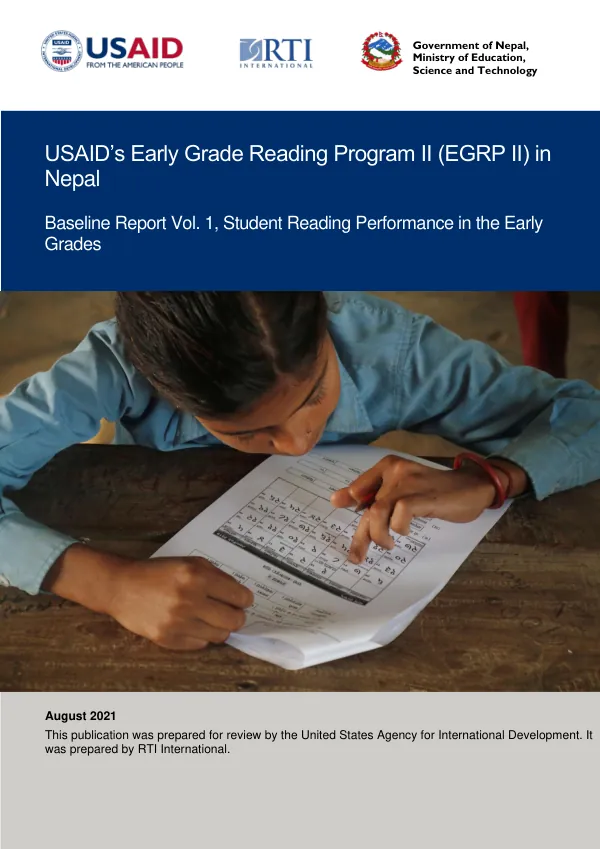
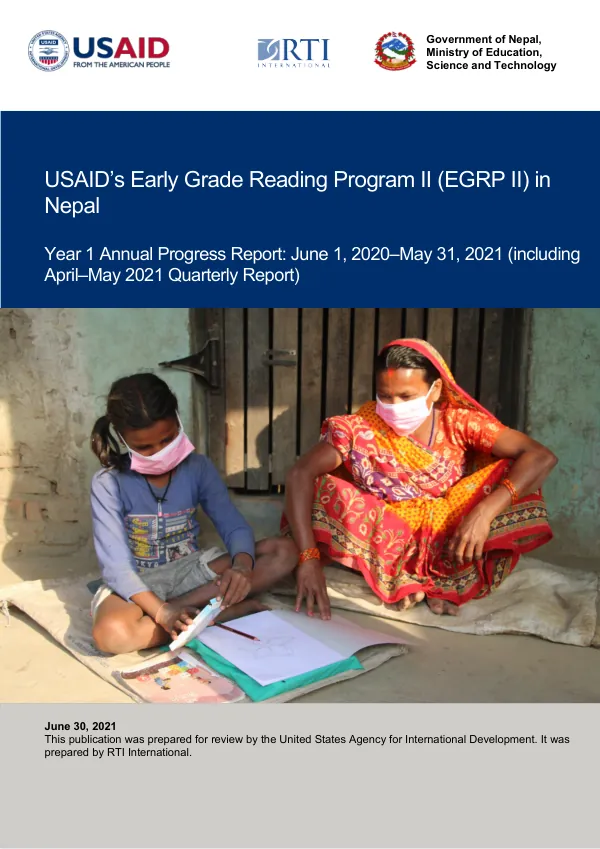
USAID’s Early Grade Reading Program II (EGRP II) in Nepal Year 1 Annual Progress Report: June 1, 2020–May 31, 2021 (including April–May 2021 Quarterly Report)
Sign inTHE RESEARCH TRIANGLE INTERNATIONAL INSTITUTE
USAID’s Early Grade Reading Program II (EGRP II) in Nepal Year 1 Annual Progress Report: June 1, 2020–May 31, 2021 (including April–May 2021 Quarterly Report)
The Early Grade Reading Program II (EGRP II) in Nepal is a USAID-funded initiative aimed at improving reading skills among early grade students.
2021 · 136 pages
Sign in to readA free account is required to download.
Abstract
The program began in June 2020 and is set to continue through May 2021. The program's primary objective is to support the development and rollout of the Integrated Curriculum (IC) and scale up Early Grade Reading (EGR) services. The program's implementation focuses on four key objectives. The first objective is to support the development and rollout of the IC and continue to scale up EGR services. This involves supporting the rollout and implementation of the IC, as well as supporting the Ministry of Education, Science, and Technology (MOEST) policy and planning for the National Early Grade Reading Program (NEGRP). The second objective is to build municipal- and provincial-level capacity for delivering EGR services. This includes providing capacity building for palika officials and Local Education Unit (LEU) staff, supporting local governments to develop policies and costed plans for NEGRP under the IC, and promoting data-driven decision making. The third objective is to improve local governments' ability to provide Training and Professional Support (TPS), coaching, mentorship, and supervision. This involves supporting the Council for Education and Human Resource Development (CEHRD)/Human Resource Development Division (HRDD) to revise TPS guidance and incorporate a menu of options, as well as supporting local governments to develop and roll out plans for TPS implementation. The fourth objective is to support continuity of learning in response to the COVID-19 pandemic. This includes EGR learning engagement for students during extended school closures, preparing for EGR instruction upon schools' re-opening, and planning for possible school re-closures. The program's progress is monitored and evaluated through a Monitoring, Evaluation, Learning, and Adapting (MEL) system and dashboards. The program also conducts routine monitoring, reporting, and collaborative learning, as well as program learning and evaluation. The program's collaboration and coordination with similar interventions in the sector, gender equality and social inclusion, communications, branding, and marking, and management, administration, and safety are also key components of the program. The program's challenges, lessons learned, and mitigation strategies are documented in the report. The program's best practices, prospects for next year's performance, and finance and expenditure status are also discussed. The report includes annexes that provide additional information on the program's progress, including updates on progress during the April-May 2021 quarter, progress by indicators, and a list of key upcoming events and dates. The program's implementation has resulted in significant progress toward its objectives. The program has supported the rollout and implementation of the IC, as well as the development and rollout of plans for TPS implementation. The program has also provided capacity building for palika officials and LEU staff, and has promoted data-driven decision making. The program's MEL system and dashboards have been developed, and routine monitoring, reporting, and collaborative learning have been conducted. The program has also conducted program learning and evaluation, and has documented its challenges, lessons learned, and mitigation strategies. The program's finance and expenditure status is also reported in the document. The program's estimated expenditures for the next quarter are provided, as well as a list of key upcoming events and dates. The program's success stories and case studies are also documented in the report, including a high-resolution photo file with captions. The program's training quality monitoring tool and training quality assurance tool are also provided in the report.
Related documents
Documents in this collection
 2021
2021USAID DEC
Unravelling adolescent girls’ aspirations in Nepal: Status and associations with individual-, household-, and community-level characteristics
Open record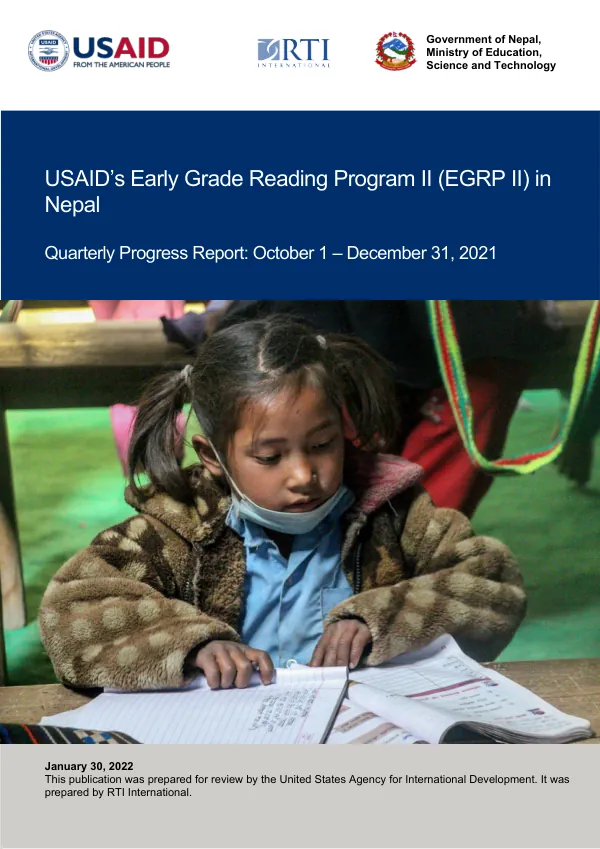 2021
2021USAID DEC
USAID’s Early Grade Reading Program II (EGRP II) in Nepal: Quarterly Progress Report, October 1 – December 31, 2021
Open record